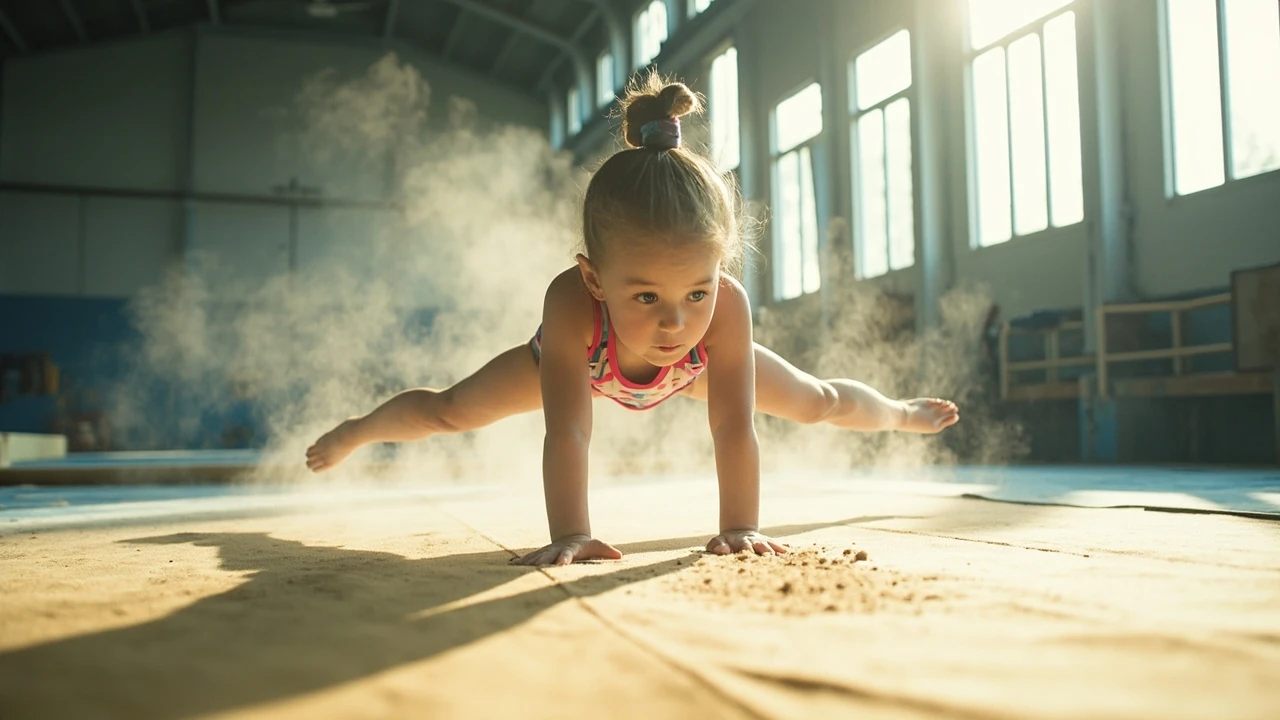
A gymnast runs out of a round-off back handspring, snaps her chest up, hits the mat with slightly bent knees, and freezes on the landing line. The crowd hears a single solid thud instead of a stutter, and the score reflects it. That sound, the clean, still finish after a tumbling pass or a vault, is the product of a deliberate landing technique, not a lucky reflex. Coaches and judges treat the landing as its own skill, because the moments after the feet touch the mat are where most deductions and injuries originate.
This guide focuses on one practical question: how do you build a reliable landing technique in artistic gymnastics? It walks through the body positions coaches look for, the timing windows that determine a stuck landing, the drills that build those positions, and the common errors that quietly cost points or lead to rolled ankles and sore knees. Whether you are a competitive gymnast, a recreational athlete, or a parent trying to understand what the coach keeps asking for, the pages below explain the mechanics and the progressions that turn a hopping finish into a controlled stick.
Landing technique
Every artistic gymnastics routine ends with a landing. The Code of Points treats the landing as a scored element, and a large share of execution deductions come from what happens in the fraction of a second after the feet touch the spring floor or the landing mat. Landing technique is the combination of body position, muscle action, and timing that lets a gymnast absorb impact, control rotation, and stop motion without a step, a hop, or a deep squat.
Three things have to happen in a successful landing:
- Impact forces are absorbed through the legs, not the back or the joints.
- Residual rotation from the previous skill is controlled so the body finishes facing the correct direction.
- Balance is held long enough for the judges to credit a stuck landing, generally about one second of visible stillness.
Each of those goals has a specific physical recipe. The rest of this article breaks those recipes down by phase, by event, and by common error.
What judges look for in a stuck landing
Judges in sanctioned competitions read landings quickly and against a written standard. The deductions fall into recognizable categories, and knowing them helps a gymnast prioritize what to fix first.
| Issue at landing | Typical deduction range | What the judge sees |
|---|---|---|
| Step or hop on the landing | 0.1 to 0.3 points per step | One or more extra foot contacts to recover balance |
| Deep knee bend or squat | 0.1 to 0.3 points | Knees flex well past the landing position |
| Arms waving for balance | 0.1 to 0.2 points | Arms move outside the shoulder line after touchdown |
| Chest down or hips behind heels | 0.1 to 0.3 points | Upper body collapses forward or back |
| Directional error (off line) | 0.1 to 0.5 points | Body lands outside the line on beam, or off the line on floor |
| Fall on the landing | 0.5 points plus skill credit loss | Hand or hip contact with the mat after landing |
Deduction ranges vary by level and code year, but the pattern is consistent: the cleaner the position, the more credit a gymnast keeps. The 0.1 deduction for a single step is small in isolation, but two steps, a sway in the arms, and a slight squat can erase a tenth of a point on a single element. Over four events that difference is often the gap between the podium and fourth place.
The physics of a clean landing
Landing technique is partly a physics problem. A gymnast returning to the mat carries momentum from the previous skill, and the body has to convert that momentum into a still, upright position without absorbing the impact in a way that buckles the joints.
Linear momentum and absorption
When the feet touch the mat, the body has downward velocity from the height of the skill and forward or backward velocity from the direction of travel. Bending the knees and hips over a longer period of time spreads the force across more distance and more muscle groups, which lowers the peak load on any single joint. A deep, sudden squat concentrates force in the knees and shins. A controlled, slightly bent-knee position lets the ankles, calves, quads, glutes, and core share the work.
Angular momentum and rotation
Tumbling passes, vault entries, and dismounts all involve rotation. Even after the feet are planted, the body still has angular momentum, the tendency to keep rotating around the hips and shoulders. Two tools control that rotation:
- Core engagement keeps the rib cage stacked over the pelvis, so the upper body does not twist independently of the hips.
- Spotting with the eyes and head gives the brain a reference point so the body can square itself to the target direction.
When those two tools work together, a gymnast can stop the rotation in one position rather than over-rotating into a second step.
Body position at the moment of contact
The single most important image in landing technique is the position of the body the instant the feet meet the mat. Coaches describe it in slightly different ways, but the components are consistent.
Foot and ankle position
The feet should land together, with the toes pointed forward and the weight centered over the middle of the foot, not the heels or the toes. Landing on the heels tends to bounce the hips backward, while landing on the toes forces a forward lean. A neutral foot lands flat, which sets up the rest of the leg chain.
Knee and hip angle
The knees should be slightly bent at touchdown, around 15 to 30 degrees, not locked and not deeply flexed. From there, the knees and hips bend together to absorb the remaining momentum. A common error is bending only the knees while keeping the hips extended, which creates a shearing force at the joint. A useful correction is to think about lowering the hips as if sitting back into a chair, then stopping the descent before the hips drop below the knees.
Torso and chest
The chest stays up and the shoulders sit over the hips. A forward-folded chest at landing tells the judge that the gymnast ran out of rotation or did not fully extend the previous skill. A backward-tilted chest often means the gymnast over-rotated and is trying to fight the rotation with the upper body.
Arms and head
Arms reach forward and slightly out, like a tightrope walker, to give the body a small amount of balance correction. The head stays neutral, eyes on the target. Dropping the head pulls the chest down with it, so a simple cue like “eyes up” can rescue a collapsing landing.
Phases of the landing in order
Coaches often break the landing into four phases, each with its own checklist. Practicing the phases separately makes the full skill easier to assemble under pressure.
- Pre-landing shape (the last quarter-turn or rotation of the skill). Hips and shoulders square to the target line, knees driving up toward the chest, toes pointed.
- Contact. Feet land together, knees slightly bent, chest tall, arms reaching forward.
- Absorption. Hips and knees continue to bend together until momentum is absorbed, then stop. There is no extra downward travel beyond the cushion.
- Stick and salute. Body holds the still position for the judge, then the gymnast presents to the panel.
The transition from phase two to phase three is where most errors appear. A gymnast who lands with locked legs cannot absorb, so the body jerks on contact. A gymnast who lands with very bent legs and continues to drop into a deep squat looks uncontrolled even if balance is fine.
Drills that build a stuck landing
Drills are useful when they isolate one component of the landing. The list below moves from lowest to highest difficulty and is a sample, not a complete program. Coaches should adapt the count, height, and surface to the athlete’s level.
| Drill | What it trains | Typical sets and reps |
|---|---|---|
| Stiff drop to flat feet | Toe-to-heel foot contact and even leg absorption | 3 sets of 8 drops from a low box |
| Snap-down to two-foot landing | Pre-landing shape and immediate absorption | 4 sets of 6 on a line |
| Tuck jump stick | Air awareness and the two-second hold | 5 sets of 5 on a panel mat |
| Hurdle, rebound, stick | Pre-vault or pre-tumbling posture and absorption | 4 sets of 5 with a soft mat |
| Round-off back handspring into pit, then onto mat | Transfer of rotation into a stuck finish | 3 sets of 3, with a coach mark |
| Full twisting dismount into pit, then onto mat | Stopping rotation without a step | 3 sets of 3, working height gradually |
Drills only work if the gymnast has a clear picture of the target position. Before each rep, a coach can ask the athlete to name what they are about to do. Saying “toes forward, knees soft, chest tall” out loud is awkward at first, and it is one of the fastest ways to build consistent body awareness.
Common landing errors and how to correct them
Most landing errors fall into recognizable patterns. The list below pairs each error with a likely cause and a practical correction.
- Stepping forward on landing. Usually caused by backward rotation in the skill or a chest that drops early. The correction is a stronger snap-down of the hips in the pre-landing shape and a firm chest position at contact.
- Stepping sideways. Often the result of an asymmetric hurdle or a twisted round-off. Drills that emphasize square shoulders through the last skill are the usual fix.
- Deep squat on landing. Comes from absorbing too far, usually because the legs are not engaged on contact. A simple “tighten your legs on touchdown” cue, combined with a low-volume box-drop drill, can rebuild the stiffness.
- Bouncing back into the mat. Means the gymnast is landing with a flat foot and locked knees, or landing on the heels. The correction is to land with the toes pointed and a slight knee bend, then absorb.
- Waving arms after landing. A sign that the body is rotating slightly past the target line. Drills that train spotting the landing point help, as does a stronger core engagement through the final rotation.
- Off-line landings on beam. Often caused by under-rotation on the dismount, which leaves the gymnast falling short of the beam. Working the dismount height in the pit, then transferring to a mat landing, is a safe progression.
Coaches often see one error replaced by another during a season. A gymnast who fixes a forward step by leaning too far back may develop a backward step in the next competition. The right response is to look for the underlying cause, usually a timing issue in the pre-landing shape, rather than chasing each new error with a new cue.
Landing technique by event
The landing skill is the same in principle on every event, but the setup changes the work a gymnast has to do. The sections below highlight the differences that matter most for training.
Floor exercise
Floor is where gymnasts get the most practice with landings because every tumbling pass ends with one. The challenge is variety. A double pike, a Yurchenko-style front entry, and a whip-back handspring series all produce different pre-landing shapes, and the gymnast has to land cleanly from each. Drills that group skills by rotation direction (backward vs. forward) help build two strong pre-landing habits instead of one.
Line awareness matters more on floor than on most events. A landing that drifts a full mat width to the side may still be credited on its own, but it pulls the rest of the routine out of the diagonal the choreographer planned.
Vault
The vault landing comes from greater height and more horizontal speed than any other landing in the sport. The mat configuration is also different. A typical setup uses an 8-centimeter landing mat stacked above a 20-centimeter safety mat, and the rebound off that stack is bouncier than the spring floor used elsewhere. Because of that, vault landings emphasize a slightly more flexed knee position on contact, then a quick drive back up to height. A gymnast who treats the vault like a floor landing often bounces off the mat and steps.
Pre-flight direction is critical. A vault that travels too far backward in the air produces a flat or under-rotated landing; a vault that travels too far forward produces a deep, off-balance landing. Coaches usually set a cone or a line behind the vault to help the gymnast calibrate the entry.
Balance beam
On beam, the landing has to fit inside a 4-inch surface, which is part of the difficulty. The pre-landing shape is the same as on floor, but the gymnast has less margin for error. Beam landings benefit from high-rep practice of dismounts into a foam pit, then onto a stacked mat, then onto the beam itself, so the body learns the precise foot position required.
Another beam-specific issue is the height of the dismount. Gymnasts who throw dismounts aggressively to get a stuck landing sometimes land with so much downward force that the beam vibrates and the feet bounce. Slightly more horizontal direction in the dismount often produces a quieter, more controlled landing than extra height.
Uneven bars
Bar dismounts travel high and far, and the gymnast lands on a stack of mats with a deep base. The absorption window is longer than on floor, which makes it tempting to drop into a squat. A clean bar landing still uses the same four phases, but the absorption phase is more gradual, and the chest stays tall through the entire descent. Drills that train the gymnast to land like a floor landing on a deeper mat tend to transfer well.
Training the body to absorb impact safely
Landing technique is a skill, but it is also a conditioning problem. A gymnast who cannot tolerate the impact load will not stick a hard landing no matter how well she knows the cues, because the nervous system will pull her out of the position to protect the joints.
Three areas of conditioning support clean landings:
- Lower-body strength. Squats, step-downs, and Nordic hamstring curls build the muscle that controls the descent. Strength is what lets a gymnast hold a slightly bent-knee position rather than collapsing into a deep squat.
- Ankle stability. Single-leg balance work and banded ankle exercises reduce the small wobbles that show up as a hop or a sway. Weak ankles are a common reason for the small arm adjustments coaches call “micro-corrections.”
- Core endurance. Hollow holds, V-ups, and rotational core work keep the ribcage stacked over the pelvis. A tired core is one of the leading causes of late-rotation errors in the back half of a routine.
Conditioning should be programmed in the off-season and reduced during peak competition, but it should never disappear. A few minutes of focused lower-body work before landings can prevent a long list of mid-season regressions.
Injury prevention around landings
Most acute gymnastics injuries happen on landings. A few habits reduce the risk without changing the routine.
- Land on a forgiving surface in training. A loose 4-inch mat over a hard floor increases impact, while a tight 8-centimeter landing mat absorbs it. The same drill on two different surfaces can be the difference between a healthy knee and a season-ending one.
- Progress skills in height before rotation. Coaches can keep a skill at competition height while reducing the number of twists or flips, then add rotation back in once the height is consistent.
- Limit full-rotation landings when fatigued. A tired nervous system makes a hard landing on the third pass of the day much more dangerous than the same landing on the first pass. Coaches often cap the number of full-power attempts per session for this reason.
- Treat ankle soreness as a signal. Persistent ankle soreness after hard landings is a sign that the impact load is exceeding what the body can absorb, and it usually responds to a temporary reduction in height or volume, not to taping alone.
For gymnasts with a history of ankle or knee injuries, a physical therapist or athletic trainer should be part of the planning around new skills. They can suggest taping patterns or pre-landing activation drills that the coaching staff may not have time to design.
How to progress a new landing skill safely
Progressions are how gymnasts turn a new skill into a stuck landing without going through an injury. The general order is consistent across events.
- Shape work on the ground. A gymnast learns the body position without any rotation or height, so the coach can correct the landing position before anything else is added.
- Drop or low-hurdle entry. The gymnast practices the absorption and stick from a small amount of height or rotation, usually into a pit or onto a stacked mat.
- Skill in the pit. The full skill is performed into a foam pit, so the gymnast can feel the rotation without the impact of the landing.
- Skill onto a deep mat. The skill is repeated onto a forgiving landing surface, where the gymnast can practice the absorption in a low-stakes setting.
- Skill onto the competition surface. Finally, the gymnast takes the skill to the floor, beam, or bars landing surface and works the full competition landing.
The order is not always linear. A gymnast may work steps two and four in the same session, or go back to step one for a single cue that is not sticking. Coaches who skip steps usually end up with hard landings that take a long time to clean up.
Building the mental side of a stuck landing
Mental rehearsal is as important as physical reps. A gymnast who has only practiced the landing under fatigue will think of it as a gamble. A gymnast who has visualized and physically rehearsed the stick in many different conditions will treat it as a known outcome.
Three mental tools help most gymnasts:
- Pre-landing cue. A short phrase the gymnast says to herself right before contact. Common cues are “toes forward, chest tall” or “stick and hold.” The cue is not magic; it simply buys the brain a few extra milliseconds to organize the body.
- Imagery of the full sequence. Sitting quietly and walking through the rotation, the contact, and the hold trains the nervous system in a low-stress setting. A few minutes of imagery before a session is a small investment for a noticeable improvement in sticking rate.
- Process goals instead of outcome goals. “Stick my round-off back handspring” is a useful outcome goal, but it depends on factors the gymnast cannot fully control. “Hit my chest-up shape at the top of the back handspring” is a process goal that produces the stick as a side effect. Process goals survive a bad day; outcome goals do not.
For younger gymnasts, parents and coaches can support the mental side by avoiding post-landing commentary during the learning phase. A simple “good try” is more useful than a long correction in the first moments after a new skill.
How to evaluate your own landings in training
Self-evaluation is the bridge between drills and competition. Gymnasts who learn to read their own landings improve faster than gymnasts who wait for the coach to comment on every rep.
A simple self-checklist after each rep can look like this:
- Did I land on the line, the beam, or the target mat?
- Were my feet together?
- Were my knees slightly bent on contact, then absorbed?
- Did I step, hop, or wave my arms?
- Did I hold the still position long enough to count?
Tracking the answers in a small training log makes the trends visible. If a gymnast is taking small arm waves on every dismount, the data will show that and the coach can target the cause directly.
Common myths about landing technique
A few recurring myths get in the way of clean landings. Coaches hear them often, and it helps to address them head-on.
- “Soft knees always means safe landings.” Not true. A soft knee is useful at the moment of contact, but a knee that stays too soft for too long turns into a squat, which is a deduction and an injury risk. The right knee is bent, then it stops bending.
- “The harder you throw the skill, the easier the stick.” Throwing harder usually adds unwanted rotation, which produces a step. Sticking is a precision skill, not a power skill, and the cleanest landings often come from the most controlled skill rather than the highest one.
- “You can learn to stick a landing by doing it a thousand times.” Repetition is necessary, but only useful when the reps are good reps. A thousand bad landings build a thousand habits. Drills with clear targets are faster than high-volume grinding.
- “Sticking is mostly about the legs.” The legs are visible, but the core is what controls rotation. A gymnast with strong legs and a tired core will still take a step, and a gymnast with a strong core can sometimes compensate for legs that are not yet fully grown.
Putting it all together in a weekly plan
A typical week of landing work for an intermediate-level artistic gymnast might combine conditioning, drills, and full-skill practice. The structure below is a sample, not a prescription.
| Day | Focus | Sample work |
|---|---|---|
| Monday | Lower-body strength and shape drills | Stiff drop stick work, squat and step-down strength, hollow holds |
| Tuesday | Event-specific skill with reduced rotation | Round-off back handspring series at three-quarter height, into a deep mat |
| Wednesday | Active recovery and core work | Light jump rope, rotational core, ankle stability circuit |
| Thursday | Full-skill practice on competition surface | Full-height series on floor, two vault landings, one beam dismount |
| Friday | Drills and mental rehearsal | Tuck jump sticks, imagery session, light tumbling |
| Saturday | Full routine run-throughs | Two passes per event, scored on a 0.0 to 0.3 landing scale |
| Sunday | Rest | Rest, light stretching, nutrition focus |
Notice that the plan does not include a large block of full-power attempts. The volume is moderate, the progressions are clear, and the conditioning runs throughout the week. That is a more sustainable approach than a single high-volume landing session that leaves the gymnast sore for two days.
Frequently asked questions
How long does it take to learn a stuck landing?
Most gymnasts can build a stuck landing for a single new skill in four to eight weeks of focused work, assuming the underlying strength is in place. The first two weeks usually go to building the body position on low-height drills. The next two to four weeks go to transferring that position to the actual skill. The last two weeks are about consistency, with the gymnast sticking the skill most days in practice. A gymnast with a heavy competition load may take longer because there is less time for drill work.
What is the most common cause of a step on landing?
By a wide margin, the most common cause is a pre-landing shape that is not yet square to the target line. The chest is too far forward or too far back, the rotation has not finished, and the body has to take a step to catch up. A close second is a tired core, which cannot hold the upper body over the hips through the final rotation. Both causes are easier to fix in drills than in full-skill practice, because the gymnast can slow down the movement and find the shape.
Do gymnasts need special shoes for landing practice?
Most training is done barefoot or in gymnastics slippers, and that is the right choice for skill work. Bare feet let the gymnast feel the floor and use the small muscles of the foot to control the landing. Cushioned training shoes can hide poor foot position and are usually reserved for conditioning work, not for landings.
Why do some gymnasts land with their knees together and others with knees apart?
The position varies by skill and by body type. Many coaches prefer knees together for a clean visual line, which judges tend to reward. Some gymnasts with wider hips find a slightly turned-out position more comfortable, and an acceptable turn-out can still be scored as a clean landing. The important thing is that the knees track over the toes, not collapse inward. Knee cave-in is an injury risk and a deduction, regardless of the starting position.
How do you keep the chest up when you are tired?
The chest drops on tired landings because the core gives out. Two things help. First, build core endurance in the off-season so it survives long routines. Second, use a “chest up” cue in the pre-landing shape, when the brain still has time to organize the body. A coach standing to the side and calling “chest” as the gymnast rotates is a useful trick during new-skill training.
Is a stuck landing worth more than a high-scoring skill?
The Code of Points rewards both difficulty and execution. A very difficult skill with a large landing error will not score as well as a slightly easier skill with a clean stick. In most levels, a clean stick is worth more than the small bump in difficulty a gymnast gets from adding a half-twist, so coaches often tell their athletes to play it safe when the choice is between a harder skill and a clean landing.
How do gymnasts practice landings without a full routine?
Most gyms have a foam pit, a loose 8-centimeter mat, and a competition-style landing mat. Gymnasts can do the skill in the pit to feel the rotation, then repeat the same skill onto the loose mat, then onto the competition mat. They can also do “drop-and-stick” drills from a box or a low bar to rehearse the absorption and hold without the full rotation. The mat configuration is usually the biggest variable, so practicing on more than one surface helps the gymnast adapt.
Can adult recreational gymnasts learn a clean landing technique?
Yes, though the progressions move more slowly. Adult gymnasts often have less ankle and hip range than younger athletes, and they tend to be more cautious, which can work in their favor for absorbing impact. A few months of focused drill work, combined with general strength training, can produce a visible improvement in the sticking rate of basic skills like round-off back handsprings and front flips.
What role does flexibility play in landing technique?
Flexibility matters at the end range of motion, but not as much as coaches sometimes suggest. The hip flexors, hamstrings, and ankles all need enough range to reach a deep, controlled absorption without strain. Tight hamstrings can pull the hips into a posterior tilt on contact, which usually produces a chest-down position. Light dynamic stretching before landings and longer static stretching after training keep the range without compromising strength.
How can a parent help with landing technique at home?
Most landing work happens in the gym, and parents should not try to coach the skill directly. The most useful home support is recovery: a good sleep schedule, balanced meals, and a quiet environment for the gymnast to rest. Parents can also help by watching routines on video with the gymnast and asking neutral questions about what they see, which builds self-evaluation skills without adding pressure.
Next steps for a cleaner landing
Pick one skill that has a stubborn landing error and one drill that targets the underlying cause. Spend two weeks on that drill, three to five reps per session, and track the result on a simple checklist. After the two weeks, re-evaluate. If the error is smaller but still there, the drill is working and the gymnast needs more time. If the error has moved to a different part of the landing, the drill has fixed one cause and exposed another, which is normal. The path to a stuck landing is rarely a single breakthrough. It is a series of small, targeted corrections that build on each other, rep by rep.