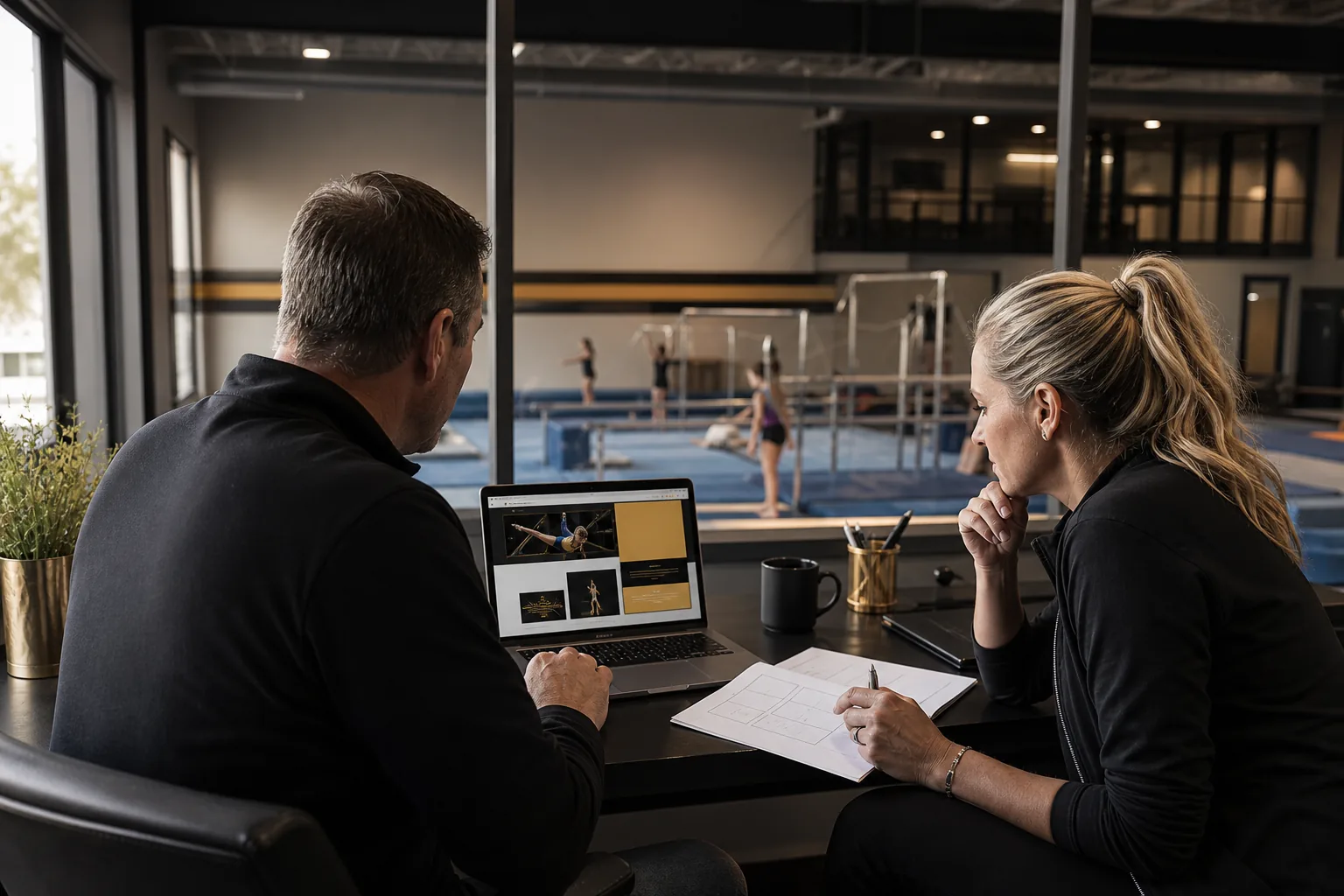
A gymnastics club does not need to behave like a media company. It does need a website that answers the questions families ask before they are ready to call. Too many club sites lead with a large photo and a registration button while leaving program levels, coaching approach, costs and next steps scattered across several pages.
A stronger online presence begins by making the real club easier to understand. Search visibility, content and promotion work better after that foundation is in place.
Start with the gymnastics club’s public promise
A useful positioning statement is concrete. It identifies who the club serves, what it teaches and what kind of pathway is available. “Building champions” sounds ambitious but says little to a parent looking for a first recreational class. “Progressive gymnastics for preschool, recreational and competitive athletes in [location]” provides a starting map.
The promise should match the actual program. A recreational-first club should not imitate elite language. A specialist competitive club should state the entry route and commitment clearly. Clarity filters enquiries as well as attracting them.
Build a gymnastics website around decisions
Website navigation should follow the visitor’s decision sequence. A practical structure might include:
- Programs: preschool, recreational, tumbling, adult, pre-team and competitive pathways.
- How placement works: ages, prerequisites, evaluations and movement between levels.
- Coaching and safety: staff roles, supervision, policies and how concerns are handled.
- Schedule and fees: enough current information to understand the commitment.
- First visit: clothing, arrival, viewing, what to bring and what happens next.
- Contact or registration: one clear action connected to the relevant program.
Every major page should answer a specific question. A visitor should not need to download three PDFs or search a social feed to learn whether a class is suitable.
Create one strong page for each gymnastics program
Separate program pages are useful when they contain genuinely different information. A preschool page should discuss early movement, supervision and class format. A competitive page should explain evaluation, training commitment and meet expectations. Repeating the same generic paragraph under six headings creates pages without value.
Each program page can cover the intended athlete, typical class structure, skills or qualities developed, prerequisites, progression, schedule, fees and the correct next step. Use the language families use, then explain specialist terminology instead of assuming it.
Local search visibility comes from accurate basics
A club serving a physical area should keep its name, address, contact details and hours consistent wherever they appear. The website should identify the real city and service area naturally. A clear contact page, embedded directions, current program information and a well-maintained local business profile do more than stuffing nearby place names into paragraphs.
Location pages make sense only when the club genuinely serves or operates in those places and can provide specific information. Do not create dozens of thin city pages that all say the same thing.
Publish evergreen gymnastics content first
News disappears quickly. Evergreen guides can answer recurring questions for years if they are maintained. A club already has the expertise to produce subjects such as:
- How gymnastics class placement works.
- What to wear to a first gymnastics lesson.
- Recreational gymnastics versus a competitive pathway.
- What each apparatus teaches beginners.
- How families can support meet preparation.
- How the club approaches progressions and safe landings.
The strongest article uses the club’s actual process. Interview a coach, add original photos with permission, answer the awkward questions and link readers to the relevant program page. Useful detail is more defensible than generic volume.
Show coaches and facilities without inventing authority
Staff pages should state verifiable roles, relevant experience and the programs a coach works with. Avoid inflated biographies and unexplained badges. If qualifications are mentioned, keep them current and name the issuing body accurately.
Facility pages should help a family understand the environment: apparatus, viewing arrangements, accessibility, parking, changing areas and how different groups use the space. A wide empty-gym photo is attractive, but operational detail reduces uncertainty.
Turn athlete stories into responsible content
Results and athlete stories can show what a program makes possible, but youth privacy and consent must come first. Clubs need clear permission for names, images and quotes, and should avoid publishing unnecessary personal details. Not every achievement needs to become a permanent public record.
A good story focuses on the work: a skill progression, return to consistency, contribution to the team or lesson from competition. This produces a more credible picture than constant podium announcements.
Make commercial and partner content obvious
If a club publishes a sponsor profile, affiliate recommendation or paid feature, label the relationship clearly. Readers should know when equipment, travel, an event or a program is commercially connected to the page. Clear disclosure protects trust and gives the partnership a legitimate format.
Measure enquiries, not only traffic
More visits are not automatically better. A club should know which program pages generate appropriate enquiries, where visitors abandon registration and which repeated questions indicate missing information. Simple measurement can reveal that a smaller page with clear fees is more valuable than a broad article attracting an unrelated audience.
Track the path from page to action while respecting privacy: program page views, contact clicks, completed registration steps and the questions staff still answer manually.
A 90-day online presence plan for a gymnastics club
Month one: make the foundation accurate
Audit every program, schedule, fee, staff role, contact route and policy. Fix broken links and remove expired announcements. Rewrite the home page so a new family can identify the right next step.
Month two: build the missing decision pages
Create or improve the main program pages, placement guide, first-visit page and coaching or safety information. Add useful internal links between related questions and actions.
Month three: publish proof and answer demand
Produce two or three substantial guides based on real enquiries. Add an authentic club or athlete story with permission. Review search and enquiry data, then improve the page where uncertainty remains highest.
The website should feel like the club
A strong gymnastics website is not the one with the most effects. It is the one where coaching philosophy, program structure and next steps agree. When the digital experience is organized, honest and specific, promotion has somewhere credible to send people.