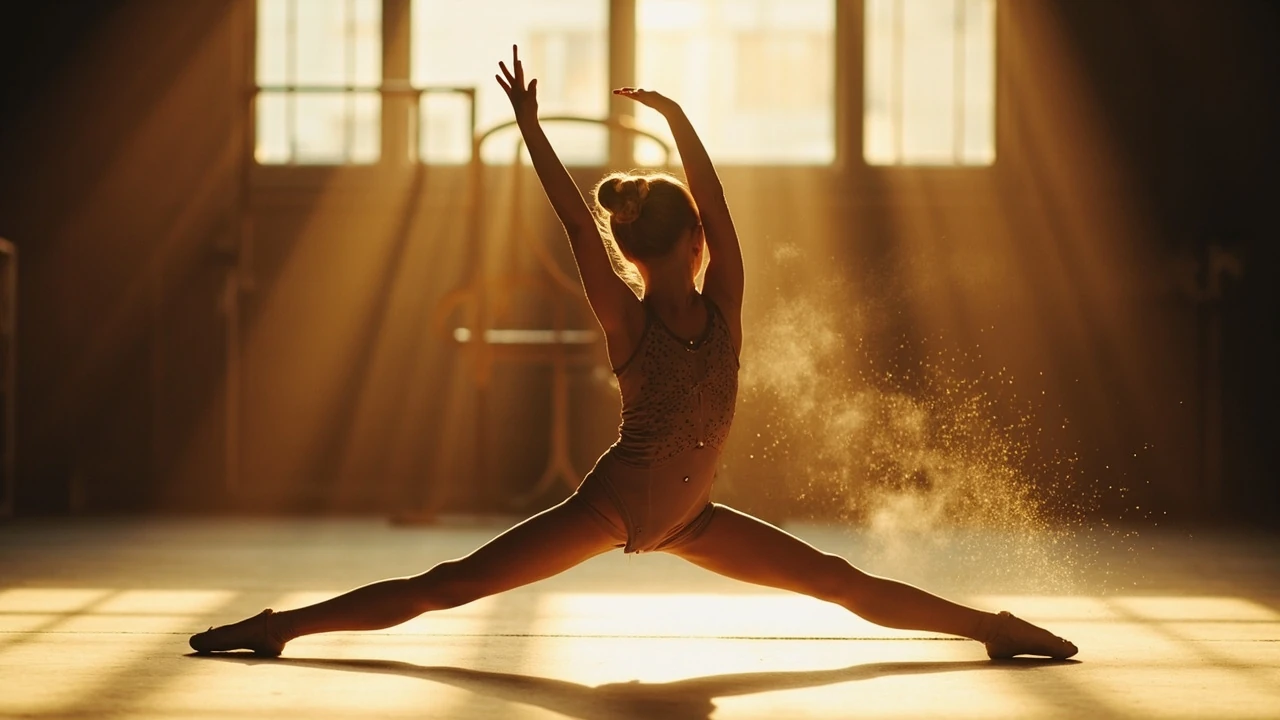
Gymnastics flexibility: what it really is and why it sets the ceiling for skill
A 12-year-old recreational gymnast in Bakersfield walks into the gym and tells her coach she wants to do a needle scale. She can already kick high and do a clean middle split on the floor. What she cannot do is a press handstand against the wall without her lower back arching into a banana shape. Her coach watches for a minute and says the limiting factor is not strength, but a very specific kind of gymnastics flexibility in the shoulders, hip flexors, and thoracic spine. That scene plays out every week in gyms around the country, and it shows why the topic is wider than the word “stretching” suggests.
Gymnastics flexibility is the controlled range of motion a gymnast can access at every major joint while keeping the rest of the body in alignment, then use that range to produce or absorb force. It is not just touching toes or doing the splits for a photo. It is the difference between a split leap that snaps into shape and one that floats; between an arabesque that looks like a sculpture and one that looks like a kicked-back leg. For athletes, it is the platform on which harder skills are built. For coaches, it is a measurable quality that can be trained on a plan. For parents, it is a useful lens for evaluating whether a program is teaching the right things safely.
This guide is written for gymnasts, coaches, and parents who want a practical working understanding of gymnastics flexibility. It covers what the term actually includes, which joint ranges matter most for each event, how to train it progressively, the limits of stretching alone, and how to spot red flags in a program. The goal is to leave you with a clear framework you can use in the gym this week, not a generic stretching checklist.
What gymnastics flexibility actually includes
Most people hear “flexibility” and think of muscle length. In gymnastics, the term is broader. It includes joint range, active control, tissue tolerance, and the nervous system’s willingness to allow movement. A good training plan addresses all four, not just the first.
Passive and active range of motion
Passive range is what a partner, a wall, or a prop can move a joint through. Active range is what a gymnast can produce under their own muscular control. Both matter, but they are not the same. A gymnast who can fall into a full split on the floor but cannot hold a 135-degree scale under tension is showing a passive-active gap. Closing that gap is a large part of skill progression, because most gymnastics positions are held actively. The body has to own the range, not just visit it.
Joint-specific mobility
Each joint has a different contribution. Hip range drives splits, leaps, and middle splits. Shoulder range drives circles on bars, handstands, and rings-style positions. Ankle range drives landings, splits, and toe point. Thoracic spine range drives straight-line handstands and arched positions. The lumbar spine is meant to be stable, not mobile. A good gymnastics flexibility program targets the joints that are supposed to be mobile and leaves the lumbar spine alone.
Tissue tolerance and nervous system tone
Range of motion is limited by more than muscle length. Connective tissue, joint capsules, and the nervous system all play a role. The stretch reflex protects muscles from being loaded too quickly. End-range positions that are entered too fast trigger that reflex and limit further movement. Slow, repeated exposure to end-range positions teaches the nervous system that the position is safe. This is one reason ballistic stretching alone is a poor strategy for serious flexibility work.
Strength at end range
Range without strength at end range is a soft target. Joints that can move to a position but cannot produce or resist force in that position are at higher risk of strain. This is the principle behind the gymnastic-specific version of “loaded stretching.” Drills such as sissy squats for hip flexors, jefferson curls for spinal control, and weighted wall handstand holds all build strength in the deep ranges the sport demands.
Why gymnastics flexibility is different from general flexibility
Yoga, dance, and general athletic flexibility all share some features with gymnastics, but the demands are not identical. Several differences explain why gymnasts train the way they do.
- Active control matters more than passive depth. Gymnastics positions are held actively. A split on the floor with a coach pushing is not the same skill as a split leap that lands under control.
- Specific positions are required, not general ranges. A 180-degree split is one number. A 180-degree split with a 45-degree leg turn, an arched back, and pointed toes is a much harder demand. The body has to be ready for the specific geometry of each skill.
- Strength and flexibility are trained together. Programs that separate “stretching day” and “strength day” miss the way the sport combines them. Most drills in a quality program do both at once.
- Joint health is a priority. Gymnasts load their joints from a young age. Mobility work is paired with stability work to protect growing bodies. The phrase “mobile but stable” is heard often in coaching circles for good reason.
For a wider look at how gymnastics sits inside an overall athletic development model, the case for gymnastics as a foundation sport is a useful companion read. It covers the carryover benefits that come from training these qualities early.
The joint ranges that matter most, by event group
Different events reward different ranges. A floor and beam specialist needs different mobility from a bars and rings-style specialist. The table below summarizes the dominant demands.
| Event group | Primary ranges | Why it matters | Common limitations |
|---|---|---|---|
| Floor and beam leaps | Hip abduction, hip external rotation, ankle plantarflexion, thoracic extension | Drives leap height, split angles, and landing position | Tight hip adductors, weak glute medius, low thoracic mobility |
| Beam and floor dance elements | Hip extension, hip external rotation, ankle plantarflexion | Arabesques, ring positions, switch leaps, and illusions | Limited hip flexor length, weak end-range glute control |
| Uneven bars, parallel bars, rings-style holds | Shoulder flexion, shoulder external rotation, lat length, thoracic extension | Supports giant swings, handstands, and L-sit to handstand work | Tight lats, poor shoulder blade control, low thoracic mobility |
| Vault, tumbling, and dismounts | Ankle dorsiflexion, shoulder flexion, hip flexion, lumbar control | Spring, rebound, and safe landing mechanics | Stiff ankles, limited hip flexor length, weak landing control |
| Static holds on all events | Composite of the above plus active end-range strength | Scales, handstands, V-sits, planks, and holds on beam | Passive-active gap, low strength in stretched positions |
For a closer look at the apparatus themselves and the demands each one places on a gymnast’s body, the apparatus overview is a helpful reference.
How to assess gymnastics flexibility without a lab
You do not need a motion-capture lab to know where a gymnast stands. A short, repeatable screen done every eight to twelve weeks gives coaches and athletes a useful baseline. The screen below is conservative and safe to do in a regular gym setting.
Suggested screen for ages 8 and up
- Active straight-leg standing scale, each leg, measured with the body in line. A simple goniometer or a phone app that reads angles off video works.
- Front split on the floor with hands on a small box, front and back leg, measuring the pelvis square to the floor.
- Middle straddle on the floor with the chest upright, measuring the angle each leg makes with the midline.
- Bridge on the floor, measuring the distance between hands and feet and the shoulder angle.
- Shoulder flexion in a prone position with the arms overhead, measuring the angle between the arms and the trunk.
- Active pike fold with the legs straight, measuring the distance from the chest to the legs.
- Ankle dorsiflexion in a half-kneeling position, measuring the distance from the wall or the knee-to-wall angle.
Each measure is recorded on a simple sheet. The screen is repeated at the same time of day, after a short warm-up. Trends matter more than single numbers. A 5-degree gain in an active scale over 12 weeks of consistent work is a much stronger signal than one good day.
Building a safe, progressive plan
A sensible gymnastics flexibility plan is built in three layers. Each layer has a clear job, and the layers stack.
Layer 1: Daily joint preparation
Joint preparation is short, dynamic, and done at the start of practice. It warms the joints, sets the nervous system, and primes the ranges the session will use. Examples include leg swings, arm circles, scorpion reaches against a wall, controlled straddle rocks, and ankle bounces. Sessions typically run 8 to 12 minutes. The goal is to feel ready, not to make a measurable change.
Layer 2: Loaded end-range strength work
This is the layer that does most of the long-term work. It includes drills that put the body into a deep range and ask the muscles to do something there. Examples include:
- Weighted wall handstand holds for shoulder flexion and thoracic control.
- Sissy squats or banded hip flexor work for hip extension and pike.
- Banded kickovers, jefferson curls, and Nordic curls for hamstring and spinal control.
- Slow eccentric heel drops for ankle dorsiflexion.
- Ring or bar pullovers for shoulder flexion under load.
Loads start small and progress over months, not weeks. Two to three sessions a week on any one range is plenty for most athletes.
Layer 3: Position-specific skill work
The third layer turns the range and the strength into skills. Split leaps with a coach correcting the position, press handstand drills, ring swings, and beam dance work all sit here. The flexibility is the platform; the skill is the structure on top. The two are trained together, never in isolation, for any gymnast who wants the range to transfer to a routine.
A sample weekly structure for a competitive-optional athlete
Below is a sample layout for a competitive-optional level gymnast who trains 18 to 20 hours a week. It is a pattern, not a script. Coaches will adapt it to the season, the athlete, and the event focus.
| Day | Joint preparation focus | End-range strength work | Skill transfer focus |
|---|---|---|---|
| Monday | Hips, ankles, pike-specific work | Sissy squats, pike pulldowns, ankle drops | Tumbling drills, handstand work |
| Tuesday | Shoulders, thoracic, lat work | Wall handstand holds, ring rows, prone Y-T-W | Bars basics, beam dance drills |
| Wednesday | Full-body active mobility circuit | Light or recovery-focused | Light skill circuits, quality reps |
| Thursday | Hips for split and straddle | Straddle-up work, weighted kickovers | Floor dance, beam leaps |
| Friday | Shoulders and power prep | Press handstand shaping, banded scap work | Tumbling, vault runs |
| Saturday | Event-specific dynamic warm-up | Optional loaded work, focus on weakest area | Full routines or skills under fatigue |
The pattern that matters is the order. Joint preparation sits at the front. End-range strength sits mid-week or on days with capacity. Skill transfer ties the two together. Programs that do flexibility in isolation at the end of a tired practice, then wonder why gains do not transfer, are skipping this structure.
Common mistakes that stall gymnastics flexibility progress
Most athletes and many coaches fall into the same traps. A few of the most common ones deserve to be named clearly.
Treating stretching as the whole plan
Sitting in a split for 10 minutes, twice a week, does not build gymnastics flexibility on its own. The body adapts slowly to sustained passive loading, and the gains are mostly passive. Active range and end-range strength lag. Real plans use a mix of passive, active, and loaded work.
Skipping end-range strength
A gymnast with great passive range and poor end-range strength will struggle to control the position. This shows up as shaking in a scale, falling out of a press handstand, or a split leap that does not hold its shape. The fix is strength, not more stretching.
Doing too much ballistic work too early
Bouncing into a split or kicking high repeatedly in a cold state loads tissues faster than they can adapt. Ballistic work has a place, but it comes after passive and active range have built a base. Until then, slow and controlled is the right speed.
Forgetting the ankles and the thoracic spine
Ankles and the thoracic spine are the two most under-trained mobility areas in many programs. Limited ankle dorsiflexion changes how a gymnast lands and how deep a split can be. Limited thoracic extension changes how a handstand looks and how a bar element finishes. Both are easy to address with consistent, specific work.
Loading the lumbar spine
The lumbar spine is meant to be stable. Many “flexibility” drills, especially for backbends, push too much bend into the lower back. The result is compression and irritation, not real range. The safer pattern is to drive extension from the thoracic spine and the hips, with the lumbar spine held neutral.
Age, growth, and timing considerations
Flexibility is one of the easier qualities to train in childhood and one of the harder ones to add in late adolescence. The reasons are mostly biological. Young joints are more mobile, tissue adapts faster, and the window for deep end-range positions opens early. That same mobility is also a vulnerability, because growing bones, open growth plates, and rapid growth spurts change how drills land.
A sensible approach by stage looks like this:
- Recreational ages 4 to 7: Focus on general joint play, animal shapes, and play-based ranges. Avoid long static holds or end-range loading.
- Compulsory ages 7 to 10: Build a passive base, introduce simple active range work, and develop end-range strength in protected positions.
- Optional ages 10 to 13: Push the passive range toward the positions the events require, and add the bulk of end-range strength work.
- Pre-teen to teen growth spurts: Expect temporary losses in range as bones grow. Emphasize active range and end-range strength. Hold passive stretching steady and avoid forcing through new range during fast growth.
- Late teen and senior: Maintenance is the main job. Adding significant new range becomes harder. End-range strength, active control, and skill work dominate.
Programs that ignore growth spurts are usually the ones that produce injuries. Programs that reduce flexibility work to “just maintenance” during growth spurts miss the chance to keep the body in its positions during a hard year. The right answer is to keep working, but with adjusted emphasis and careful loading.
How to evaluate whether a program is doing this well
For parents who did not come from a gymnastics background, the markers below help separate a thoughtful program from a flashy one. None of these are about talent. They are about how the gym works day to day.
Ask to see the warm-up
The first 20 minutes of a serious gymnastics practice is almost always a structured warm-up. If you can watch a session and see organized joint preparation, dynamic drills, and clear progressions, that is a positive sign. If you see a long static stretch at the start followed immediately by a hard skill, that is a warning.
Ask how the program tracks progress
Good programs keep simple records of flexibility and skill data. Even a basic spreadsheet with the screening tests above is a strong signal. A program that cannot tell you what the athletes’ ranges looked like in March and what they look like in May is not measuring the right things.
Watch the coaches during drills
Coaches who know the sport are watching for two things at once: the shape of the position and the way the body is moving into it. They correct by adjusting the setup, not by pushing the body further. A coach who regularly pulls a leg or an arm further into a stretch under load is using a method that does not match the current evidence.
Look for a full program, not a flexibility niche
Some gyms brand themselves as flexibility specialists. A useful gymnastics flexibility program should be part of a larger training plan that includes strength, skill, and conditioning. A pure flexibility class, while it can be a useful add-on, is not enough to build complete gymnasts.
For a wider view of what to look for when choosing a program, the parent’s guide to choosing a gymnastics program covers the topic from a different angle.
The relationship between gymnastics flexibility and injury risk
Injury risk in gymnastics is multi-factorial. Volume, load management, growth, technique, and equipment all play a role. Flexibility sits inside that picture in a specific way. Two athletes with the same passive range can have very different risk profiles based on active control and end-range strength.
The clearest evidence in the current research literature points to a few practical points:
- Athletes with a large passive-active range gap are more likely to strain muscles in loaded positions.
- Ankle dorsiflexion limitations are linked to altered landing mechanics and higher landing forces.
- Shoulder mobility limitations are linked to altered bar and ring mechanics, especially in giants and handstand work.
- Loss of range during a growth spurt is normal and temporary, but ignoring the loss is not. The plan has to adapt.
For background on the load side of the question, the meet-prep checklist is a useful resource for parents and coaches, because overuse injuries often show up in the weeks leading into a major competition.
Tools, equipment, and what is actually useful
Flexibility work does not need a lot of equipment. A small kit covers most of what a serious program requires.
| Item | Primary use | What to look for | What to skip |
|---|---|---|---|
| Stretching strap or long band | Passive and active-progressive leg work | Sturdy, non-stretchy, easy to grip | Elastic bands that pull the leg rather than let the athlete pull |
| Small box or low platform | Front and middle split support | Stable, low enough to set the pelvis square | Tall platforms that push the spine out of alignment |
| Foam pad or panel mat | Comfort during long floor positions | Firm enough to support joints, soft enough to pad | Soft mattresses that sink under load |
| Bands for shoulder work | Loaded shoulder rotation and pull-aparts | Light and medium resistance | Very heavy bands used for ballistic end-range work |
| Wedge or slant for ankles | Ankle dorsiflexion loading | Stable base, easy angle to start | Wobbly wedges that shift under load |
| Wall, low bar, or rings | Handstand and shoulder strength | Smooth surface, correct height | Setup that forces a banana back or an arched neck |
The cheapest tool is the most useful: a coach who can see and correct position. No piece of equipment replaces that.
How gymnastics flexibility transfers to other sports
For athletes and parents thinking about long-term athletic development, the carryover of gymnastics-style mobility into other sports is real. A wide range of controlled motion supports faster change of direction, deeper athletic positions, and safer landings in football, basketball, hockey, and many other sports. The article on how gymnastics skills transfer to football, basketball, and hockey is a helpful starting point for that conversation.
Putting it all together in a 12-week plan
A 12-week block is a useful unit for planning. The structure below assumes a recreational to pre-team gymnast with general goals. Coaches will adapt it for competitive athletes.
Weeks 1 to 3: Build a base
- Daily joint preparation, 10 minutes.
- Two end-range strength sessions per week, 20 minutes each.
- Skill work, three times per week, with specific mobility goals inside the skills.
- First baseline screening on day one.
Weeks 4 to 7: Add depth
- Daily joint preparation, 12 minutes.
- Two to three end-range strength sessions per week.
- Add one longer position-specific session per week, focused on the slowest-improving range.
- Re-screen at week 8 to confirm the trend.
Weeks 8 to 12: Convert to skill
- Daily joint preparation stays.
- Reduce pure strength-endurance work, add skill-density drills.
- Push the position-specific work toward the actual event demands.
- Re-screen at week 12 and set the next block.
Most athletes who follow a plan like this for a full 12 weeks will see meaningful change in their weakest ranges, even if their strongest ranges barely move. That is a normal and healthy response. The plan is then re-tuned to keep the curve moving.
What “good” looks like in the long term
Long-term gymnastics flexibility is not about hitting a specific angle. It is about a body that can hold the shape the sport asks for, on demand, in any condition. An athlete who can do that in a warm gym, in a tired state, in a meet, and in a cold gym has the right kind of flexibility. Angle numbers help, but they are not the whole story.
For athletes, the practical targets are usually:
- Active scale 135 degrees or more on each leg, held without shaking for 10 seconds.
- Front split 180 degrees, square pelvis, with the back leg turned out and the chest upright.
- Middle straddle 180 degrees, chest upright, both legs turned out.
- Press handstand, controlled, with no banana back.
- Ankle dorsiflexion, knee-to-wall distance of at least 4 to 5 inches.
- Shoulder flexion in line with the ears when the back is against a wall.
These are reference points, not requirements. The right number is the one that lets the athlete perform the skills they want, on the events they train, without pain.
Frequently asked questions
How long does it take to improve gymnastics flexibility?
Most gymnasts see measurable change in a focused range within 8 to 12 weeks. Larger passive range changes in stiff athletes can take 6 to 12 months of consistent work. Active range usually improves faster than passive range when strength is part of the plan.
What is the best age to start serious flexibility training?
General mobility work can start at any age. More serious end-range loading for specific positions usually begins around age 7 to 9, after a few years of general gymnastics. The exact timing depends on the athlete, the coach, and the rate of growth.
Should flexibility be trained every day?
Joint preparation can be done daily. Loaded end-range strength work for a specific range is usually done 2 to 3 times a week. Long static holds in deep positions are best done 2 to 3 times a week, with recovery days in between. The plan that works is the one the athlete can repeat consistently.
Does yoga help with gymnastics flexibility?
Yoga can help with general mobility, body awareness, and breathing. It is not a substitute for sport-specific training because the positions, the load, and the demands are different. Many gymnasts do well with yoga as a complementary practice, especially for hips and thoracic spine.
How can I improve my splits the fastest?
The fastest progress comes from a combination of daily short active work, 2 to 3 weekly end-range strength sessions, and consistent skill transfer drills such as split leaps and straddle jumps. Long passive holds in the split alone produce the slowest results.
Is it normal to lose range during a growth spurt?
Yes. Bones grow faster than muscles and connective tissue can adapt. Temporary loss of 5 to 15 degrees of range is common during growth spurts. The right response is to keep training with adjusted loads, emphasize active range, and avoid forcing new passive range during the fastest growth phases.
How do I know if I am overstretching?
Pain that lingers into the next day, joint swelling, and a sharp or pinching feeling at the end range are the main warning signs. Mild muscle soreness after a deep session is normal. Pain that changes the way an athlete walks, lands, or moves is not.
Can flexibility alone make a gymnast better?
No. Flexibility without strength, skill, and good coaching produces positions that look good in a photo and break down under load. The best results come from flexibility, strength, and technique trained together, in the right order, in the right dose.
Should I stretch before or after practice?
Dynamic, movement-based joint preparation is best before practice. Static, end-range holds fit better after practice or on dedicated mobility days. The order matters because cold tissue in a deep static hold is a common setup for strains.
How do I pick a coach who takes flexibility seriously?
Look for a coach who can describe how the program measures, plans, and progresses flexibility over time. Ask to see the warm-up and the strength work. A good coach will adjust the plan to the athlete, the season, and the growth stage. If the answer is “we stretch for 20 minutes after warm-up” and nothing else, the plan is probably thin.