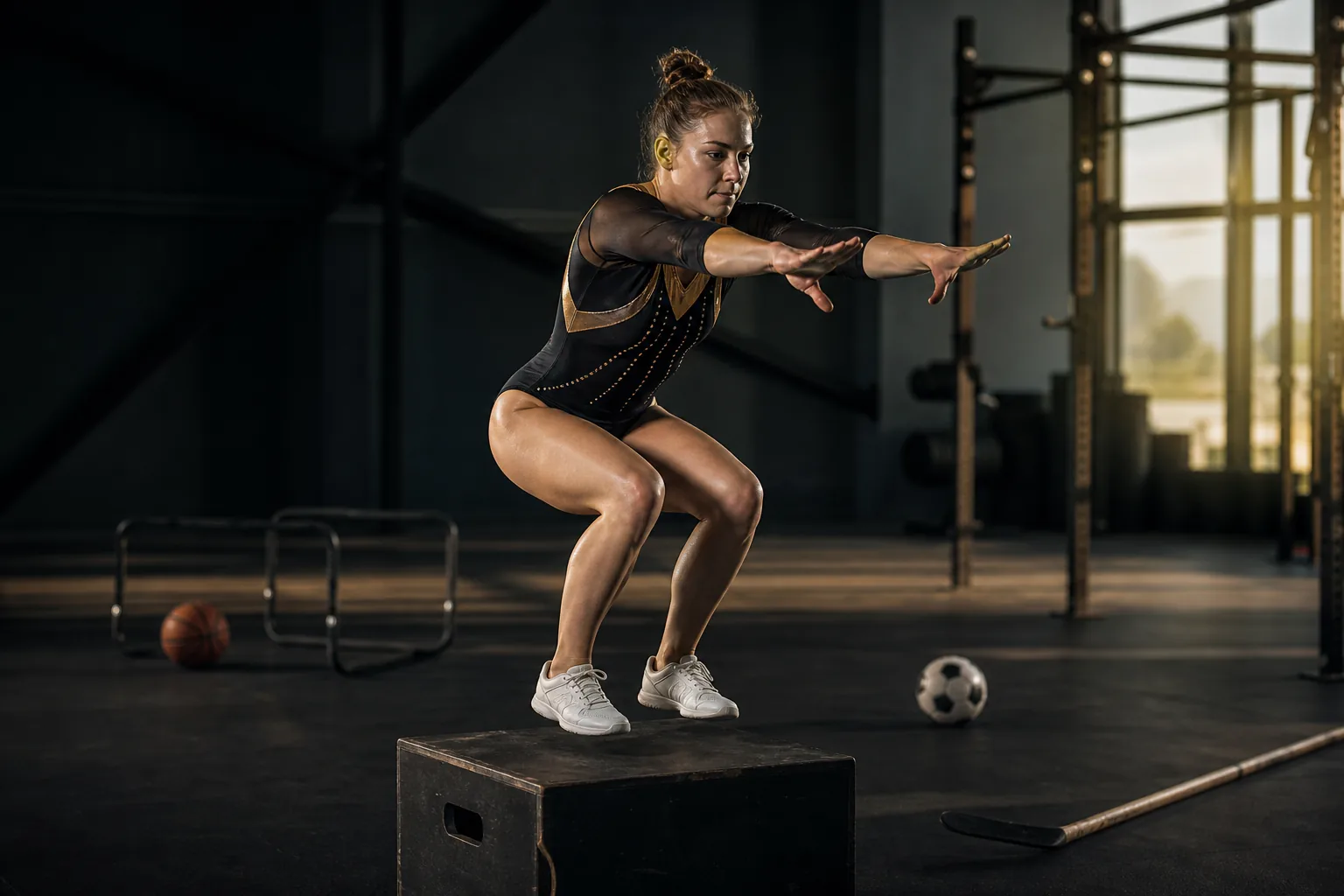
When a gymnast moves into another sport, coaches often notice coordination first. The athlete may learn a new shape quickly, stay composed during an awkward landing or understand a correction after seeing it once. Those qualities are real, but transfer is not automatic.
Gymnastics creates general movement resources. Football, basketball and hockey decide how those resources must be used under the pressure of a game. The useful conversation is therefore not “Which sport is best?” but “Which gymnastics skills give an athlete more solutions, and what specific practice is still required?”
What transfer from gymnastics actually means
A transferable skill is rarely a complete technique. A back handspring does not appear in a hockey shift. The underlying abilities may appear everywhere: producing tension, locating the body in space, absorbing force, coordinating the arms and legs, changing shape in the air and recovering balance.
Transfer improves when coaches identify the shared problem and then practice it in the destination sport. Gymnastics may teach controlled rotation; basketball teaches when to rotate while seeing the rim, ball and defender.
Balance: from beam to field, court and ice
Beam makes balance obvious because the base of support is narrow. The deeper lesson is that balance is active. The gymnast continually adjusts pressure, trunk position and visual focus while preparing the next element.
In football and soccer, that ability supports single-leg actions, contact and rapid recovery after a cut. In basketball, it helps an athlete arrive under control before a pass, shot or change of direction. On ice, the base is narrow and moving, so hockey players repeatedly organize force over an edge.
The destination sport still sets the posture. A hockey stance is not a beam pose. The transferable quality is the ability to find control while the base and task change.
Landing mechanics for basketball athletes
Basketball players jump in traffic, rotate, reach and land without always choosing the exact foot position. Gymnastics teaches that landing deserves practice, not just instruction to “bend the knees.” Athletes learn to see the surface, organize the trunk, share force and finish with control.
A basketball program can build on this foundation with sport-specific variability: landing after a rebound, reacting to a pass, changing the planned direction and moving immediately into the next play. The progression should preserve decision-making without turning every landing into maximum intensity.
Falling and recovery in football
Football exposes athletes to contact, trips, dives and positions that do not resemble a clean drill. Basic rolling and falling experience can reduce panic and give the athlete a movement option when balance is already lost.
This does not make contact safe or replace sport-specific coaching. It means an athlete who has safely explored different orientations may be better prepared to protect space, distribute contact and stand up ready for the next action.
Trunk control and force transfer in hockey
Hockey players create force through the skate while the upper body manages a stick, opponents and visual information. The trunk connects these tasks. Gymnastics develops the ability to hold and change body shapes under tension, which can support force transfer without unnecessary movement.
Off-ice gymnastics-style work should remain simple: controlled supports, hanging where appropriate, locomotion, landing, rotation and single-leg balance. Elaborate exercises that imitate skating poorly can distract from strength and control that are better built directly.
Rotation and spatial awareness across sport
A gymnast learns to initiate, control and stop rotation. Basketball athletes rotate during layups, rebounds and contested finishes. Football players turn through catches, contact and changes of direction. Hockey players transition between forward, lateral and backward orientations while staying connected to the play.
Spatial awareness gives the athlete a sense of where movement is heading, but perception of opponents and objects must be trained in the game. Closed gymnastics drills can establish control; open sport practice adds the information.
Upper-body support and contact confidence
Bars, rings and floor introduce loading through the hands and arms in ways many field-sport athletes do not experience early. Age-appropriate support and hanging can build grip, shoulder control and confidence using the upper body.
These qualities may help during falls, physical contests and general strength work. They do not justify advanced rings strength or high-volume handstands for every athlete. The exercise must fit the person and training plan.
How coaches can use gymnastics without pretending to coach gymnastics
A field or court coach can borrow low-complexity fundamentals while referring technical gymnastics skills to a qualified gymnastics coach. Useful starting categories include:
- Landing from low jumps in several directions.
- Rolling and getting up in a controlled environment.
- Basic balances with purposeful reaches and changes of level.
- Simple crawling, support and locomotion patterns.
- Age-appropriate hanging, shaping and trunk-control tasks.
The objective should be stated clearly. If an exercise exists only because it looks athletic, it probably does not deserve much training time.
What gymnastics cannot replace
Football requires perception of space, teammates and pressure. Basketball requires ball skill, timing and decisions. Hockey requires years of edge work and comfort on ice. Gymnastics cannot provide those specific experiences.
It also does not guarantee injury prevention. Training can develop capacity and skill, but sport remains uncertain. Claims should stay proportionate to the evidence and the individual athlete.
A better model for the all-round athlete
The strongest model is layered. Gymnastics builds movement vocabulary and control. General physical preparation develops strength, speed and capacity. Sport practice teaches perception, timing and technique. Competition integrates them under consequence.
An all-round athlete is not someone who collects the most drills. It is someone with enough physical options to learn the game, enough specific practice to choose the right option and enough control to move into the next action.