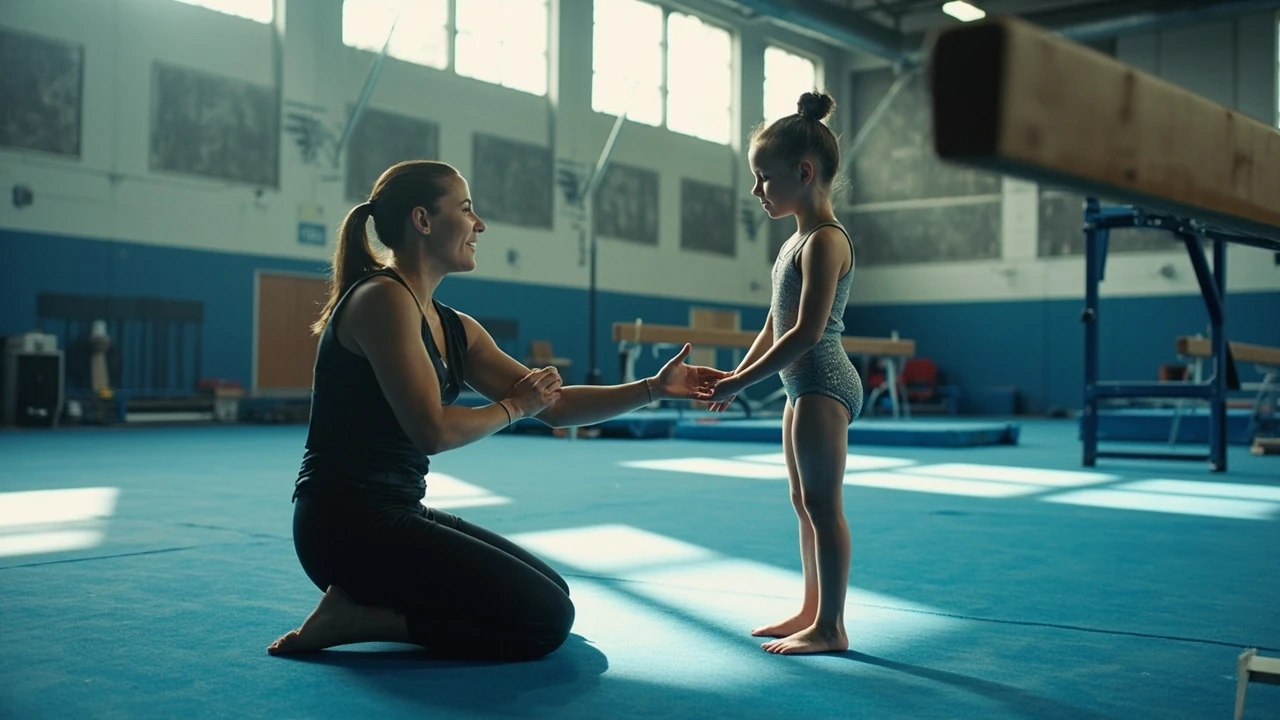
A mother watches her eight-year-old finish a clean round-off back handspring on the tumble track and wonders out loud whether the recreational class is still the right place for her. The coach across the mat nods slowly and says the words many parents eventually hear: she might be ready for a team. That moment, when a child outgrows the structure of a once-a-week class and starts asking about scores, leotards, and travel meets, is the practical center of the question of when to move from recreational to team gymnastics.
This guide is written for parents, gymnasts, and coaches who are weighing that decision. It focuses on the signs that matter, the questions to ask a program, the trade-offs of time and cost, and a step-by-step way to test readiness before committing to a competitive year.
When to move from recreational to team gymnastics
The short answer is that readiness is a combination of skill, age, temperament, and family capacity, not a single test or birthday. Most children who transition successfully show three things at the same time: a foundation of basic skills performed consistently, a genuine interest in harder work, and a willingness to be coached on details that no longer feel fun. The decision usually lands between ages six and nine for girls and slightly later for boys, but the range is wide because gym culture, program depth, and the child’s own development vary so much.
Rather than waiting for a perfect moment, families get the best result by treating the move as a planned step. That means defining what “team” actually means in your area, knowing what skills your child already owns, and understanding what the next year will ask of everyone in the family.
What “recreational” and “team” actually mean
Before reading the rest of this guide, it helps to define the two lanes clearly, because programs use these labels in different ways.
- Recreational gymnastics is a once- or twice-a-week class built around general physical literacy, basic shapes, and progressive skill development. Lessons are usually grouped by age rather than ability, and the goal is participation rather than competition.
- Pre-team or developmental team sits in between. It is usually two to four sessions per week, often by invitation or tryout, and prepares gymnasts for the hours and structure of a competitive team without yet requiring travel or sanctioned scoring.
- Competitive team trains year-round, often four days a week or more, and competes in sanctioned meets organized by bodies such as USA Gymnastics, USAG’s Junior Olympic program, or the Xcel program. Training, meet schedules, and equipment time increase significantly.
- Team gymnastics in the school sense is a different animal: a high school or middle school squad that competes in interscholastic meets. The skill floor is different, and the season is usually a few months rather than a year-round commitment.
Because the word “team” can mean any of these, your first step is to ask any program you are considering exactly which version they offer, how many hours a week it requires, and what the competition calendar looks like.
The five readiness signs that matter most
Coaches and program directors usually watch for the same handful of indicators when they consider moving a child up. None of them alone is enough, but together they paint a clear picture.
1. Consistent execution of core skills
A gymnast who can repeat a skill correctly across multiple sessions is a much stronger candidate for team than one who hits it once and loses it the next week. Programs typically expect a baseline that includes a solid handstand, a clean cartwheel and round-off, a pullover on bars, a straight jump and split leap on beam, and a forward roll to handstand on floor. The exact list varies by program and by the level the child is entering, but the principle is the same: the foundation must hold under pressure.
2. Willingness to be corrected
Team gymnastics is coached closely. The pace is faster, the corrections are more specific, and the line between a good day and a bad one is often about listening. A child who can take feedback on a turn she does not like, try it again without shutting down, and remember it next practice is showing the kind of coachability that team demands.
3. Genuine interest that survives a hard week
Liking gymnastics in the lobby and liking it after three hard practices in a row are two different things. Coaches look for kids who, after a tough session, still want to come back. A useful test is whether the child asks about harder skills, watches competition videos, or practices at home on her own. If the answer is no, the recreational class may still be the right place.
4. Physical readiness for the training load
Team training involves more repetitions, more impact, and more focused conditioning. Gymnasts need enough body awareness and core strength to handle that load without injury. Most gyms screen for this in a tryout or observation session by having the child work through a series of drills and conditioning circuits. Parents can ask the coach what conditioning the child would be expected to do and how the program builds it up over a season.
5. Family capacity for the schedule
This is the readiness sign most often overlooked. A competitive team can mean four to five practices a week plus travel meets that take up entire weekends, missing school, and a real financial commitment. The child’s readiness is only half the picture. If the family schedule cannot absorb a few car rides, a few early mornings, and a few missed birthday parties, the year will be harder than it needs to be. A frank conversation with the program director about the realistic weekly and yearly load is time well spent.
Age is a guide, not a rule
Most programs that run a Junior Olympic track or a developmental pipeline suggest that the right age to start thinking about team is somewhere between six and nine, with a few programs accepting gymnasts a little younger for pre-team and a few bringing kids in around ten if they switch from another sport. Boys often enter the team track a year or two later than girls in part because the male development pathway through USA Gymnastics is structured around later entry points and longer training cycles.
What matters more than the year on a birth certificate is where the child sits in the skill and maturity range for her age. Two children of the same age can be in very different places, and a strong program will evaluate them on what they can do, not on a fixed cutoff.
Skill benchmarks by approximate age
The table below summarizes typical skill benchmarks used by many recreational-to-team programs. They are not a checklist your child must pass in order; they are a rough yardstick so you can have a productive conversation with the coach.
| Approximate age | Floor | Beam | Bars | Vault | Typical training load |
|---|---|---|---|---|---|
| 5 to 6 | Cartwheel, round-off, bridge, forward roll | Straight jump, releve walks, simple balances | Pull-over, cast, basic swings | Straight jump on a low board, squat onto mat | 1 to 2 sessions per week |
| 7 to 8 | Round-off back handspring on tumble track, handstand | Split leap, full turn, small dismount | Back hip circle, pullover with support | Handstand flat back onto resi mat | 2 to 3 sessions per week, possible pre-team |
| 9 to 10 | Back tuck on trampoline or pit, connected series | Back walkover, leap series, simple acro | Clear hip, kip attempts, long hang swings | Yurchenko-style entries with support | 3 to 4 sessions per week, optional competitions |
| 11 and up | Tuck and layout connections, twisting | Acro series, more complex dance elements | Release moves, transitions | Yurchenko layouts under coach spotting | 4 to 5 sessions per week, regular competition |
Use this as a starting point, not a final word. Your child’s coach will know the specific list her program expects at each level, and those lists are often written into the gym’s own curriculum.
How a tryout or evaluation usually works
Most reputable programs do not accept a child onto a team based on a single class visit. The evaluation process is designed to protect the child, the family, and the program from a mismatch.
A typical tryout or evaluation runs one to two hours and includes a short warm-up, a series of skill stations across events, and a brief conditioning or flexibility circuit. Coaches look for body lines, the ability to repeat a skill after a single correction, how the child handles a new challenge, and how she interacts with the other gymnasts in the room. Some programs offer a multi-week observation period instead of a single test, which can be a kinder way to gauge readiness for a child who warms up slowly.
Questions to ask the program at the evaluation
A tryout is also an interview, and the right questions save a lot of frustration later.
- How many hours per week does this group train, and how is that expected to change over the next year?
- What is the competition schedule, and how many meets are required?
- What is the monthly cost, and what does it include (coaching, meet fees, leotards, choreography, team travel)?
- What is the coach-to-athlete ratio, and how is the head coach credentialed?
- What happens if my child plateaus or struggles with the hours? Is there a clear path back to a less intense group?
- How does the program handle injuries, return-to-sport plans, and off-season conditioning?
- What is the communication rhythm with parents, and how is feedback shared?
The answers will tell you as much as the skills the child demonstrates. A program that answers clearly and is comfortable with these questions is usually a healthier environment than one that deflects or overpromises.
Recreational vs. team at a glance
This table compares the most common trade-offs between staying in recreational gymnastics and moving into a team or pre-team program. Costs and hours reflect typical ranges in the United States; your area may be higher or lower.
| Factor | Recreational | Pre-team / developmental | Competitive team |
|---|---|---|---|
| Weekly sessions | 1 to 2 | 2 to 3 | 3 to 5 |
| Session length | 45 to 90 minutes | 90 to 120 minutes | 2.5 to 5 hours |
| Monthly tuition (typical U.S. range) | 80 to 220 USD | 180 to 380 USD | 350 to 700+ USD |
| Meet fees per season | None or local showcase | Local intrasquad or small meets | 500 to 3,000+ USD including travel |
| Time off for injury or burnout | Easy to pause | Usually possible for a session or two | Harder to pause, may affect group placement |
| Performance pressure | Low | Moderate, with internal benchmarks | High, with scored outcomes and rankings |
| Long-term time commitment | Flexible | Year | Multi-year, often 9 to 12 months per year |
Notice the cost column. The financial jump from recreational to team is rarely just monthly tuition. Meet fees, warm-ups, private lessons, choreography, and travel can quietly double or triple the actual family cost. A good rule of thumb is to ask the program for a realistic total for the year, not just the monthly number.
The hidden cost of moving too soon
Moving a child onto a team before she is ready is one of the most common mistakes families make, often with the best of intentions. The signs of a premature move usually appear within the first few months:
- The child dreads practice and needs a long pep talk to walk into the gym.
- Small mistakes trigger frustration or tears that do not ease up over time.
- Sleep, appetite, or mood change in ways that line up with the training week.
- Old friends and other activities start to disappear from her life, and she does not seem to mind because the team is now her entire identity.
- Injuries, especially stress-related ones like wrist pain, shin splints, or back strain, show up early in the season.
None of these are automatic disqualifiers, but if several of them appear together, it is worth a conversation with the coach about whether the current group is the right fit, or whether a step back to a developmental group would let the child keep growing without the pressure.
When a “no” is the right answer
Some children are simply better served by staying in a strong recreational program, taking a few privates, or exploring other sports alongside gymnastics. That is not a failure; it is good coaching. The gymnastics community is small enough that many of the best athletes of an older generation trained recreationally through their pre-teen years and still ended up on successful college or elite teams later, because they arrived physically and emotionally intact.
How to test readiness without fully committing
If you are not sure whether the move is right, you can design a low-risk test rather than signing up for a full year.
- Ask the gym for a two- or three-week trial in the pre-team group at the regular schedule. Most programs are happy to arrange this.
- Keep the child in her current recreational class during the trial so she has a soft place to land.
- Track two things: the child’s own words about each session, and the coach’s notes on consistency and coachability.
- After the trial, ask the coach a direct question: based on what you saw, would you place her in the lower, middle, or upper end of the group she just tried?
- If the answer is “lower end” and you are comfortable with that, the move is probably right. If the answer is “not yet,” a few months of focused recreational work or a private lesson plan may be the better path.
This kind of trial protects everyone. It gives the program real information, the child a controlled taste, and the family a clear way to decide without a financial cliff.
Working with the coach, not against them
The relationship between a parent and a competitive coach is one of the most important parts of a team experience. Parents get the best result when they approach it as a partnership with clear boundaries.
- Let the coach coach. The child hears one voice about skills, not three.
- Keep feedback on effort and attitude, not on scores or rankings.
- Communicate early about anything that might affect training, from a school test to a family trip to a difficult week at home.
- Trust the program during injury recovery and follow the medical team’s return-to-sport plan rather than pushing for an earlier return.
- Celebrate the small wins: a stuck dismount in practice, a clean bar set, a better landing. Scores will come and go.
If communication breaks down at any point, a calm, specific conversation with the head coach or program director is almost always the right first move. Most issues in youth gymnastics are fixable when addressed early.
Special cases: switching sports, late starts, and boys’ programs
Not For additional context, every gymnast arrives at the team decision through a long career in recreational classes. Some common variations are worth a separate look.
Switching from another sport
Children who come from dance, diving, martial arts, or cheer often transfer a surprising amount of body awareness and air sense to gymnastics. A good program will evaluate them on current skill, not on years in the sport. Expect a slightly longer ramp-up period for specific event work, especially bars and beam, but the underlying athleticism tends to transfer well.
Late starts at 10, 11, or 12
Late starters can absolutely thrive on a team, especially on Xcel and school teams where the skill ceiling is achievable with focused training. The pathway to the highest levels of USA Gymnastics is narrower and may not be realistic, but the joy of competing, the discipline of training, and the friendships along the way are just as real. Families should ask the program to be honest about the realistic competitive path before committing to multi-year tuition.
Boys’ artistic and other disciplines
Boys’ artistic gymnastics has its own developmental arc, with events like pommel horse, rings, parallel bars, and high bar dominating the picture. Pre-team and team entry usually happens a year or two later than for girls, and skill benchmarks differ. A boy who has outgrown a recreational class often signals it the same way: by asking for harder skills, taking corrections well, and wanting more time in the gym.
If your child is interested in tumbling and trampoline, acrobatic gymnastics, or rhythmic gymnastics, the same readiness principles apply, but the training paths are separate. Ask the program whether they offer those disciplines or can recommend one nearby.
What the research and governing bodies say
Governing bodies such as USA Gymnastics, British Gymnastics, and Gymnastics Australia publish age-group guidelines and skill progressions for a reason. They are built from decades of athlete development research, and they tend to favor late specialization over early. A widely cited principle in youth sport science is that early diversification, meaning exposure to several sports through the age of about twelve, supports long-term athletic development and reduces overuse injury risk. The American Academy of Pediatrics has published similar guidance on age-appropriate specialization.
The practical takeaway is that the move from recreational to team gymnastics does not need to happen as early as possible, and it should not be driven by a single coach’s enthusiasm. It is a decision that benefits from the same patience you would bring to any long-term investment in your child.
A simple decision checklist
If you have read this far and still feel undecided, the checklist below can help. Each item is a question you should be able to answer “yes” to before moving forward.
- My child has the core skills the program expects at this level, performed consistently rather than occasionally.
- My child asks about harder skills, watches gymnastics, and shows interest between sessions.
- My child takes corrections well and recovers from a bad set without shutting down.
- Our family schedule can absorb the training and meet calendar for a full year.
- We have a realistic budget that includes tuition, meet fees, warm-ups, and travel.
- We have visited the program, watched a practice, and asked the hard questions about hours, cost, and philosophy.
- Our child understands that team gymnastics will include hard days, and still wants to do it.
- We have a backup plan in case the fit is not right after a trial period.
If even two or three of these are unclear, a longer recreational season with a few privates, or a pre-team step rather than a full competitive team, is often the wiser move. You can always step up later. Stepping down after a hard year is much harder.
Common mistakes families make
Most of the regret parents express about the recreational-to-team transition falls into a few predictable patterns.
- Choosing a program because a friend is there rather than because it is the right fit for the child’s level and goals.
- Confusing the word “team” with the word “elite” and pushing for a level the child is not ready for.
- Underestimating the family time cost, especially the weekend meet travel that takes over an entire season.
- Letting one strong practice or one good video create the impression that the child is ready for the next level.
- Skipping the medical and conditioning side of the picture, especially during growth spurts when flexibility and strength can shift quickly.
None of these mistakes are fatal, and most families recover from them. They are simply easier to avoid with a little planning than to fix after a hard year.
How the move affects school, friends, and family life
A team schedule is a real schedule. Practices often run in the late afternoon, which means homework starts later, dinner is on the run, and bedtimes can be tight. Meets often fall on weekends, and travel meets can take a parent out of work for two or three days at a time. Older siblings notice the change, and so does the family calendar.
Two things help. First, a clear, agreed-upon family calendar set at the start of the season, including the known meet dates, is worth the time it takes to put together. Second, protecting at least one non-gymnastics activity or friendship through the year gives the child a small piece of life that is not about scores. Programs that understand this tend to be the ones worth staying with.
Helpful reading from this site
If you are weighing the move to a team, the two pieces below on this site cover adjacent ground and may be useful as you plan.
The beam drills piece is a good reference for the kind of detail work a team coach will expect, and the meet checklist is a useful way to preview what a competition day actually feels like before you sign up for one.
External reading and orientation
For a general overview of the sport and how artistic gymnastics is organized, the Wikipedia page on artistic gymnastics is a useful starting point. For a current view of how USA Gymnastics structures its development and competition pathways, the USA Gymnastics athlete development pathway page explains the progression from beginner through the Xcel and Junior Olympic programs in plain language.
Frequently asked questions
What is the best age to move from recreational to team gymnastics?
There is no single best age, but most children make the move between six and nine, with boys often starting a year or two later. The right answer for your child depends on her skill foundation, her interest, and the specific program she is joining. A coach-led evaluation is more useful than a calendar.
How many hours a week is a typical team practice?
Pre-team and developmental groups usually train two to three times a week for about 90 minutes to two hours per session. Competitive teams commonly train three to five times a week, with sessions of two and a half to five hours. Ask the specific program for its schedule before committing.
What skills should my child have before trying out for a team?
Most programs expect a solid handstand, a clean round-off, a back walkover or back handspring on a mat or tumble track, a pullover on bars, and a straight jump and turn on beam. The exact list depends on the level she is trying out for. A conversation with the head coach will give you the precise benchmark for that program.
How much does team gymnastics cost per year?
Costs vary widely by region and program. Monthly tuition for a competitive team commonly runs from 350 to 700 USD, with meet fees, warm-ups, choreography, and travel adding several thousand dollars across a season. Ask the program for a realistic total-year estimate, not just the monthly number.
What if my child is not ready but really wants to join the team?
Wants are worth taking seriously, but they are not the whole picture. A pre-team or developmental group can give her the structure she is asking for without the full competitive load, and a few months of focused recreational work plus privates may close the gap. Many gyms will let her train in the team environment for a trial period before making a final decision.
Can my child switch from another sport like dance or cheer to a gymnastics team?
Yes. Body awareness, air sense, and flexibility from dance, cheer, diving, and martial arts usually transfer well. The ramp-up is typically longer for event-specific skills like bars and beam, but coaches are used to evaluating athletes from other sports and will focus on what she can do now, not on how she got there.
What are the signs that my child should stay in recreational gymnastics for another year?
If she dreads practice, struggles with corrections, has not yet built a strong foundation in basic shapes and skills, or if the family schedule cannot absorb the year, another recreational season is usually the better choice. Many of the most successful older gymnasts spent their younger years in recreational programs.
What is the difference between Xcel and Junior Olympic team programs?
Both are sanctioned competitive tracks under USA Gymnastics. Xcel is a more flexible program with five levels, designed to be accessible to a wider range of athletes, with fewer required hours and a less rigid skill structure. Junior Olympic is the traditional development track with ten levels and a longer pathway toward the highest levels of the sport. The right choice depends on your child’s goals, hours, and competitive temperament.
How do I know if a gymnastics program is the right fit?
Watch a practice, meet the head coach, ask about coach-to-athlete ratios, ask how injuries are handled, and ask how progress is communicated. A healthy program will welcome these questions, give clear answers, and not pressure you to sign before you are ready.
What if my child burns out or gets injured during the team year?
Burnout and overuse injuries are real risks in youth gymnastics. The right response is a frank conversation with the coach about reducing hours, taking a planned break, or stepping back to a developmental group. Most programs have a path for this; if yours does not, that is a meaningful warning sign about the fit.