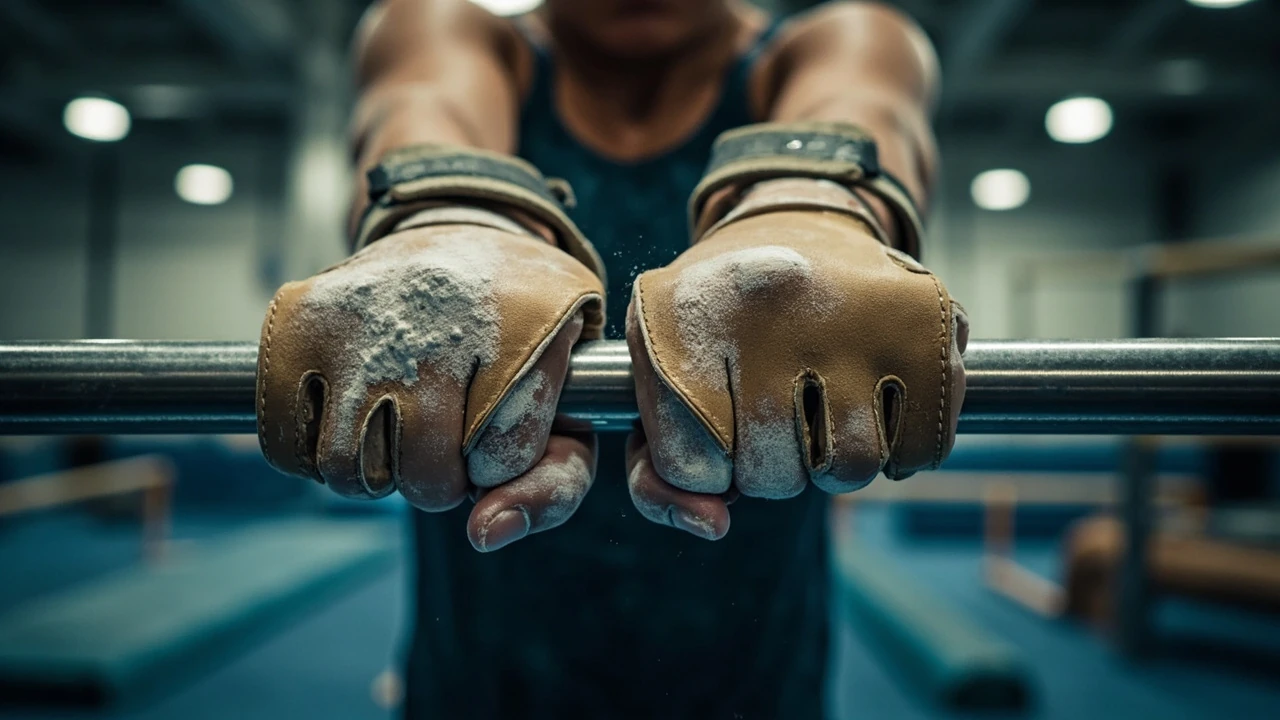
A gymnast plants her hands on the bar, slides up into a handstand, and feels the leather give just enough to find a clean line. The next rep goes the same way. A week later, the same grip slips on a release skill and she lands short. The difference is rarely strength. It is the bar grips: their thickness, break-in, dowel shape, and care. This guide is built around the decisions a gymnast or parent actually faces when buying, breaking in, and maintaining bar grips, from a first pair of competition dowels to a seasoned leather pair that needs re-shaping.
Bar grips in gymnastics: what they actually do
Bar grips are fingerless leather or synthetic hand coverings that a gymnast wears on the bar to protect the skin, reduce friction loss, and add a layer of mechanical advantage between the palm and the steel. The official equipment name is dowel grips; the gymnastics community usually calls them bar grips, hand grips, or simply “grips.” They are standard in women’s artistic gymnastics on the uneven bars and balance beam releases, and they are optional in men’s gymnastics on the high bar, where the leather bar is already thicker and most optional coverage is limited by event rules.
The purpose of bar grips is not to replace grip strength. A gymnast still needs to hold the bar, control rotation, and time release. Bar grips are an interface. They distribute pressure across the palm, allow the dowel (the dowel grip inserts a small bar between the fingers and the leather) to lock the hand in a consistent shape, and protect the skin during long training sets of giants, clear hips, Tkatchevs, and dismounts. Without them, the hand tears, calluses split, and chalk builds unevenly. With them, the hand is preserved for the next set and the next day.
If a coach is asking whether a young gymnast needs bar grips, the practical answer is that most competitive gymnasts who train on the uneven bars will need a pair by the time they start learning release skills. A recreational gymnast who only does pullover and back hip circle work can train in bare hands and chalk alone. The transition point is usually marked by the first giant swing or the first release movement in a series.
Anatomy of a bar grip: parts, materials, and what each one does
Most bar grips look simple, but every part plays a role. Reading a product page is easier once the structure is clear.
- Leather body. The main palm piece is usually vegetable-tanned leather, around 1.5 to 2.0 mm thick. Softer leather breaks in faster and feels more forgiving. Stiffer leather lasts longer and holds dowel shape under heavy use.
- Finger holes. Two or three small holes near the top of the grip let the second and third fingers anchor the leather. Two-hole grips suit most hands. Three-hole grips spread the load across an extra finger and are often preferred by gymnasts with smaller fingers or those who throw harder release skills.
- Dowel. A small rigid bar inside a fabric tube across the top of the grip. Dowel grips force the hand into a slightly more closed, “cuffed” position so the bar settles into the heel of the hand. Buckle grips do not have a dowel and rely on wrist strap tension alone.
- Wrist strap and buckle. The leather strap wraps around the wrist and closes with a single metal buckle. The buckle sets how tightly the grip sits on the hand. The strap and buckle take most of the pull when the gymnast releases the bar.
- Stitching and edging. The seams run along the sides of the palm. Double-stitched edges resist tearing when the grip catches the bar. A poorly stitched edge is the first failure point on a cheap pair.
The thickness of the leather, the shape of the dowel, the number of finger holes, and the buckle placement all change the feel of the grip on the bar. Choosing between them is mostly about hand shape and skill profile, not price tier alone.
Dowel grips versus buckle grips
This is the most important decision a gymnast or parent will make. The two styles look similar from across the gym, but they change how the hand behaves on the bar.
| Feature | Dowel bar grips | Buckle (no dowel) bar grips |
|---|---|---|
| Mechanism | Small rigid bar inside the top of the grip, set with a screw or crimp | No internal bar; wrist strap tension holds the leather against the hand |
| Hand position | Slightly more closed, “cuffed” hand shape | More open hand, closer to a natural hold |
| Common use | Competition uneven bars and balance beam releases | Beginner and intermediate training, low-bar work, some optional levels |
| Skill set | Giants, release skills, twisting releases, transition elements | Pullover, back hip circle, sole circle, low-to-medium difficulty combinations |
| Break-in | Longer; dowel needs to soften and the leather needs to cup the hand | Shorter; leather only |
| Adjustment | Dowel can be re-bent, replaced, or removed by a coach | Only wrist strap can be adjusted |
| Failure mode | Dowel can crack or shift if mistreated | Leather stretches and the grip can slide down the hand |
| Typical cost | Higher, especially competition leather | Lower; good starter option |
Most gymnasts eventually move to dowel grips. The dowel gives a more repeatable hand position, which matters when a release skill needs the same hand shape every rep. The decision usually lines up with the level of the skills being trained rather than the level of the competition. A level 4 gymnast who has just learned a clean giants series will benefit from a dowel pair long before she competes one in a routine.
How to size bar grips correctly
Badly sized bar grips are the single most common reason a gymnast blames a grip for slipping. Sizing is simple once the hand is measured the right way.
- Measure the hand. With the palm flat, measure from the base of the palm at the wrist crease to the base of the middle finger. This is the “grip length.” A hand that measures 14.0 to 14.5 cm usually wears a size 0; 14.5 to 15.5 cm a size 1; 15.5 to 16.5 cm a size 2; 16.5 to 17.5 cm a size 3. Manufacturers vary, so always check the brand’s own chart.
- Match the wrist. The wrist strap should wrap twice around a thin wrist and just over once around a thicker wrist. A strap that is too long leaves slack that catches the bar; a strap that is too short forces the buckle to sit on the inside of the wrist, which is uncomfortable in giants.
- Test the finger holes. The second and third fingers should sit firmly in their holes without the leather bunching at the knuckles. If the holes gape, the grip is too wide for the hand. If the fingers turn white at the tips, the holes are too tight.
- Check the dowel position. The dowel should sit just below the base of the fingers, not across the knuckles. A dowel that rides too high will dig in when the hand closes.
A useful in-store check is to buckle the grip on, hang from a low bar, and let the wrist strap settle for a few seconds. The grip should not rotate around the hand. If the leather shifts to the side, the size is off or the leather is too soft. A new pair of stiff leather can be sized slightly tight on purpose, because leather gives about half a size during the first few weeks of use.
Breaking in bar grips without damaging them
New bar grips feel stiff, sometimes uncomfortably so. Breaking them in the wrong way shortens their life. The aim of break-in is to soften the leather, shape it to the hand, and seat the dowel in the correct curve. The risk is over-bending the dowel, stretching the finger holes, or fraying the stitching.
- Wear them during low-skill sets first. Pullover, back hip circle, and cast-to-handstand work lets the leather cup the hand under low load. Avoid giants and releases during the first training sessions with a new pair.
- Use them dry. Do not soak new bar grips in water to “soften” them. Water stiffens vegetable-tanned leather as it dries and can warp the dowel permanently.
- Bend the dowel gradually. If the dowel is too straight, roll it gently between the palms with light pressure, a few minutes at a time. Most dowels settle into the right curve after three to five training sessions.
- Chalk the inside sparingly. A thin layer of chalk on the inside of the grip reduces tackiness. Too much chalk turns into paste, dries the leather, and causes the grip to slip.
- Watch for hot spots. A blister under a new grip almost always means a sizing issue, not a leather quality issue. Stop, re-check the fit, and adjust before the next session.
A practical break-in timeline for a typical dowel pair looks like this: a few short, low-skill sessions in week one; medium-skill sets in week two; full giants and release skills by week three. By week four, the leather should feel like a second skin and the dowel should hold its shape under load. If the grip is still stiff and uncomfortable after a month of regular use, the leather was either too dry to start with or the size is off.
Care and storage: keeping bar grips usable for seasons, not weeks
Bar grips are leather goods, and leather goods fail when they dry out, get soaked, or sit folded in a gym bag. A small care routine makes a noticeable difference in lifespan.
| Action | How often | What it does | What to avoid |
|---|---|---|---|
| Air dry flat after every session | Every training day | Prevents leather from shrinking or warping | Folding inside a wet gym bag |
| Wipe down with a dry cloth | Every training day | Removes chalk paste and skin oils | Wet wipes with alcohol or fragrance |
| Condition lightly with leather balm | Every 4 to 6 weeks | Replaces natural oils and keeps leather supple | Heavy oils, mink oil, or saddle soap on competition grips |
| Check stitching and dowel | Every 2 to 3 weeks | Catches small failures before they become in-routine failures | Ignoring a loose buckle or frayed stitch |
| Store flat in a cool, dry place | Always | Stops leather from curling or cracking | Leaving on a hot car seat or near a radiator |
Two rules resolve most care questions. First, treat the grips like good shoes: clean, condition, and let them rest. Second, never store them wet. A pair of bar grips left in a sealed bag overnight will stiffen up like cardboard by morning and feel wrong for the rest of the week.
When to replace bar grips
Bar grips do not have a fixed expiry date, but they all reach an end. The replacement decision is usually about safety and consistency, not appearance.
- The dowel has cracked or slipped. A broken dowel changes the hand position without warning, especially mid-release. Once a dowel shows a hairline crack, the pair should be replaced or re-doweled by a coach who knows the technique.
- The wrist strap is stretched. If the buckle has to be set tighter than it was a season ago just to keep the grip on the hand, the leather has lost its memory and the pair is at the end of its life.
- Stitching is fraying along the palm seam. A fraying seam can let the leather split under load. Visible thread loss is a sign the grip is close to failing.
- The leather is hard and shiny. When leather has dried out, it stops gripping the hand. The palm slides, the wrist strap does the work, and the release skill feels unpredictable.
- The gymnast has outgrown them. A growth spurt of half a size or more means new holes, a new buckle position, or a new pair. Forcing old grips to fit a larger hand is one of the most common causes of slipping mid-skill.
For a gymnast training five or six days a week on the bar, a typical pair of competition dowel grips lasts one full season. For a recreational gymnast, the same pair can last two seasons or more. Buckle grips tend to wear out faster because the wrist strap takes more of the load.
Common mistakes with bar grips, and how to avoid them
Most bar grip problems come from a small set of recurring issues. A short list of the ones coaches see week after week.
- Sizing by age, not by hand. A 10-year-old with a long hand needs a different size than her 12-year-old teammate. Always measure the hand against the brand chart.
- Over-chalking the inside. Chalk belongs on the palm, not on the inside of the grip. Excess chalk turns into a drying paste that shortens leather life.
- Buckling too tight. A wrist strap pulled so tight that it cuts circulation will slip as soon as the hand sweats. The buckle should be firm, not constrictive.
- Soaking grips to soften them. Water changes the shape of vegetable-tanned leather and can warp the dowel. Soften them with use, not with water.
- Using one pair for everything. A wet pair of grips on a heavy set is the fastest way to lose skin. Rotate pairs and let them dry between sets.
Buying bar grips: a short checklist
Before clicking order or walking to the front desk at the gym shop, run through this list. It saves a return trip and a wasted week of break-in.
- Measure the hand and check the brand’s sizing chart.
- Decide between dowel and buckle based on the skills being trained this season.
- Pick the right number of finger holes for the hand shape.
- Choose the leather thickness: thinner for early levels, thicker for repeated release work.
- Check the buckle is on the outside of the wrist, not the inside.
- Inspect the stitching and the dowel screws before leaving the store.
- Plan the break-in: low-skill sets in week one, full skills by week three.
How bar grips fit into a full training setup
Bar grips are one piece of a wider hand-and-bar setup. A pair of grips alone will not fix a slipping problem if the rest of the routine is off. The grip on the bar is the sum of chalk, the leather, the wrist wrap, the wrist strap, and the gymnast’s hand. Each one has a job.
Chalk reduces sweat and adds a thin layer of texture. The bar itself matters: a new bar feels different from a worn one, and a fiberglass or composite bar (used on some uneven bars) feels different from a steel bar. The hand itself changes week to week, especially during a growth spurt or a heavier training block. A pair of bar grips that worked perfectly in October can feel wrong in February for reasons that have nothing to do with the grips.
A practical habit is to keep two pairs of grips in rotation during heavy training weeks. One pair rests and dries while the other pair is in use. The pair that has been resting always feels more secure on the bar, because the leather has not been stretched by a long training session. The two-pair rotation also gives the coach a backup if a buckle breaks or a stitch lets go on competition day.
Where to start if you are choosing a first pair
A first pair of bar grips should be simple: a basic buckle grip in the correct size, with leather that is not too stiff. The aim of a first pair is to teach the gymnast how to wear grips, how to chalk them, and how to care for them, not to set a competition hand shape. Once the gymnast is comfortable in the pair and the coach sees a consistent hand position on the bar, it is worth moving to a dowel pair that matches the skill level being trained.
Parents often ask whether a more expensive pair is automatically better. Price usually tracks leather grade, dowel quality, and brand consistency, not magic performance. A mid-priced dowel grip from a brand that fits the hand will outperform a premium pair that is the wrong size. Fit, break-in, and care are doing most of the work.
Frequently asked questions
What size bar grips does a gymnast need?
Measure from the base of the palm at the wrist crease to the base of the middle finger, then match that length to the brand’s sizing chart. A typical junior hand falls in the size 0 to size 2 range, depending on the manufacturer. Always check the chart rather than sizing by age.
Do beginner gymnasts need bar grips?
Not always. Recreational gymnasts doing pullover and back hip circle work usually train in bare hands and chalk. Once a gymnast starts learning giants, clear hips, and release skills, bar grips become standard to protect the skin and stabilise the hand on the bar.
What is the difference between dowel grips and buckle grips?
Dowel grips have a small rigid bar inside the top of the leather that forces the hand into a slightly more closed shape. Buckle grips have no dowel and rely on the wrist strap alone. Dowel grips are more common for competition and release skills; buckle grips are common in early training.
How long does it take to break in bar grips?
Most dowel pairs settle into a usable shape over three to five training sessions, with full break-in after two to four weeks of regular use. Buckle pairs usually break in faster because there is no dowel to shape.
Can bar grips be washed?
Washing is not recommended. Wipe the inside with a dry cloth after each session and condition lightly every few weeks. Soaking or machine washing stiffens the leather and can warp the dowel.
How do you keep bar grips from slipping?
Make sure the size is correct, the wrist strap is firm but not tight, the dowel is in the right position, and the inside of the grip is not packed with chalk paste. Replace the pair if the leather has hardened or the wrist strap is stretched.
When should bar grips be replaced?
Replace them when the dowel has cracked, the wrist strap is stretched, the stitching is fraying, the leather is hard and shiny, or the gymnast has outgrown the size. For heavy training, plan on one full season per competition pair.
Are men’s bar grips different from women’s bar grips?
Men’s gymnastics usually does not use dowel grips on the high bar, where the leather bar already provides grip and the FIG rules limit hand coverage. Women use dowel grips on the uneven bars and balance beam releases. Sizing, leather, and dowel mechanics are similar between the two when grips are used.
Can a gymnast use the same pair for high bar training and competition?
Yes, but it is worth keeping a second pair as a backup. Heavy training wears leather faster than competition alone, so a separate training pair and a competition pair can extend the life of the competition pair for an entire season.
What is the best way to store bar grips between training sessions?
Let them air dry flat, away from direct heat, and store them in a cool, dry place. Avoid sealed gym bags, car trunks, and radiators. A simple mesh bag or open pouch in a gym drawer is usually enough.