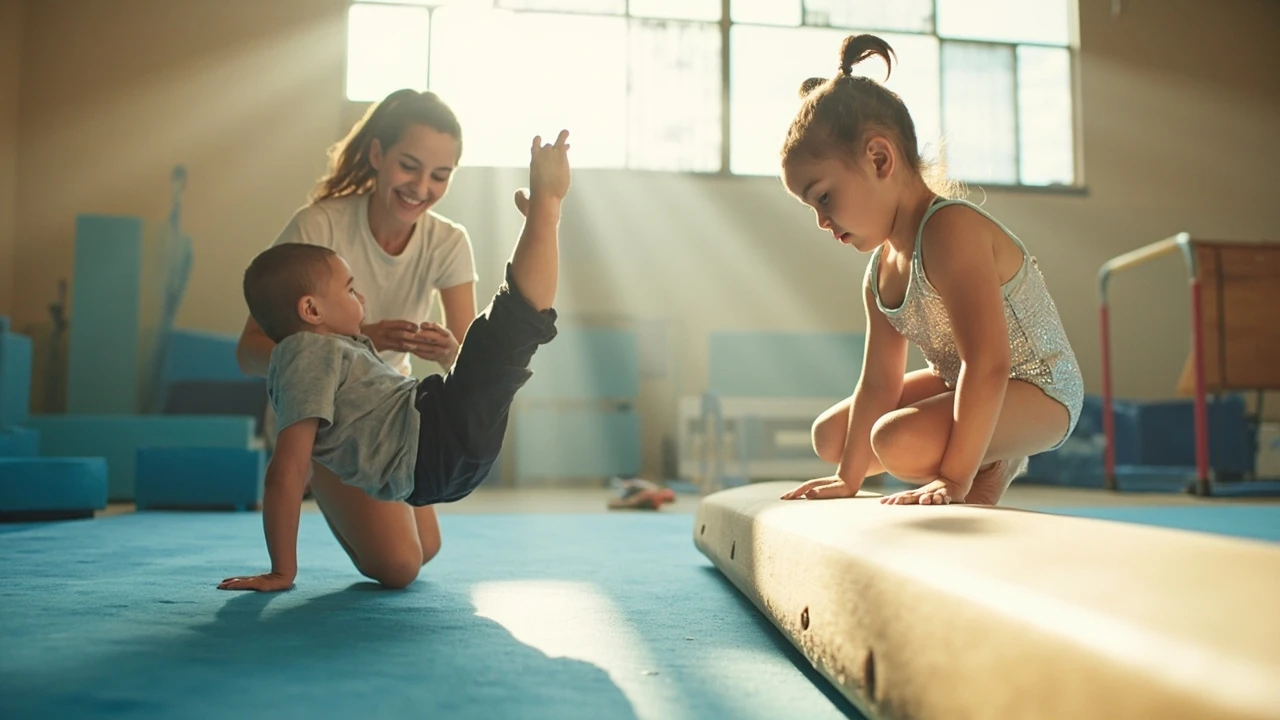
A parent stands at the gym lobby window watching her seven-year-old swing on the uneven bars. Some of the children in the next group are already training three days a week, traveling to meets, and wearing team leotards. Her own child is happy with a once-a-week class and a sticker chart. The question is not which path is better in the abstract, but which path fits a specific child, family schedule, and budget. This guide on recreational vs competitive gymnastics for children breaks down the differences in a way that helps families make that decision without pressure and without missing important details.
Recreational vs competitive gymnastics for children: the core difference
The clearest way to separate the two paths is to ask one question: what is the child training for? In a recreational program, the child is training for general physical literacy, social development, and enjoyment of the sport. In a competitive program, the child is training to perform specific routines that will be scored against other gymnasts at sanctioned meets. Everything else, from practice hours to equipment to leotard choices, flows from that single difference.
Recreational classes usually run 55 to 90 minutes once or twice a week. Competitive team practices often run 9 to 25 hours a week, broken into four to six sessions depending on the level and the club. A child can spend a full year in a recreational program without ever being asked to perform a routine for a judge. A competitive child at the same club is expected to learn compulsory or optional routines within the first season.
Parents sometimes assume that competitive gymnastics is simply “more recreational.” It is not. The two programs have different expectations, different coaching styles, and different measures of success. Treating them as a smooth continuum can set up disappointment for the child and financial surprises for the family.
How goals shape each program
Every gymnastics program has a goal, even if it is not written down. Knowing the goal of a specific class helps a parent decide whether it matches the family’s goal for the child.
Goals in a recreational program
- Build fundamental movement skills such as balance, coordination, and body awareness.
- Introduce each apparatus in a safe and age-appropriate way.
- Help the child develop a positive relationship with physical activity.
- Offer a structured outlet for energy, focus, and social play.
- Allow the child to progress at their own pace without external ranking.
Goals in a competitive program
- Prepare routines that meet the technical and artistic standards of a sanctioned level.
- Develop the strength and consistency needed to handle increased training volume.
- Build mental skills such as handling nerves, working with a judge, and recovering from mistakes.
- Track progress through scores, placements, and qualifying scores.
- Prepare the gymnast for a season of meets, which may include travel and overnight stays.
The overlap is real, but the emphasis is different. A recreational program sees success when a child learns a forward roll cleanly. A competitive program sees success when a child hits a routine in front of a judge with no major errors.
Time commitment at a glance
Time is the most underestimated factor in the recreational vs competitive gymnastics for children decision. A child who loves gymnastics at age six may not love it the same way at age nine once the schedule doubles. Understanding the realistic weekly load helps families avoid burnout.
| Stage | Weekly practice hours | Sessions per week | Typical season meets |
|---|---|---|---|
| Recreational, beginner | 1 to 2 | 1 | None |
| Recreational, advanced | 2 to 4 | 1 to 2 | Optional in-house showcase |
| Pre-team / developmental | 4 to 8 | 2 to 3 | 1 to 3 local invitationals |
| Compulsory levels (USAG levels 4-5) | 9 to 14 | 3 to 4 | 5 to 8 sanctioned meets |
| Optional levels (USAG levels 6-10) | 16 to 25 | 4 to 5 | 7 to 10 sanctioned meets plus optional state and regional |
Hours at the gym are only part of the picture. Competitive families also need to budget time for travel to meets, fundraising events, and conditioning homework that recreational programs rarely assign.
Cost differences that families should plan for
Recreational gymnastics is closer in price to a music lesson. Competitive gymnastics is closer in price to a serious youth sport with significant travel. The difference is large enough that families should ask the club for a written breakdown before committing.
| Expense type | Recreational (per year, typical range) | Competitive (per year, typical range) |
|---|---|---|
| Monthly tuition | Moderate, billed once a month | Higher, often billed as a flat team fee |
| Annual registration | One club fee, sometimes a national membership | Club fee, plus sanctioned body membership for athlete and judge-protecting coach |
| Uniforms and leotards | Comfortable athletic wear is fine | Team leotards, warm-ups, competition suits, and travel bag required |
| Meet entry fees | Rare or limited to in-house events | Per meet, paid by the family across the season |
| Travel, lodging, and meals | None, except optional showcases | Regular, including some overnight trips once levels rise |
| Private lessons and physical therapy | Rarely needed | Common at higher levels |
The ranges vary widely by region and club, but the structure of the cost is consistent. Recreational gymnastics is a fixed monthly bill. Competitive gymnastics layers monthly tuition, meet fees, gear, and travel on top of each other.
What coaches look for in each setting
A recreational coach is usually trained to keep a class safe, progressing, and fun for mixed ages and abilities. They spend their day managing many children at once and teaching the basic shape of every skill. They are looking for readiness signals such as focus, listening, and a willingness to try a skill a second time after a fall.
A competitive coach is usually trained to design season-long training plans, score routines against a code of points, and manage a small group of gymnasts through higher-risk skills. They look for the same readiness signals, but they also need physical markers such as the strength to hold a solid handstand, the flexibility to meet a specific split, and the mental capacity to absorb corrections during a long practice.
This is why many clubs run a pre-team or developmental group. It is a bridge that lets a coach observe a child over several months before offering a competitive spot. Parents who want clarity can ask the head coach how they make the decision and what skills or habits they prioritize.
Physical and mental load on the child
Gymnastics is high-impact for the wrist, shoulder, back, and ankle, especially as the difficulty of skills rises. Recreational classes stay within a load that most children can handle without special recovery. Competitive training raises the volume of skills, the number of repetitions, and the number of impacts on the body.
Parents should pay attention to a few practical signs:
- Persistent pain that does not go away after a normal warm-up is a reason to talk to the coach and, if needed, a sports-focused clinician.
- Sleep disruption and constant fatigue can mean the body is not recovering between sessions.
- A sudden loss of enthusiasm for a sport the child loved a few months earlier is a signal worth taking seriously, not as weakness but as information.
Mental load matters as well. Competitive gymnastics is judged. Even at the lowest sanctioned levels, a child is being compared to other children in front of an audience. Recreational gymnastics can include showcases and parents’ week, but it is not built around a score. Some children thrive on the score, others shut down. Knowing which type of child you have is one of the most useful pieces of information in this decision.
When a child should move from one path to the other
Movement between the two paths happens in both directions, and neither direction is a failure.
A child can move from recreational to competitive when several conditions line up:
- They consistently ask for more time in the gym and practice skills at home for fun.
- They can focus through a full 90-minute class without repeated prompts.
- They have the strength and body control to do the basic shapes that lead into higher skills, such as a straight-body handstand against a wall.
- The family can absorb the new schedule and cost without straining other priorities.
A child can also move from competitive back to recreational, or simply out of the sport, and that can be the right call too. Burnout, injury, a changing school load, or a simple change of interest are all valid reasons. A healthy club will not punish a family for making that call.
Questions to ask a club before enrolling
Whether the family leans recreational or competitive, the right questions to ask a club are similar. The answers help a parent compare programs on something more useful than the size of the facility.
- What is the coach-to-child ratio in each class, and how is it set for safety reasons?
- How does the club decide who is invited into the competitive pipeline?
- What is the policy on private lessons, and are they required at any level?
- How does the club handle a child who wants to step back from competition?
- What does a typical season look like, including meets, in-house events, and breaks?
- How does the club communicate with parents about progress, concerns, and injuries?
Clubs that answer these questions clearly and without pressure are usually clubs that take both the recreational and the competitive sides of the sport seriously.
How family schedule should factor into the choice
Family life is part of the equation. A child cannot train 18 hours a week if the family schedule cannot support the driving, the meal planning, the laundry, and the emotional energy that competitive seasons require. A parent who is excited about a competition can forget that the parent driving two hours each way for a one-day meet is a different person than the parent watching a 45-minute recreational class.
Some families plan a year in advance around the gym. Other families cannot, and that is a real constraint, not a lack of commitment. A recreational program that the child attends consistently for several years delivers most of the physical benefits of gymnastics. A competitive program that the child quits after one hard season delivers almost none of them.
Common mistakes parents make in this decision
A few patterns show up often enough to name directly.
- Pushing a young child into competition because the child is “talented” at age six. Talent at six is mostly enthusiasm and natural flexibility, both of which exist in most healthy children.
- Assuming recreational is only a waiting room for competitive. Many children stay in recreational gymnastics for the entire time they do the sport, and that is a healthy outcome.
- Comparing the family’s situation to another family on the same team. The other family may have a different work schedule, a different number of children, or a different budget.
- Ignoring the child’s own signal. A child who dreads practice is telling the parent something, even if the child cannot put it into words.
- Choosing a club based on social media presence rather than coach credentials, retention rates, and injury history.
How a typical season feels in each program
Knowing the rhythm of a season is a small but useful piece of the puzzle. Recreational seasons tend to be predictable and calm. Competitive seasons move in waves.
| Time of year | Recreational rhythm | Competitive rhythm |
|---|---|---|
| Early fall | New class sign-ups, fresh rotations of skills | Pre-season conditioning, new routine choreography begins |
| Late fall | Steady skill progression | First sanctioned meets, travel light |
| Winter | Slight slowdown, focus on strength and shapes | Heavy meet schedule, travel increases |
| Spring | Optional in-house showcase for friends and family | Championship season, state and regional events |
| Summer | Flexible schedules, camps, and short sessions | Off-season training, summer camps, and clinics |
Parents who are considering competitive gymnastics should be ready for a winter that is heavier than a recreational winter. Parents who are happy in the recreational lane should not feel pressure to add meets just because the calendar changes.
Long-term outcomes of each path
Both paths build physical literacy, confidence, and a long list of transferable skills. The shape of the long-term outcome is different.
Recreational gymnastics that a child enjoys for several years tends to produce a teen and adult who is comfortable in their body, willing to try new physical activities, and able to move well into adulthood. Coaches and trainers in other sports often comment that former recreational gymnasts have above-average body awareness and coordination, which is one of the reasons that a foundational habit of movement built in childhood pays off for decades.
Competitive gymnastics, when it fits the child, tends to produce a teen with strong discipline, a clear sense of working toward a goal, and an unusually high tolerance for structured practice. When it does not fit, the same intensity can produce the opposite result, which is one reason the fit matters so much.
How to make the decision in a few practical steps
Parents who want a structured way to choose can work through these steps in order.
- Write down what the family actually wants from gymnastics this year, not what looks impressive.
- Ask the child directly what they like about class and what they would change.
- Look honestly at the family schedule and budget for the next 12 months, not the next month.
- Visit two or three clubs, watch a recreational class and a team practice, and talk to the head coach.
- Try a session or two at the level the family is considering, including a trial team practice if competition is on the table.
- Reassess every 6 to 12 months, because the right answer at age seven is not always the right answer at age ten.
Working with a coach as a partner, not a gatekeeper
Coaches see hundreds of children come through their doors. A good coach will be honest about the level a child is ready for, even if that means keeping a child in recreational for another year or moving a child down a level after a competitive season. Parents do not need to be experts in gymnastics to spot a coach who is a good partner. They can look for a few signs:
- The coach explains the why behind a recommendation, not only the what.
- The coach answers questions from a parent and a child in different ways.
- The coach is willing to say “not yet” instead of pushing a child forward to keep a family happy.
- The club’s other families describe a clear, respectful relationship with the coaching staff.
A coach who behaves like a gatekeeper is a sign to slow down, ask more questions, and consider another club if the answers are not satisfying.
What to do if the child changes their mind mid-season
Children change their minds. A child who begged for competition in September may want to quit in February. A child who loved recreational class for three years may suddenly want to try a team in the spring. Both situations are normal.
The useful response is to ask what changed, listen to the answer without rushing to fix it, and then talk to the coach. Most clubs have a process for both directions, and a small adjustment, such as dropping a practice day or switching the level of a routine, can solve a problem that feels overwhelming to the child.
Internal resources for parents and gymnasts
Two pieces on this site pair naturally with a decision on recreational vs competitive gymnastics for children. The piece on how gymnastics clubs can build a stronger online presence gives parents a way to evaluate a club’s communication before signing up, and the guide to academy sports programs helps families place gymnastics in the wider picture of youth sports choices.
A note on injuries and long-term wellbeing
Gymnastics, like any sport that asks the body to handle impact and rotation, comes with an injury risk. Parents can manage that risk without becoming anxious by focusing on a few basics: a warm-up that includes the wrists, shoulders, and ankles, a coach who is certified through a recognized body, a club that follows the published progression charts for each skill, and a child who is encouraged to speak up about pain. The same principles that keep recreational gymnastics safe at one hour a week help keep competitive gymnastics safe at twenty hours a week, scaled to the load.
Closing thoughts on a personal decision
The decision between recreational and competitive gymnastics is one of those parenting choices that has no single right answer. It is shaped by the child’s personality, the family’s resources, the strength of the local clubs, and the goals the family actually holds, not the goals the family feels it should hold. Treating the question as a fit problem rather than a rank problem is the most useful frame. The right program is the one the child will still be enjoying a year from now, in a body that is healthy, in a family that is not stretched too thin, with a coach who respects both the sport and the child. Revisit the question regularly, listen to the child, and adjust the path when the data changes. That is the core of choosing well between recreational and competitive gymnastics for children.
Frequently asked questions
What is the main difference between recreational and competitive gymnastics for children?
The main difference is the goal. Recreational gymnastics focuses on general skill development, fun, and physical literacy. Competitive gymnastics focuses on preparing routines that are scored at sanctioned meets. Practice hours, expectations, cost, and even the coaching style shift around that single difference.
At what age can a child start competitive gymnastics?
Most clubs begin pre-team or developmental programs around ages 5 to 7, with entry into the lowest sanctioned competitive levels a year or two later. The right age depends more on the child’s focus, strength, and readiness than on the calendar. Many children who start competitive gymnastics later still have long, successful competitive careers.
How many hours a week does a competitive child gymnast train?
Hours vary by level and club. Pre-team and developmental groups often train 4 to 8 hours a week. Compulsory-level gymnasts commonly train 9 to 14 hours a week, and optional-level gymnasts often train 16 to 25 hours a week, split across four or five sessions.
Is recreational gymnastics worth it if my child never competes?
Yes. Recreational gymnastics builds balance, coordination, strength, and a long-term relationship with movement that transfers to other sports and to adult fitness. Many former recreational gymnasts are described by coaches in other sports as unusually coordinated and body-aware.
How do I know if my child is ready for the competitive path?
Look for consistent focus through a full class, a real interest in practicing skills at home, the physical strength to handle basic shapes such as a straight handstand, and a willingness to accept corrections. Most clubs will evaluate a child over several weeks before offering a spot on a competitive track.
How much more expensive is competitive gymnastics?
Competitive gymnastics is meaningfully more expensive than recreational gymnastics, mainly because of meet entry fees, travel, team gear, and the higher monthly tuition. The exact number varies by region and club, so ask for a written breakdown of the full season before committing.
Can a child switch from competitive back to recreational?
Yes. Children switch in both directions for many reasons, including burnout, injury, school demands, or a simple change of interest. A healthy club will support that decision rather than pressure a family to keep a child on the competitive path.
What are the signs that a child is overtraining in gymnastics?
Persistent pain that does not go away after warming up, constant fatigue, sleep disruption, frequent illness, and a sudden loss of enjoyment are all signs that a child may be overtraining. Any of these is a reason to talk to the coach and, if needed, a clinician familiar with young athletes.
Do private lessons matter in recreational gymnastics?
Private lessons are rarely needed in recreational gymnastics, since the group setting is designed to cover the basics safely. Some families add a single lesson now and then for a specific skill, but it is not a routine expectation at the recreational level.
How often should a family reassess the recreational vs competitive choice?
Reassess every 6 to 12 months, or sooner if there is a major change in the child’s interest, health, school load, or family schedule. The right answer at age seven often shifts by age ten, and a path that felt easy a year ago may feel heavy now. A short, honest conversation with the child and the coach is usually enough to keep the choice current.