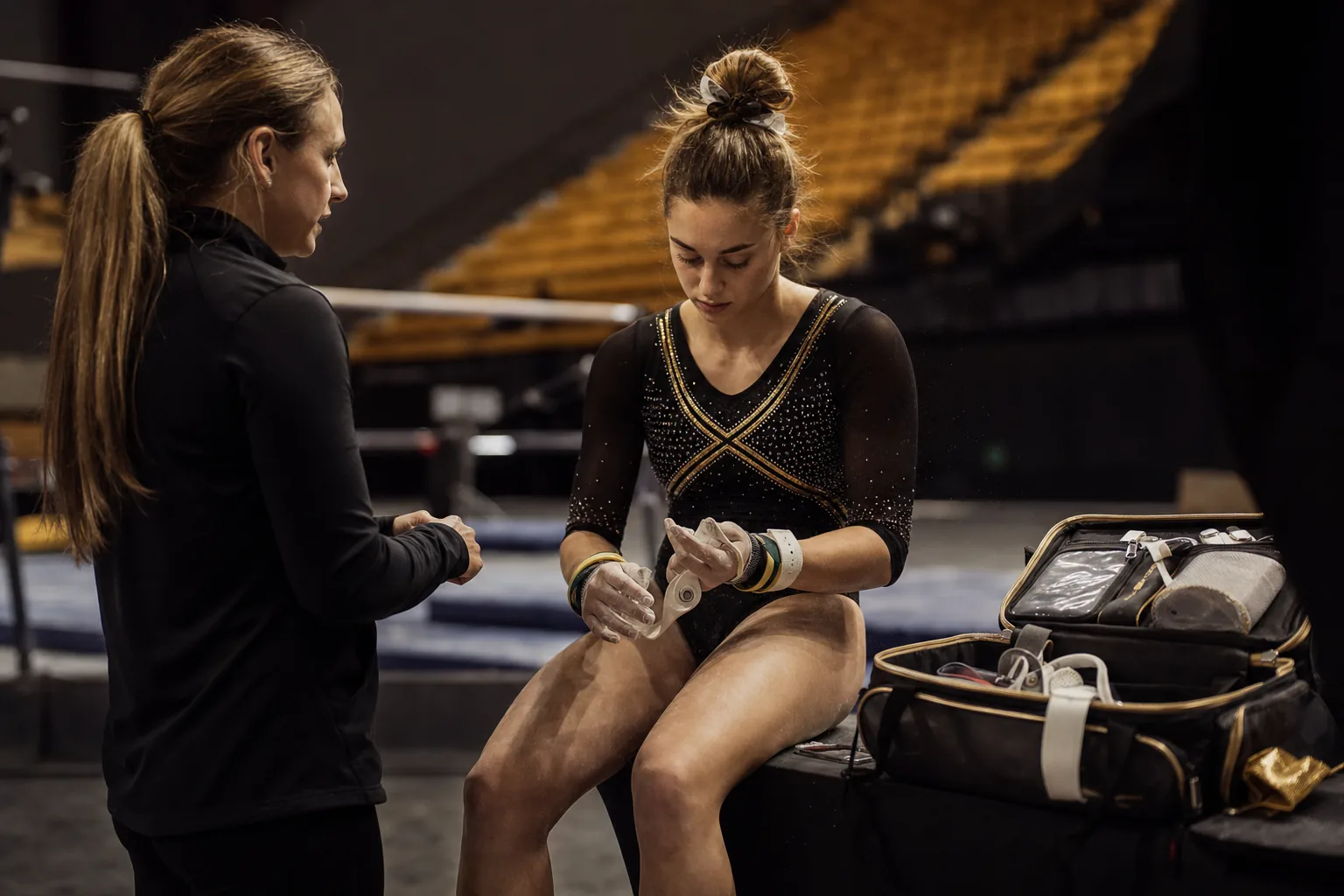
A gymnastics meet can make ordinary details feel urgent. A missing grip, unfamiliar warm-up order or rushed meal can take more attention than the routine itself. Good preparation does not remove nerves. It reduces the number of avoidable decisions the gymnast has to make on competition day.
The most effective checklist is built around the athlete’s established routine and the rules of the specific event. Use this guide as a planning framework, then confirm times, equipment and procedures with the coach and meet organizer.
One week before the gymnastics meet
The final week is usually a time to organize, not reinvent. Training decisions belong to the coach, but the athlete and family can confirm the schedule, travel, uniform, registration status and what the venue allows.
- Check the official session, arrival and warm-up times.
- Confirm the venue address, parking and spectator information.
- Review uniform requirements and whether numbers or credentials are provided.
- Inspect grips, wristbands, footwear and personal equipment while there is time to solve a problem.
- Ask the coach how communication will work if the session changes.
Avoid creating a new motivational system or making a major equipment change because competition is close. Familiarity is valuable. If something genuinely needs to change, involve the coach early.
Build a gymnastics meet bag before the night prior
Pack the bag with the gymnast, not for the gymnast. Knowing where each item lives reduces searching and builds ownership. The exact list depends on discipline and level, but a practical artistic gymnastics bag may include:
- Competition uniform and any required warm-up clothing.
- Grips, wristbands and approved hand-care items if used.
- Hair supplies that have already been tested in training.
- Water bottle and familiar food permitted by the coach and venue.
- Simple spare items: tape if approved, an extra hair tie and backup clothing.
- Any required membership card, credential or event information.
- A separate bag for used or chalky equipment.
Label personal equipment where appropriate. Do not assume another athlete can lend a specialized item at the venue.
Plan food, hydration and sleep around the real schedule
Competition days may begin early or run through a normal meal time. Families should use familiar food and routines rather than trying an aggressive “competition” plan. The goal is to arrive fueled, hydrated and comfortable.
If an athlete has medical, nutritional or allergy needs, follow the established advice of the appropriate professional and check venue restrictions. General online guidance cannot account for those needs.
Sleep preparation is also logistical. Pack early, set travel times and remove the midnight search for a uniform. One imperfect night does not determine a meet, but a calm evening protects attention.
The night-before gymnastics checklist
- Place the packed meet bag and uniform in one known location.
- Charge any phone needed for travel or coach communication.
- Set more than one alarm if the session is early.
- Confirm who is driving and the planned departure time.
- Read the organizer’s latest message once, then stop checking repeatedly.
Visualization or routine review may help an athlete who already uses it. The night before a meet is not the time to force a mental strategy that feels unnatural.
Arrival at the gymnastics venue
Use the coach’s requested arrival time. It often includes check-in, changing, equipment organization and team instructions before formal warm-up. Arriving extremely early can create unnecessary waiting; arriving late transfers stress to the whole group.
Once the gymnast joins the team, the coach should become the main operational voice. Parents can solve spectator, ticket and seating questions without pulling the athlete out of preparation.
Warm-up: prepare, do not prove
Meet warm-ups are often shorter and more structured than a normal training session. The objective is to prepare the body, feel the apparatus and confirm key timing. It is not a private competition to show every possible skill.
The gymnast should know which corrections and cues matter most. A short phrase such as “finish the shape” or “see the landing” is easier to use than five technical thoughts. Coaches decide what to repeat and when to move on.
Managing nerves during a gymnastics competition
Nerves are not proof that an athlete is unprepared. They are a normal response to consequence and attention. Trying to eliminate every sensation can create a second problem: now the gymnast is nervous about being nervous.
A practical reset is specific and physical. Exhale, feel the feet, look at the first position, repeat the established cue and begin the known routine. Between events, return attention to the next controllable task rather than calculating every possible score.
What parents can say before and after a routine
Before competition, simple support is usually best: “I’m glad I get to watch you,” “Trust your preparation,” or “Have a good time with your team.” Last-minute technical coaching can conflict with the coach and make the athlete carry more instructions.
After a routine, respond to the athlete in front of you. If they are excited, share it. If they are disappointed, make room before analyzing. A score does not require an immediate family meeting.
If something goes wrong
A fall, equipment issue or forgotten sequence can feel enormous in the moment. The next task is to re-enter the competition safely and follow the coach’s direction. One event should not be allowed to consume the remaining events.
Questions about judging, equipment or procedure should go through the appropriate coach or official channel. Spectator confrontation rarely helps the gymnast.
After the gymnastics meet
Recovery and review do not have to happen at the same time. First handle food, travel, rest and ordinary connection. When the athlete and coach are ready, review a small number of points:
- What part of preparation made the day easier?
- Which routine choice or response worked well?
- Where did the gymnast lose a familiar cue or rhythm?
- What is one training priority before the next meet?
Video can support the review if it is used as evidence rather than punishment. Keep clips secure and obtain appropriate consent before posting, especially when minors or other athletes are visible.
The short meet-day checklist
Know the time. Pack familiar equipment. Arrive when the coach asks. Warm up to prepare. Use one clear cue. Let the coach coach. Support the athlete before evaluating the result.
A successful meet is not necessarily the one with no mistakes. It is the one where preparation leaves the gymnast enough attention to compete, respond and learn.