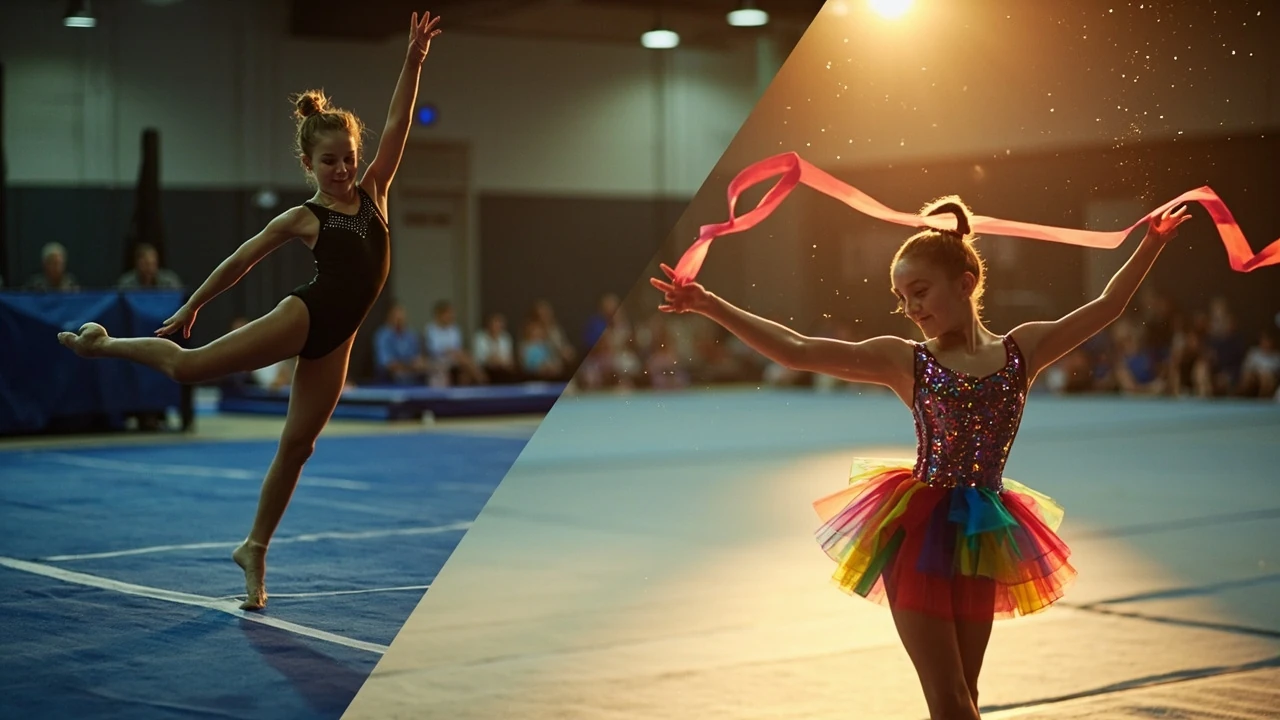
A gymnast lands a double pike at a club showcase, waves to a parent in the front row, and walks off without a single judge raising a tablet. The same athlete, wearing nearly the same leotard two weeks later at a sanctioned meet, scores a 9.1 execution mark after a missed connection. The choreography was almost identical. The framing was not. That gap between performance and score is the clearest way to see how gymnastics exhibition routines differ from scored routines, and it shapes everything from how athletes prepare to how spectators should read what they see.
Exhibition routines are built to entertain and showcase. Scored routines are built to be measured. Those two goals pull choreography, difficulty selection, and risk decisions in opposite directions, and the differences show up long before a single element is performed.
How gymnastics exhibition routines differ from scored routines in everyday terms
The shortest answer is that exhibition routines exist to display an athlete or a club, while scored routines exist to be evaluated against a code of points. Every other difference flows from that one split in purpose. A scored routine must satisfy the judges; an exhibition routine must satisfy the audience, the athlete’s own development goals, or both. When you watch an exhibition, you are watching a performance. When you watch a scored routine, you are watching a test.
This split affects:
- The code of points or judging system that applies, if any.
- The choice of skills, especially difficulty versus entertainment value.
- How artistry, dance elements, and personality are weighted.
- The amount of risk an athlete is expected to take.
- Music, choreography, costumes, and props.
- Who is allowed in the venue and how results are announced.
If you are a parent, fan, or club manager trying to interpret what you see, the practical question is not which type of routine is better. Each format has a job. The job of an exhibition is to build confidence, entertain, and let an athlete work on quality without the pressure of a score. The job of a scored routine is to let the judging system rank performance on a shared scale.
What an exhibition routine actually is
An exhibition routine is any gymnastics performance that is not part of an officially scored competition. The term covers a wide spectrum. At one end is a formal gala featuring Olympic medalists, often organized by a federation or a sponsor. At the other end is a club’s annual “friends and family” night where every level gets a turn on the floor.
Common examples include:
- Club showcases and end-of-year demonstrations.
- Opening or closing performances at gymnastics meets.
- Charity exhibitions and community events.
- National team tours and post-Olympic exhibition tours.
- Halftime and halftime-style entertainment at multi-sport events.
- Promotional appearances for gyms, athletes, or brands.
None of these routines carry an official score. They can still be judged internally for training feedback, and they can be choreographed to a very high standard, but the score sheet is not the point. A clean double layout at an exhibition is still impressive, but a wobble on a showcase floor is not converted into deductions and a placement.
That freedom is exactly what makes exhibitions useful. A coach can ask a gymnast to work on a cleaner toe point, a more expressive landing pose, or a more confident tumbling pass without worrying that a single missed element will cost the team a trophy.
What a scored routine is
A scored routine is performed inside a sanctioned competition that uses a published judging system. In the United States, that most often means USA Gymnastics sanctioned events using the Junior Olympic or Xcel programs. Internationally, the senior international code is set by the Fédération Internationale de Gymnastics (FIG) Code of Points, which is updated after each Olympic cycle.
In a scored routine, the judges apply a Difficulty score, an Execution score, and (depending on the level) an Artistry or Composition score. The Difficulty value reflects the difficulty of the skills performed. The Execution score starts from a fixed value and is reduced by deductions for bent knees, separated legs, wobbles, hops on landings, falls, and other technical errors. Composition covers requirements like connection value, element groups, and artistry expectations.
If you want a deeper breakdown of the score sheet itself, our scoring guide walks through the exact components. For now, the key point is that every element a gymnast performs in a scored routine is potentially worth, or costing, points. There is no safe, low-risk option once the routine has started.
Side-by-side comparison
The table below summarizes the main differences between exhibition and scored routines. The list is not a ranking. It is a tool to help you read what is happening when you watch either format.
| Aspect | Exhibition routine | Scored routine |
|---|---|---|
| Primary goal | Entertain, showcase, develop | Be evaluated and ranked |
| Judging system | None required; optional internal feedback only | Mandatory official scoring (JO, Xcel, FIG, etc.) |
| Difficulty expectations | Chosen for the athlete and the audience | Chosen to maximize the difficulty score |
| Risk level | Often deliberately lowered | Often deliberately raised |
| Costume rules | Flexible, often themed | Strict, must meet the federation’s apparel rules |
| Music and choreography | Free to match the theme | Must fit time limits and sometimes genre rules |
| Props | Allowed in many settings | Generally not allowed in scored events |
| Audience interaction | Common; waving and acknowledging fans is normal | Discouraged; focus stays on the routine |
| Results | No placements, ribbons, or medals | Placements, awards, team scores, qualification impacts |
| Effect on athlete’s competitive record | None | Counted toward rankings, qualification, scholarships |
Reading the table is the easiest way to grasp how gymnastics exhibition routines differ from scored routines at a glance. The two formats are not weaker or stronger versions of the same thing. They are different activities that share a floor and some equipment.
How choreography changes between the two formats
Choreography is where the difference is most visible. A scored routine is shaped to satisfy the requirements of the code. On floor exercise, that means hitting required element groups, building difficulty into clean connections, and distributing elements so that the judges see variety in directions, rotations, and body shapes. A coach designing a JO floor routine is not asking, “What would look great in this transition?” They are asking, “What gives us the highest possible connection value and covers the composition requirements?”
Exhibition choreography is shaped around the performer and the audience. It can include: To place this section in context, the Code of Points gymnastics offers a concise background reference.
- Longer dance sections that would be impractical in a 90-second scored floor routine.
- Character work, storytelling, or a single clear theme.
- Signature elements chosen for visual impact rather than point value.
- Group sections, mirror work, and crowd-pleasing formations.
- Props such as ribbons, flags, hoops, or themed accessories where the venue allows them.
This is also why exhibition tours, such as the post-Olympic tours that follow every Games, look so different from the meets those same athletes competed in. A Yurchenko double pike is the same skill in either context, but the surrounding choreography is built to make an audience react, not to satisfy a difficulty panel.
Why risk decisions diverge
One of the most important practical differences is the level of risk each format asks an athlete to accept. In a scored routine, especially at a major meet, an athlete who plays it safe with difficulty will usually lose to an athlete who attempts more. Under the FIG code, a clean triple-twisting double tuck is worth more than a clean double tuck, and a clean double tuck is worth more than a clean 1.5 twisting layout. Risk is rewarded when the skills are landed.
Exhibitions pull the opposite direction. The athlete is often not at peak training, may be coming back from injury, or may be in a venue that is unfamiliar. Coaches will sometimes use exhibitions to let a gymnast work on upgrading a single skill in a low-stakes environment. Other times the entire routine is dialed back so the athlete can focus on artistry, expression, and connection with the audience instead of chasing difficulty.
For parents watching, this is why a routine that looks easier than a recent scored routine is not a sign of regression. The athlete may be deliberately training a new line, recovering from a small issue, or simply performing for fun.
Music, costume, and prop differences
Music, costume, and props are three areas where the two formats are visibly different. The rules are tighter for scored routines because the judges need a consistent view of the body, and the music length is usually capped. Exhibition events are much more permissive.
| Element | Exhibition routine | Scored routine |
|---|---|---|
| Music length | Flexible, can run longer to match a theme | Capped by event rules (commonly around 90 seconds for floor) |
| Music style | Any genre that fits the venue and audience | Any genre, but cuts and edits must respect choreography |
| Leotard design | Themed, character-based, sometimes with extra trim | Must meet federation rules on coverage and decoration |
| Props | Often allowed, especially in club showcases | Generally not allowed; specific exceptions for rhythmic gymnastics |
| Backup music expectations | Standard at most shows | Strict technical check; routine may not start if music fails |
Props deserve a note. In artistic gymnastics, props are almost never allowed in scored competition. In rhythmic gymnastics, apparatus such as ribbon, hoop, ball, clubs, and rope are required. In exhibitions, you will see ribbon, hoops, and themed accessories used across many disciplines because the event is about visual storytelling, not adherence to apparatus rules. This is also why exhibition content travels so well on social media: the eye-catching combinations would be illegal in a scored meet.
How judges and feedback differ
At a sanctioned meet, the judging panel is appointed by the sanctioning body, follows a published system, and produces a score that is part of the athlete’s competitive record. In an exhibition, there may be no judges at all, or the judges may be the athlete’s own coaches. The feedback is private, developmental, and never published as a result.
That changes the stakes in a way that coaches take very seriously. A routine used as a competition dress rehearsal at a home exhibition lets a coach:
- Run a full warm-up and competition-style landing on a real floor.
- Time the music against the choreography one more time.
- Test a new skill in a low-pressure setting before a big meet.
- Let younger gymnasts experience the feeling of performing in front of a crowd.
For the gymnast, the absence of a score removes the biggest single source of stress. Falling in an exhibition is still uncomfortable, but it does not cost a placement. That is a real psychological benefit, and it is one of the strongest reasons clubs keep their annual showcases even at the busiest points of the competitive calendar.
What changes for the spectator
From a spectator’s seat, the two formats feel different long before you know the rules. Exhibitions are louder, friendlier, and more interactive. The athlete is allowed to smile at a parent, point at a friend in the crowd, or freeze in a final pose for a photographer. Scored competitions are quieter, more focused, and more uniform. The athlete stays in the competition zone, performs, salutes the judges, and exits.
If you are a parent trying to understand what your child is signing up for, here is a quick reference list of practical differences you will actually feel:
- Exhibitions usually have open seating, snacks, and a relaxed atmosphere. Scored meets feel more like a sports event with sections, posted lineups, and warm-up schedules.
- At exhibitions, the same athlete may appear on multiple events in the same show. At scored meets, the event order is fixed and tightly timed.
- At exhibitions, awards are sometimes replaced with flowers, shout-outs, or photo opportunities. At scored meets, awards are organized by placement and follow a strict order.
- At exhibitions, you may see the coach on the floor with younger gymnasts. At scored meets, coaches stay off the competition floor except where rules allow spotting for safety.
None of this means an exhibition is “less than” a scored routine. It means the audience contract is different. The exhibition is asking you to enjoy the performance. The scored meet is asking you to watch a measurement.
Where training goals overlap with exhibition work
Training routines and exhibition routines are not the same thing, but they are closer to each other than either is to a scored competition. In training, a gymnast may run part of a routine, or a connection, with no music and no audience. The goal is to refine a single piece of the larger puzzle. In an exhibition, the whole puzzle is on display, but the score is not. Coaches often use exhibitions to combine the polish of training with the pressure of performing. As a separate reference, the latest world national news headlines adds source-specific context to this discussion.
This is also where the categories blur in everyday conversation. A “showcase routine” at a club recital may be built as a dress rehearsal for an upcoming meet. An “exhibition gala” at a major event is closer to a professional show. The terms are not interchangeable, but the differences in how gymnastics exhibition routines differ from scored routines show up the same way in both cases: less pressure on the score sheet, more room for personality.
Common myths worth clearing up
Because exhibitions and scored meets are often held in the same gym and feature the same athletes, several myths have grown up around them. A few are worth correcting directly.
Myth 1: Exhibition scores count toward a gymnast’s record. They do not. Exhibitions are not part of any sanctioned ranking. If a club posts results from a showcase, those are for fun and for the athletes’ memories. They have no effect on qualification, scholarship eligibility, or national rankings.
Myth 2: Exhibition routines are easier and require less preparation. They are often more choreographically complex and require more rehearsal time per minute of music, because the athlete is not simply working a familiar competition routine. Building a new themed routine with a clean ribbon section or a non-standard entrance takes real time.
Myth 3: An exhibition is a safe way to test a brand-new skill for the first time. It can be, but only if the venue, the floor, and the spotters are set up properly. Coaches make these decisions case by case, and an exhibition is not automatically a safe testing ground. A controlled training session is still the right first environment for most new skills.
Myth 4: Judges never care about exhibitions. Many judges do watch exhibitions, sometimes as part of their continuing education or as informal observation. What they cannot do is assign an official score. Their feedback, if they offer it, is private.
These myths matter because they shape how families and clubs plan their season. If a parent believes that a poor performance at a club showcase will damage a gymnast’s competitive record, they may avoid the showcase entirely. The reality is the opposite: the showcase is one of the best developmental tools a club can offer.
How to choose the right format for a young athlete
Most gymnasts will do both formats in any given year, and the calendar usually decides which is which. Meets are scheduled by the sanctioning body, and showcases are scheduled by the club. Still, there are useful questions to ask when you are planning a season or thinking about a specific event.
For a parent or coach, the practical checklist is short:
- Is there a sanctioned meet coming up where the gymnast wants to qualify or post a score? If yes, prioritize the meet, and use the exhibition as preparation.
- Is the gymnast returning from an injury, or new to a level? Lean on exhibitions to rebuild confidence and stage presence.
- Is the club offering an end-of-year showcase? Treat it as a real performance with real preparation, not a casual walkthrough.
- Is there a community event or charity exhibition? It is a good fit for older gymnasts who enjoy performing and want to give back.
- Is the gymnast considering an exhibition tour or postseason show? These are professional opportunities and should be discussed with the coach as a separate commitment from competitive goals.
For more on the surrounding season, our meet preparation checklist is a useful companion to this guide. It walks through the days leading up to a scored competition, which is where the mental shift between exhibition and scored mindset really matters.
A quick decision guide for readers
To make the differences easier to use day to day, the table below maps common situations to the format that usually fits them best. It is not a rule, but it captures the pattern most clubs follow.
| Situation | Best fit | Why |
|---|---|---|
| Working on artistry after a tough season | Exhibition | Low pressure, room to experiment with expression |
| Chasing a qualifying score for state or regionals | Scored meet | Only sanctioned scores count toward qualification |
| Testing a new dismount in a real venue | Controlled training first, then exhibition | Lower risk than a scored meet, but still not the first place to try a skill |
| Building a routine for a fundraising gala | Exhibition | Audience and theme drive the choreography |
| Preparing for an NCAA or international tryout | Scored meet, with exhibition as a finishing tool | Recruiters need official scores; exhibitions polish presentation |
| Helping a young gymnast experience a crowd | Exhibition | Friendly audience and no score pressure |
When in doubt, ask the head coach which format is being prioritized in the current training cycle. The answer usually maps cleanly onto one of the rows above.
Where the two formats meet
There is a third category that sits between exhibition and scored competition: the in-house mock meet. Many clubs run a practice competition, complete with a judges table, a printed lineup, and a real score sheet. The scores are usually written but not posted publicly, and the meet is treated as a dress rehearsal.
A mock meet borrows from both sides. It uses the judging system of a scored meet and the safe environment of an exhibition. For gymnasts, it is one of the most useful training tools available, and for parents it is a great chance to see how the real meet will feel without traveling or paying entry fees.
For clubs that want to go deeper into the business side of running these events, our guide on building a stronger online presence for gymnastics clubs covers how to publicize showcases, mock meets, and competition results in a way that supports the club’s long-term brand.
Frequently asked questions
Do exhibition routines follow the same code of points as scored routines?
No. Exhibition routines do not need to follow any code of points. They can include skills, transitions, and choreography that would not be allowed or would not score well in a sanctioned event. A coach may use the code as a reference for safety and execution, but it is not enforced.
Can a gymnast use an exhibition routine to qualify for a meet or event?
Generally no. Qualification is based on scores from sanctioned meets only. An exhibition performance, no matter how clean, does not count toward qualifying scores, scholarship eligibility, or national rankings. Always check the rules of the specific qualifying path, but the principle is consistent across programs.
Are judges present at exhibitions?
Sometimes, but not in an official capacity. A coach may score an exhibition routine privately for feedback, and a meet official may be present to run the show. The key difference is that no official score is published, and no result is recorded for competitive purposes.
Is an exhibition routine easier than a scored routine?
Not necessarily. The difficulty may be lower, but the choreography, performance quality, and rehearsal time can all be higher. Difficulty and entertainment value are different goals, and exhibition routines prioritize the latter.
Why do clubs still run exhibitions if they don’t count?
Exhibitions serve several purposes. They give gymnasts stage experience, let coaches test routines in a low-pressure setting, build club community, and offer a development opportunity for athletes who do not compete. They are also one of the most effective ways to recruit new families into a program.
Can a gymnast use props in a scored routine?
In most artistic gymnastics scored events, props are not allowed. In rhythmic gymnastics, the apparatus is a required part of the routine. In exhibitions, props are usually allowed and often encouraged, especially in themed shows.
How long is a typical exhibition routine compared to a scored routine?
Scored floor routines are usually capped at around 90 seconds in most programs. Exhibition routines vary widely and can run from under a minute to several minutes, depending on the venue, the format, and the choreography. Longer routines are common in galas and themed showcases.
What should a parent look for when watching an exhibition versus a scored meet?
At an exhibition, watch for confidence, expression, and how the athlete interacts with the audience. At a scored meet, watch for difficulty choices, clean execution, and how the athlete handles the pressure of the score panel. Both formats are performances, but they are testing different things.
Can a gymnast compete and perform in an exhibition in the same week?
Yes, and it is common during showcase season. Coaches manage the workload carefully, especially for older or higher-level athletes. The exhibition is usually treated as a fun addition rather than a training session, with priority going to the scored meet.
How do exhibition tours for elite athletes work?
Post-Olympic and other elite exhibition tours are organized by federations, sponsors, or promoters. Athletes are invited based on their competitive results, perform at arenas across a region, and often sign contracts that include rehearsal commitments. The routines are choreographed specifically for the tour, not lifted from competition.
A practical takeaway
Think of an exhibition as a stage and a scored meet as a test. The athlete you see at a club showcase is the same person who will compete the following month, but the questions being asked of them are different. At the showcase, the question is, “Did the audience feel something?” At the meet, the question is, “What did the code of points make of this routine?” Both questions are worth answering, and most gymnasts will answer both every season. Understanding that split is the simplest way to read what you are watching and to support the athlete in front of you.