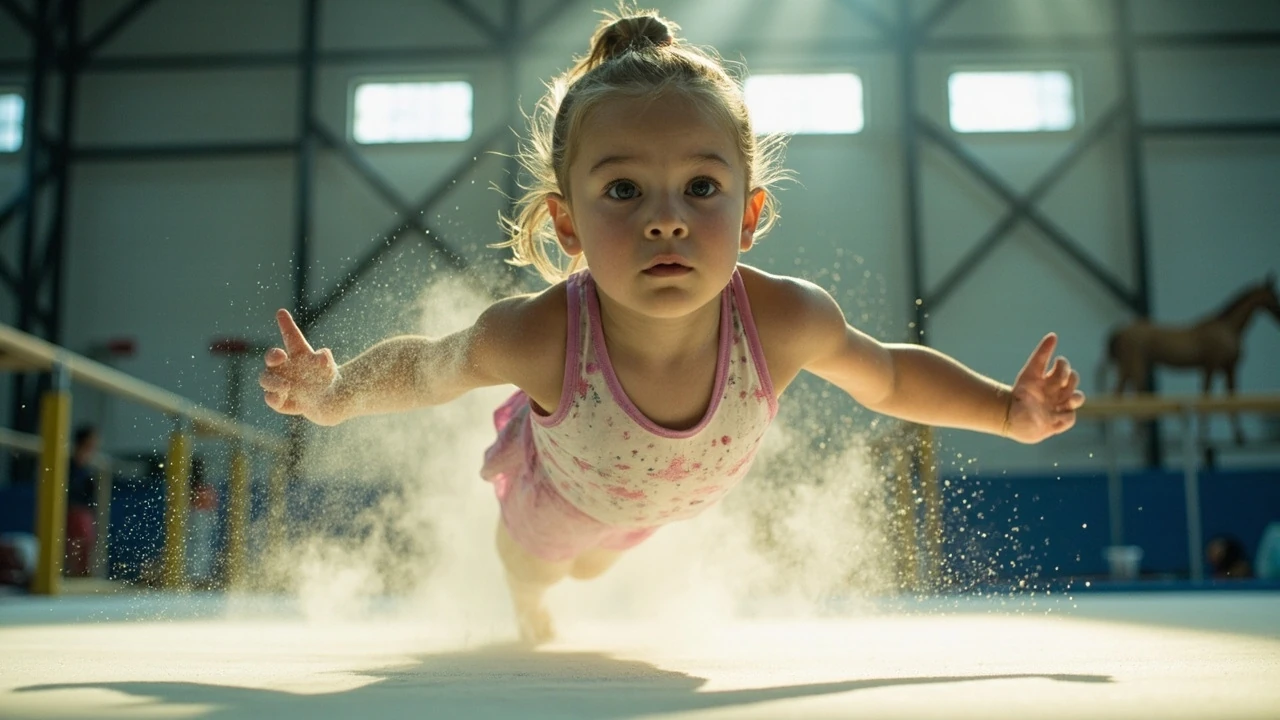
Some moments in sport stop a room. A floor routine lands so cleanly that the judges stop writing. A gymnast under-rotates a release, floats long enough to save it, and sticks a landing that should not have been possible. A basketball player rises above a packed paint, releases the ball a half-second later than every defender expects, and the net barely moves. People call these moments epic sports moments, and then they usually move on without asking what made them.
Epic results are not accidents. They are the visible surface of a long list of unglamorous habits, drills, recoveries, and decisions. The same logic that lets a gymnast rewrite a routine in the last two seconds of competition also lets a striker curl a free kick into the top corner or a hockey defenseman break up a two-on-one. This article looks at what actually goes into those moments, and how coaches, parents, and athletes can build the conditions that make them more likely.
What epic sports really means in everyday training
The phrase epic sports gets used as a marketing label, a video-game genre, and a casual compliment for a great highlight. In a training context, it is more useful. Epic moments share a few traits that any coach can recognise:
- They look difficult, but they look clean. There is no panic in the body language.
- The athlete has more time than the situation seems to allow, even though the clock is running out.
- The result is repeatable under pressure, not a one-off fluke.
- The decision to attempt the move was made earlier, usually in practice, not in the moment.
That last point is the one that matters most. By the time an athlete is competing, the room for creative thinking is small. The body, the timing, and the breathing pattern have already been rehearsed. The “epic” feeling comes from watching well-rehearsed skills show up exactly when the scoreboard needs them.
The four building blocks behind most epic sports moments
If you break a highlight down, almost every epic sports clip is built from the same four blocks. Coaches who want to produce these moments deliberately usually focus their week around them.
| Building block | What it looks like in practice | How it shows up in competition |
|---|---|---|
| Body control | Slow isolations, holds, balance work, and landings done at half speed before full speed. | Clean lines, stuck landings, and the ability to absorb contact without losing form. |
| Rhythm and tempo | Metronome drills, music-timed runs, and counting out loud during skills. | Skills that arrive on time, with the right amount of air time and connection to the next move. |
| Decision-making | Small-sided games, scenario drills, and “last 15 seconds” simulations in training. | Calm choices under fatigue, including the choice to simplify a routine when needed. |
| Recovery | Planned sleep, easy days, mobility, and clear injury-management rules. | Sharper skills at the end of long meets, fewer late-competition mistakes. |
None of these blocks is glamorous on its own. That is the trick. A floor routine that ends with a double pike is not the product of one big skill. It is the product of thousands of small decisions about how to spend a Tuesday afternoon, and whether to skip the extra mobility work because the athlete “feels fine”.
Why gymnastics is a useful lab for epic sports moments
Gymnastics is one of the clearest training grounds for the habits that create epic sports moments. The sport punishes sloppy mechanics immediately. If a shoulder angle is off by five degrees on a release move, the skill fails. If a landing is not absorbed through the hips, the knees pay for it. There is nowhere to hide.
That is exactly why skills developed in gymnastics transfer so well to other sports. Athletes who have spent years on a beam or a pommel horse tend to arrive in team sports with better spatial awareness, cleaner landing mechanics, and a higher tolerance for inversion and rotation than peers who have not. The article on how gymnastics skills transfer to football, basketball, and hockey walks through several of those transfer points in detail, and it lines up with what coaches see on the field.
For athletes, the practical lesson is that the qualities people call “epic” in sport are usually built in places that look nothing like the highlight. A held planche, a slow handstand on the floor, and a controlled landing on a tumble track do not look like a viral clip. They are the reason the viral clip happens.
Training habits that quietly produce epic results
Across gymnastics, team sports, and individual disciplines, the same habits keep showing up in athletes who deliver when it counts. None of them are magic. All of them are repeatable.
Slow reps before fast reps
Coaches at strong clubs usually build sessions around a slow-to-fast ladder. The first set of a new skill is done at half speed, often with a spot or a drill version. Only when the body shape is clean does the athlete add speed. This is the opposite of how most recreational athletes train, which is to attempt the full skill until something goes wrong, and then ask why.
Quality rep counts instead of total rep counts
A tired athlete who can no longer hold a straight line is learning a bad habit with every extra rep. Tracking “good reps” instead of total reps is a simple way to keep the standard high. A session with 18 clean handstand holds beats a session with 50 sloppy ones, every time.
Drills that match the exact problem
Generic fitness rarely produces epic sports moments. Targeted drills do. If a gymnast is missing handstand connections on floor, the answer is not more push-ups. It is a queue of handstand-to-skill transitions done on a line, repeated until the timing becomes automatic. Specific problems deserve specific drills.
Recovery treated as part of the program
Sleep, food, hydration, and easy days are where adaptation actually happens. Athletes who treat recovery as a side note often look sharp in October and broken by March. Athletes who plan it in advance usually peak when the calendar matters.
How competition preparation shapes the moment
Big moments feel epic partly because they are rare. Athletes do not compete every day, and the body does not get unlimited chances to deliver a peak routine. The way a meet is approached matters as much as the training that led to it.
A practical meet-preparation checklist is useful here. The article on how to prepare for a gymnastics meet walks through the last 72 hours before competition, from travel and warm-up planning to mental rehearsal. Most of the same steps apply, in spirit, to other sports: know the schedule, control the inputs you can control, and rehearse the pressure moments in practice so they are not new on the day.
Two habits separate good competition days from rough ones:
- Run-throughs the day before at competition intensity, not full-out effort. The goal is to feel the routine, not to fatigue the body.
- Pre-meet visualisation of two or three specific skills, including the routine after a mistake. Visualising the recovery is more useful than visualising a perfect run.
These habits do not guarantee a highlight. They do make it much more likely that, if the highlight arrives, the athlete can finish it.
Equipment choices that quietly raise the ceiling
Equipment rarely gets credit for epic sports moments, but it often sets the ceiling. A bar that feels dead, grips that slip, or a beam that has lost its spring all push the athlete toward conservative choices. The right setup, on the other hand, removes small worries and frees attention for the skill itself.
For gymnasts, that usually starts with grips. The piece on bar grips in gymnastics explains how to choose, break in, and maintain them so the connection to the bar feels reliable. The same principle applies in other sports: a hockey stick with the right flex, a football boot that fits the surface, or a basketball shoe that matches foot shape all do the same quiet work.
| Sport area | Small equipment decision | Effect on the moment |
|---|---|---|
| Gymnastics, uneven bars | Grip leather, dowel angle, and break-in method | More secure connection, fewer early releases, longer holds under fatigue. |
| Basketball | Shoe cushioning and ankle support match to foot type | Better landing mechanics after jumps and direction changes. |
| Football | Boot stud pattern matched to pitch surface | More stable plant foot for strikes and direction changes. |
| Hockey | Stick flex and blade pattern matched to position and strength | Cleaner releases, more accurate passing under pressure. |
None of this replaces skill. Equipment that fits simply stops being a problem, which is exactly what an athlete needs in a tight moment.
Mindset and the feeling of “epic” in competition
There is a psychological pattern behind most epic sports moments. The athlete is not thinking about how big the moment is. They are thinking about the next small task: the next hand placement, the next step, the next breath. Big-picture thinking tends to tighten the body and slow the reaction. Task-focused thinking tends to free it.
Three practices tend to help athletes reach that state under pressure:
- Cue words that are short and physical. “Tight core”, “soft knees”, and “long neck” work better than “be confident” or “hit this routine”.
- A reset routine after mistakes. A breath, a hand on the apparatus, and a clear next-step cue, rehearsed in training so it does not need to be invented on the spot.
- Process goals instead of outcome goals. “Land the first pass clean” is more controllable than “win the meet”, and it tends to produce the second as a side effect.
Coaches who want to develop this mindset usually start in low-stakes training environments, where athletes can practice resetting after a missed skill without the scoreboard involved. By the time a real moment arrives, the reset is muscle memory, not a new idea.
How different sports borrow the same idea
Although the visuals look very different, the structure of an epic sports moment is similar across disciplines. A quick comparison helps show what is actually the same.
| Sport | What an “epic” moment looks like | Underlying habit |
|---|---|---|
| Gymnastics, floor or beam | Stuck landing after a high-difficulty tumbling pass | Slow-air awareness, hip engagement, and trained landing mechanics. |
| Basketball | Late-clock three-pointer after a cross-court read | Repetition of contested shots in practice and pre-decided reads on screens. |
| Football | Long-range finish after a quick combination | First-touch quality and shooting technique under fatigue. |
| Hockey | Breakaway goal after a stretch pass | Stick-handling speed, head up, and a planned release option. |
Notice that the underlying habits are not always the obvious ones. A basketball player who hits a deep three is usually relying on shooting mechanics that were built in empty gyms, not on a clutch gene. A hockey player who scores on a breakaway is usually relying on a release choice that was decided in a Monday practice, not in the moment of the breakaway.
What parents and coaches can do this week
Most of the value in chasing epic sports moments is not in the highlight itself. It is in the daily environment that makes the highlight more likely. A few practical moves that can be made this week:
- Audit one training session for quality reps versus total reps. Adjust the count so quality is the goal.
- Add a short “pressure minute” at the end of a regular session, where the athlete has to perform one skill under a simple constraint, like a 30-second clock.
- Check that the equipment being used actually fits. Replace worn grips, ill-fitting shoes, or tired warm-up kit before they become a reason to play safe.
- Plan a real recovery day in the coming week, not just a “light session” that is secretly still hard.
- Pick one skill to rehearse in slow motion, with a clear standard, before allowing it to be attempted at full speed.
None of these will produce a highlight on its own. Together, they create the kind of training week that eventually does.
Where to learn more about the gymnastics side of epic sports
For readers who want to dig into the gymnastics-specific habits behind the broader idea of epic sports, two starting points on this site are useful. The piece on why gymnastics is the foundation of every sport covers the transfer from gymnastic training into other sports, and the article on beam drills that build confidence and clean lines on the artistic beam shows what slow, specific work looks like in practice.
Both pages connect to the same idea at the heart of this article: the moments that look effortless on camera are usually the product of patient, specific, unglamorous work. That work is open to any athlete, at any level, who is willing to build it. The epic part is simply the moment the world happens to be watching.
If you are coaching, training, or supporting an athlete, a useful final check is to ask what the last two training weeks actually contained. Were they full of slow reps, recovery, and specific drills, or were they full of total-rep counts and tired bodies? The answer usually predicts the kind of moment the next competition will produce, epic or otherwise.
Frequently asked questions
What does “epic sports” actually mean in training?
In a training context, epic sports refers to performances that combine difficulty with clean execution and good decision-making under pressure. The phrase is useful when it points at habits that produce those performances, not when it is used as a label for highlight clips alone.
Can any athlete create epic sports moments, or is it only for elite levels?
The habits behind epic sports moments are available at any level. Slow reps, recovery, equipment that fits, and rehearsed decisions are not limited to elite athletes. Higher-level athletes simply have more time to build them, which is why their highlights often look smoother.
How long does it take to develop the habits behind epic sports moments?
Meaningful change usually shows up within a single training block of four to eight weeks, if the habits are consistent. Bigger changes, like a stuck double pike or a reliable breakaway release, take longer and depend on overall training history, not just one focused block.
Is gymnastics really a good foundation for other sports?
Yes, especially for sports that involve rotation, landing, and body control. The mechanics built on a beam, floor, or vault transfer well to football, basketball, and hockey, as the site’s piece on how gymnastics skills transfer to football, basketball, and hockey explains in more detail.
What role does equipment play in producing epic sports moments?
Equipment rarely creates the moment, but it can quietly limit it. Gear that fits and is well maintained removes small worries and lets the athlete focus on the skill, which is usually the difference between a cautious performance and a confident one.
How can parents support epic sports development without overcoaching?
Parents can support it by protecting sleep, food, and recovery time, and by asking process-focused questions after training rather than result-focused ones. Questions like “What did you work on today?” tend to be more useful than “Did you win?”
Are there simple drills that help build the habits behind epic sports?
Yes. Slow-motion skill reps, balance holds, controlled landings, and short pressure-minute drills at the end of a session are all simple, low-cost ways to build the underlying habits. The key is consistency over weeks, not intensity in a single session.
How do coaches decide which habits to focus on first?
Most coaches start with body control and rhythm, because they are the foundation for everything else. Decision-making drills become more important as the athlete gets closer to peak competition, when the scoreboard actually matters.
What is the most common mistake when chasing epic sports moments?
The most common mistake is chasing difficulty before control. Adding harder skills on top of unstable mechanics produces fewer highlights and more injuries. Building control first almost always produces more visible progress in the long run.
How do I know if a training environment is set up for epic sports development?
Look for clear standards, slow-to-fast progressions, planned recovery, and equipment that is well maintained. If the gym or club checks those boxes, the conditions for epic moments are usually already in place.