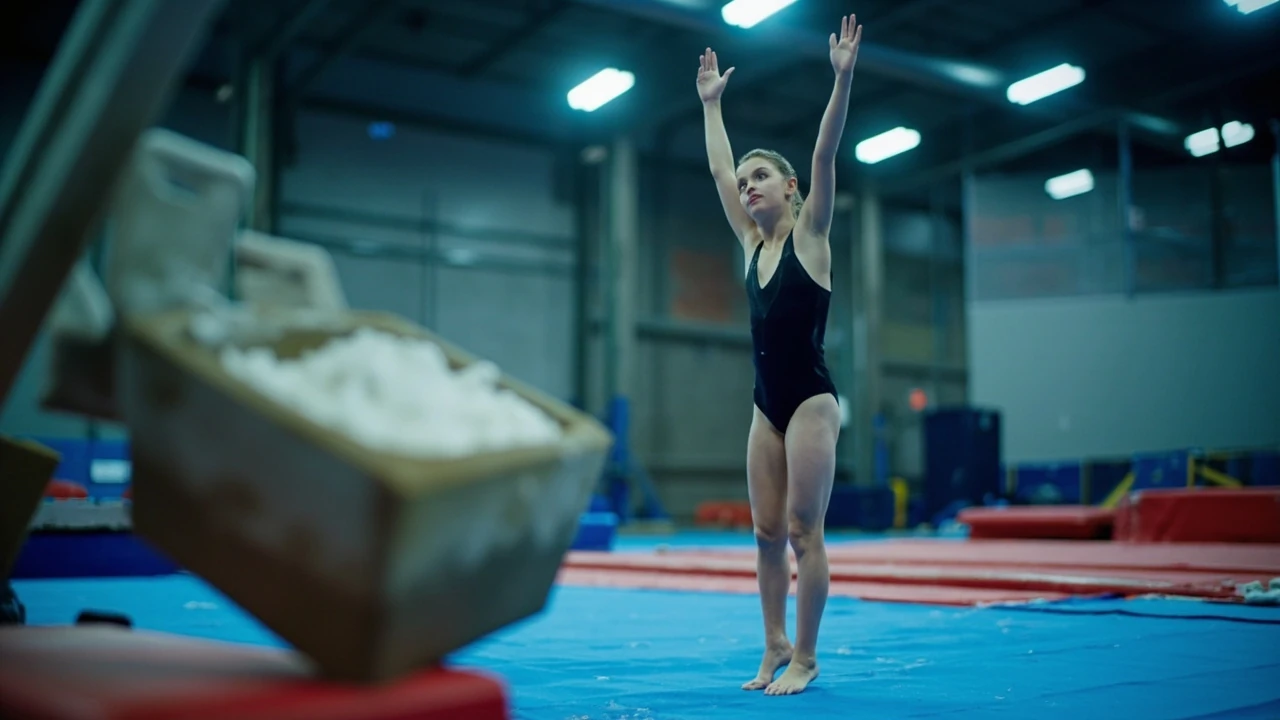
A gymnast tries the same round-off back handspring for the twentieth time in a session. Half of those attempts look nearly identical. The other half are where the skill actually gets learned, because the body finally hits the timing, the block, the spatial awareness, and the breath it was missing. That gap between attempts is where rep fitness lives, and it is the single biggest variable that separates a gymnast who progresses from one who plateaus.
Rep fitness is a shorthand coaches use for the ability to perform a large number of clean, controlled repetitions of a movement pattern without losing quality, form, or intent. It is not the same as muscular endurance, although the two overlap. It is not the same as volume training, which only counts sets and reps as numbers on a page. Rep fitness is the quality side of repetition: can a gymnast keep doing the skill the right way when the body is tired, the clock is ticking, and the pressure of a meet is two weeks away.
What rep fitness really means in gymnastics
Coaches borrow the idea of repetition from strength training, where a “rep” is one complete movement of an exercise. In gymnastics, the term stretches further. A rep can be a single handstand hold against the wall, a full bar set, a cast to handstand on the uneven bars, a kip, a leap series across the floor, or a dismount attempt on the beam. The unifying question is always the same: can the athlete repeat the movement with the same technical intent each time, and can they keep doing it under fatigue?
Three ideas sit inside that definition.
- Technical fidelity. Each repetition should match the model the coach has set: a tight hollow body, a clean handstand line, a properly blocked round-off. A rep that looks sloppy is practice of a sloppy skill.
- Repeatability. One perfect rep proves the body can do the skill. Ten in a row, with brief rest, prove the body can do the skill when it is mildly tired. That is the level required for meet routines.
- Intent. Repetition with a purpose is different from empty volume. The athlete must know what they are checking on every rep: the shoulder angle, the toe point, the timing of the breath.
This is why coaches write “quality reps” in their daily plans. They are naming the thing that a counter cannot measure, and the thing that decides whether a skill shows up under pressure.
Why repetition matters more in gymnastics than in most sports
Gymnastics routines are short, technical, and unforgiving. A four-event all-around at level 8 might last roughly 90 seconds of actual performance, with multiple skills on each event. There is no room for a slow warm-up or a tentative first attempt. The athlete has to be able to reproduce each skill, in order, in combination, and at full speed, every single time. That requirement is built almost entirely through repetition.
Compare that to a team sport, where an athlete can have a quiet few minutes and still contribute. A gymnast does not get a quiet moment between the leap series and the tumbling pass on the floor. Either the round-off back handspring layout is automatic, or the routine falls apart in front of a judge. Repetition is what turns the layout into something automatic.
There is also a neurological reason. Motor learning research has shown for decades that the brain encodes a movement pattern through consistent, repeated execution with feedback. A single correct attempt leaves a faint trace. Hundreds of correct attempts build a stable motor program. When a gymnast is nervous at a meet, the brain does not have to search for the pattern. It just runs it. That stability is rep fitness.
The training science behind rep fitness
Rep fitness is not a marketing term. It sits on a foundation of motor learning and strength-endurance principles that have been studied in both gymnastics and adjacent sports. A few specific mechanisms matter most.
Motor pattern consolidation
When a gymnast performs a skill many times with the same technical cues, the movement pattern is gradually transferred from slow, conscious control to faster, more automatic control in the cerebellum and basal ganglia. The athlete stops having to “think” about every joint angle. That automaticity is what allows them to do a skill while watching a teammate, listening to music, or managing pre-routine nerves.
Repetition is the only way to drive that shift. Watching a video, talking through cues, and mental imagery all help, but the brain still needs the actual physical repetitions to update the motor program.
Local muscular endurance
Rep fitness also depends on the ability of the working muscles to keep producing force across many cycles. A cast to handstand on bars is not a one-rep max effort. It is a sustained pulling and shaping effort that has to be repeated across a routine. The shoulder girdle, core, and grip muscles all have to be conditioned for that demand. Repetition with sub-maximal loads trains exactly that capacity, which is why high-volume bar sets and beam series are so common in the middle of a training cycle.
Movement economy
Skilled gymnasts use less energy per rep than beginners because their coordination is more efficient. Repetition teaches the body to recruit only the muscles that are needed, in the right order, and to relax the muscles that are not. Over time, a five-rep set that used to leave a gymnast breathing hard starts to feel almost rhythmic. That economy is a measurable kind of fitness, even though it does not show up on a heart rate chart in the way people expect.
| Concept | What is repeated | Main goal | What fails when it is missing |
|---|---|---|---|
| Rep fitness | A full gymnastics skill or sub-skill with technical intent | Automatic, clean execution under fatigue | Skill breaks down in the second half of a routine or under meet pressure |
| Muscular endurance | A strength exercise at sub-maximal load | Ability to sustain force output over many reps | Loss of power, slow-down, and form break at the end of a set |
| Volume training | Any work, counted as sets and reps | Total workload over a session or week | Overuse injuries, staleness, and burnout |
| Skill drilling | Progressive parts of a skill | Build a new skill through shaping and progression | Skill never gets linked together into a clean whole |
How coaches actually program rep fitness
Most good gymnastics plans build rep fitness in three layers. Coaches do not just assign a generic number of reps and walk away. They decide which layer a rep belongs to, what the rest interval is, and what the cue is for that day.
Layer 1: shaping reps at low fatigue
At the start of a session, when the athlete is fresh, the focus is on doing small, correct reps. A handstand against the wall for 30 seconds, a single hollow body rock, a set of five tap swings on bars with a precise hollow shape. The number of reps is small, the rest is generous, and the coach is watching for technical detail. This layer is where new motor patterns get installed.
Layer 2: skill reps under mild fatigue
After a warm-up and conditioning, the athlete moves into skill reps. These are the real reps: round-off back handsprings on the floor, kips on bars, leap series on beam, full turns on the floor. The goal is to keep the same technical intent as in layer 1, but the body is now warm, slightly fatigued, and the athlete is being asked to chain more skills together. Rest is shorter. Coaching feedback is sharper. This is where the skill starts to feel automatic.
Layer 3: routine and meet-pace reps
Near the end of a training cycle, the athlete practices full routines, or chunks of routines, at meet pace. The number of reps is low, but each one is a high-pressure, high-context attempt. The goal is to make the routine feel normal, so that the heart rate spikes at a meet do not change the output. This layer is also where mental rep fitness gets built.
How many reps are enough
There is no single answer, and any coach who quotes a magic number is oversimplifying. The right number of reps depends on the skill, the level, the training age of the athlete, and where the athlete sits in the training cycle. That said, a few rough patterns are useful.
| Skill type | Daily target reps (beginner, levels 3-5) | Daily target reps (intermediate, levels 6-8) | Notes |
|---|---|---|---|
| Handstand holds or kick-ups against the wall | 10-15 holds of 20-30 seconds | 5-10 holds of 30-45 seconds | Quality matters more than total time. Stop if the line breaks. |
| Round-off back handspring on floor or tumbletrak | 15-20 reps | 20-30 reps | Block reps in small sets, not all at once. |
| Kip on bars | 10-15 reps with spot if needed | 15-25 clean reps | Rest between sets to keep hip drive sharp. |
| Cast to handstand on bars | 8-12 reps with light assistance | 10-15 reps to 45 degrees or higher | Stop when the angle starts to drop. |
| Leap series on beam or floor | 5-8 full series | 8-12 full series | Use the same leap order as the routine. |
| Full routines on any event | 1-2 full routines per event per session | 2-3 full routines per event per session | Reserve for the second half of the training cycle. |
Notice that the highest skill reps are the lowest in number. A full floor routine is the most “expensive” rep in the entire week. Coaches protect it. They do not waste it on days when the athlete is tired, distracted, or carrying an injury.
Common mistakes that quietly destroy rep fitness
Coaches and parents often see a gymnast do a lot of work in a session and assume that work equals rep fitness. It does not, if the work is structured in the wrong way. A few patterns show up again and again.
Doing the easy version on repeat
If a gymnast is asked to do 20 round-off back handsprings but their block is consistently low and their arms are bent, they are not building rep fitness. They are building a sloppy rep. A better plan is 6-8 high-quality reps with detailed feedback, a longer rest, and a return to the rep. The number on the page will be smaller, but the skill will improve.
Skipping rest to “be tough”
Gymnastics culture sometimes rewards athletes who power through fatigue without asking for rest. That habit is harmful to rep fitness. Without enough rest, the nervous system cannot reset, the technical cues start to drift, and the athlete is training the wrong pattern. A short, well-timed rest is part of the rep, not a break from it.
Letting competition-style reps leak into early-cycle training
Saving meet-pace reps for the right phase of training is harder than it sounds. Parents see a child do a double back at the gym and assume that means they are ready to do double backs in a meet. Rep fitness is not just about owning a skill. It is about owning it in a routine, in a sequence, at meet pace, with the heart rate already high. Coaches manage this by keeping the early training cycle focused on layers 1 and 2, and by protecting layer 3 for when the body is actually ready.
Ignoring the boring reps
Handstand holds, hollow rocks, basic tap swings, and the same leap drilled for 15 minutes are exactly the reps that build the foundation for everything else. They are also the reps that get skipped when the athlete is tired, distracted, or focused on the next big skill. Strong rep fitness is built on the boring reps, not the exciting ones.
How to know if rep fitness is actually improving
Counting reps is the easy part. Measuring whether the quality of those reps is improving is harder. Coaches use a few practical signals.
- Consistency across a set. Can the athlete do the same skill at the same quality across a set of 8-10 reps? The first rep and the last rep should look close in form. If the last two reps are noticeably worse, the rep fitness is not where it needs to be.
- Performance on a tired day. A good test is a session after a hard conditioning day, or the second day of a training camp. If the athlete can still produce a clean set of skills, rep fitness is high. If the skills fall apart, there is a gap.
- Hit rate at practice meets. Internal practice meets are a real test. If the athlete hits 90 percent of skills in a low-pressure practice meet, but only 70 percent at a real meet, the missing piece is usually mental, but it is also often rep fitness. The skill is not yet automatic enough to survive real adrenaline.
- Recovery between reps. A good measure of rep fitness is heart rate or breathing. If the athlete is gasping after two tumbling passes, the conditioning is not where it needs to be to support a full routine.
Rep fitness at different ages and levels
Rep fitness has to be matched to the athlete, not just the skill. A 6-year-old in a recreational program and a 16-year-old training for elite-level competition are doing fundamentally different things, even when they are doing “the same drill.”
| Stage | Typical age | Main goal of rep fitness | What to avoid |
|---|---|---|---|
| Recreational | 4-8 | Build a positive relationship with repetition; install basic shapes and lines | Long, high-pressure sets that turn into tears |
| Compulsory levels 3-5 | 6-11 | Lock in compulsory routines, build basic endurance | Too many reps of advanced skills that are not yet in the routine |
| Optional levels 6-8 | 9-14 | Build optional routines, develop meet-pace rep fitness | Skipping strength work because the athlete looks “strong enough” |
| Optional levels 9-10 | 12-16 | Refine difficulty, build consistency, manage fatigue | Over-repping high-difficulty skills at the cost of accuracy |
| Elite and pre-collegiate | 14 plus | Maintain automaticity under meet pressure, prevent overuse | Refusing to drop volume during injury recovery |
At every stage, the principle is the same: the rep is only useful if the athlete is doing it with intent and with enough rest to keep the form clean. The numbers change. The principle does not.
How parents can support rep fitness at home
Parents are not coaches, and the gym is the right place for the bulk of the work. That said, a few home habits make a real difference.
- Protect sleep. Sleep is when motor patterns consolidate. A gymnast who is doing 50 reps a day on low sleep is repping into a fog. The reps that build skill are the ones done after a good night of rest.
- Support nutrition. Repetition is energy-expensive. Snacks that combine protein and carbohydrates after a session help the body recover for the next session. A gymnast who is under-fueled will see rep fitness drop, even if the training hours are the same.
- Encourage rest days. Off days are part of the plan. They are not a sign of weakness. A parent who respects the rest day is helping rep fitness as much as a parent who drives to every training session.
- Resist the urge to coach from the sideline. The coach is the one counting the reps and watching the form. Parents who add cues from the bleachers usually confuse the athlete, which quietly damages the intent of every rep.
For more on how the right program structure supports this kind of growth, it is worth looking at how a well-run club builds the wider training environment. The practical side of choosing a gymnastics program is closely tied to how the program handles rep fitness, conditioning, and recovery across the year.
How rep fitness connects to other sports
Gymnastics is unusual in how much it depends on repetition, but it is not the only sport that does. The same idea shows up wherever a movement has to be produced under pressure, again and again. Pitchers build rep fitness for their fastball. Soccer players build it for a free kick. Swimmers build it for a 100-meter race. The principles transfer.
That is one of the reasons a gymnastics background is so useful for athletes who later switch sports. The motor learning, the body awareness, and the willingness to do the same drill over and over are habits that show up anywhere repetition matters. Several of the transfer paths are well documented, including how gymnastics skills move into football, basketball, and hockey at a competitive level.
Recovery is part of the rep
A rep does not end when the feet hit the floor. The next rep starts when the body has had time to reset, the heart rate has come down, the breath has returned, and the technical cue is back at the front of the mind. Coaches who plan rest intervals as carefully as they plan work intervals are protecting the integrity of every rep in the set.
For gymnasts, rest is not just sitting down. It is a quiet moment where the athlete runs through the cue in their head, watches a teammate, and gets ready to do the rep the way it should be done. That is the recovery that rep fitness actually needs.
A simple weekly plan for building rep fitness
The following outline is a sample of how a competitive optional-level gymnast might structure a week. It is a template, not a prescription. The exact numbers should be set with the coach.
- Day 1: Strength and shaping. Handstand holds, hollow body work, press handstand drills, and a small set of low-fatique skill reps. Aim for high quality at low volume.
- Day 2: Skill reps on floor and beam. Tumbling series, leap series, and beam connections in small sets with full feedback. Conditioning at the end.
- Day 3: Skill reps on bars and vault. Bar sets, cast to handstand drills, run-up vaulting with multiple reps. Conditioning at the end.
- Day 4: Active recovery or rest. Light shapes, flexibility, mobility work, or a full day off.
- Two full routines on each event, with rest between attempts. Focus on holding the cue from the first skill to the last.
- Day 6: Meet simulation. Half the day at routine pace, half the day in a mock meet with judges and a real warm-up window.
- Day 7: Rest. Sleep, food, and very little else.
Notice that the highest-pressure reps are clustered at the end of the week, after the body has had time to absorb the work. This is not accidental. The body needs to know what it is being asked to repeat before it can repeat it well.
What to do when rep fitness is not improving
Sometimes a gymnast does the work and the skill still does not get more consistent. A few things are worth checking before deciding that the athlete has hit a wall.
- Is the rest long enough? Fatigue is the most common reason for a stall. If the athlete is doing 20 reps in a row without enough rest, the last 10 are not training what the first 10 are training.
- Is the cue clear? A rep without a cue is a rep without intent. If the athlete cannot say what they are checking on each rep, the rep is doing less than it could.
- Is the skill too new? A skill that has not yet been shaped correctly will not improve by repetition. It will get a more consistent wrong answer. The athlete may need to step back to a progression.
- Is the athlete healthy? Stress fractures, growth plate irritation, and overuse injuries are common in gymnastics. A drop in rep fitness is often the first sign that something is off. Rest and a visit to a sports medicine professional are usually the right next step.
- Is the program well-structured? Rep fitness is the output of a long process. A program that jumps from skill to skill, that does not protect strength and conditioning work, or that does not give the athlete enough time on a single skill will produce inconsistent results no matter how hard the athlete works.
Understanding the broader program structure can help here. Parents who want to know what a well-designed program looks like in practice can compare notes with the patterns described in this practical guide to artistic gymnastics apparatus, which covers how each event is taught through progression and repetition.
Rep fitness as a long-term habit
The most useful thing rep fitness gives a gymnast is not a better round-off or a higher bar score. It is the habit of doing the work, day after day, with the same intent, even when the work is boring, even when the body is tired, even when the meet is far away. That habit is what carries an athlete through an eight-year competitive career. It is also the habit that shows up in every other part of life that depends on practice.
Coaches who build rep fitness well are not chasing numbers. They are building a kind of discipline that is hard to fake. Gymnasts who internalize it early tend to stay in the sport longer, perform better under pressure, and recover from mistakes faster. Parents who understand it tend to stop worrying about how many skills their child has and start noticing the quality of the skills their child can repeat.
For a wider view of how daily training choices feed into long-term athlete development, including how athletes and parents can plan around a meet cycle, the practical checklist for preparing for a gymnastics meet is a useful companion read.
Frequently asked questions
What is rep fitness in gymnastics?
Rep fitness is the ability to repeat a gymnastics skill with the same technical intent and quality across many attempts, including when the body is tired. It is the quality side of repetition, and it is the foundation of consistent meet performance.
How is rep fitness different from muscular endurance?
Muscular endurance is about how long a muscle can keep producing force. Rep fitness is about whether the whole skill stays technically correct across many reps. A gymnast can have good muscular endurance and still have poor rep fitness if the form breaks down in the second half of a set.
How many reps should a gymnast do per day?
It depends on the skill, the level, and where the athlete is in the training cycle. A typical optional-level gymnast might do 15-30 clean reps of a tumbling skill and 10-15 reps of a bar skill per day, plus a smaller number of full routine reps later in the week. The coach should set the exact number.
Does more repetition always mean better rep fitness?
No. Repetition only helps when the rep is done with the right intent and enough rest to keep the form clean. Too many sloppy reps, or reps done while exhausted, will not build the skill and can even make the form worse.
Can rep fitness be trained at home?
Some of the supporting work can. Handstand holds against a wall, hollow body rocks, flexibility, and core work can all be done at home with a clear program. Skill reps on equipment, however, need the gym and the coach, and parents should not try to run those sessions at home.
How long does it take to build rep fitness?
Motor learning research suggests that a new movement pattern takes weeks to months of consistent practice to become automatic. A young gymnast building a new skill might spend 8-16 weeks of regular training before the rep fitness for that skill is solid enough for a meet.
What is the difference between rep fitness and overtraining?
Rep fitness is the goal. Overtraining is what happens when the volume or intensity exceeds the body’s ability to recover. The signs of overtraining include a drop in performance, persistent fatigue, mood changes, and an increase in small injuries. If any of these show up, the volume should be reduced.
Why do gymnasts repeat the same skill so many times?
Because repetition is the only way to turn a new skill into an automatic one. The brain needs many clean attempts to encode the movement pattern, and the muscles need many clean attempts to handle the demand. A few reps of a skill teaches the body. Many reps of the skill make it part of the routine.
Does rep fitness carry over to other sports?
Yes. The habit of repeating a movement with intent is useful in any sport that has a technical element, including baseball, swimming, track and field, and martial arts. The specific skills do not transfer directly, but the underlying motor learning does.
How can I tell if my child’s rep fitness is actually improving?
Watch the last few reps of a hard set, not the first few. If the form is still clean at the end of a set when the body is tired, rep fitness is improving. If the form is falling apart by the end, more rest or fewer reps are usually the answer.