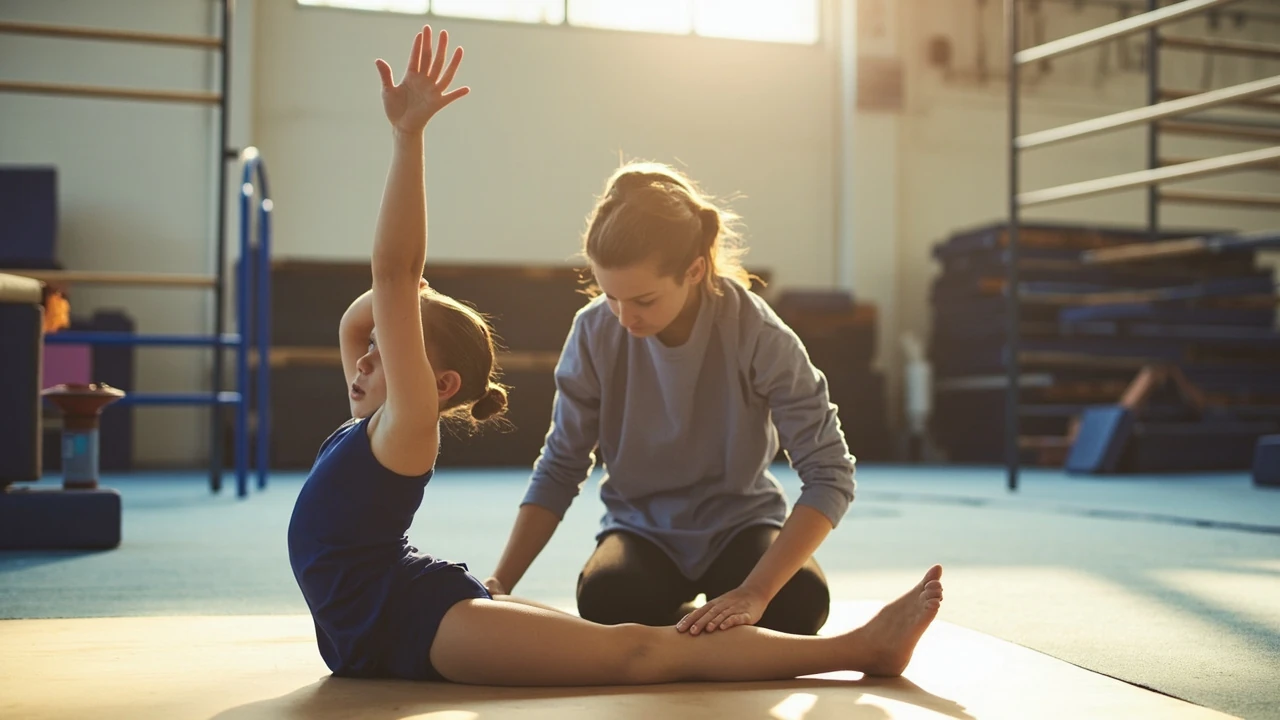
Lifetime fitness: how gymnastics builds habits that last
A parent signs a four-year-old up for a recreational gymnastics class in the fall and quietly wonders whether the time, the driving, and the leotard are worth it. The answer shows up a decade later, when that child still moves with confidence in a gym, picks up a new sport without fear, and does not have to be persuaded to exercise. This is the working definition of lifetime fitness: a base of physical literacy, strength, and habit that survives the move from childhood to adolescence, from adolescence to adulthood, and from competitive sport to whatever active life a person actually lives.
Gymnastics is one of the more reliable ways to build that base, not because it produces champions, but because it trains the body in a way that almost every other physical pursuit uses. Climbing, balancing, falling, jumping, landing, twisting, and breathing under pressure are not only gymnastics skills. They are the small components of how a human body stays capable across decades. The rest of this article looks at what lifetime fitness actually means, why gymnastics is unusually well suited to it, what the research and training literature actually say, and how parents, coaches, and adult returners can use that knowledge.
What lifetime fitness really means
Lifetime fitness is not a product you can buy or a single score on a treadmill. It is a set of overlapping capacities that hold up over a long stretch of years:
- Cardiorespiratory endurance, the ability of the heart, lungs, and blood vessels to keep working under load.
- Muscular strength and endurance, the ability to push, pull, carry, and hold position without immediate fatigue.
- Flexibility and joint range, the ability to move through normal patterns without pain or compensation.
- Balance and coordination, the ability to control the body in space, including during unexpected shifts.
- Body composition, the relative balance of lean mass and fat mass that supports the other capacities.
- Motor skill, the ability to learn and refine new movement patterns at any age.
Public health bodies describe this cluster as health-related fitness, and they usually keep the first five elements as the core, with skill tucked in as the gateway that lets the others stay useful. The physical fitness overview on Wikipedia describes the same five-pillar model and traces it back to early work in exercise science. The fifth pillar, motor skill, is where gymnastics does some of its quietest work.
Why gymnastics is a useful starting point
Most sports specialize early. A swimmer builds a particular kind of shoulder, a runner builds a particular kind of leg, a footballer builds a particular kind of repeat-sprint engine. Gymnastics is one of the few activities that trains every major capacity at once, in every session, at almost any age.
| Capacity | How a typical gymnastics session trains it |
|---|---|
| Strength | Bodyweight holds, supports, climbs, and landings on bars, rings, floor, and beam. |
| Endurance | Repeated circuits of skills, conditioning circuits, and longer floor routines. |
| Flexibility | Daily bridge, split, shoulder, and back extension work, plus skill-specific shaping. |
| Balance | Beam work, single-leg holds, air awareness drills, and controlled landings. |
| Coordination | Sequencing of rolls, handstands, twists, and transfers between apparatus. |
| Body composition | High movement density in short time windows, with non-restrictive seasonal training loads. |
That density is unusual. A 60 minute recreational class may include climbing, jumping, balancing, hanging, crawling, and short bursts of sprinting, all under the eyes of a coach who can correct form. Few other youth activities cover that much ground in that little time. For a parent thinking about how to give a child the broadest possible base, gymnastics is an efficient choice, which is one reason it is often described as a foundation sport. The article on why gymnastics is the foundation of every sport covers the same idea in more detail.
What the training and physical literacy research actually says
Two bodies of evidence matter most for lifetime fitness through gymnastics: the physical literacy literature, and the long-term athlete development frameworks that grew out of sport science in Canada, the United Kingdom, and Australia.
Physical literacy is usually defined as the motivation, confidence, physical competence, knowledge, and understanding that keep a person active for life. A review by Sport Australia describes it as a capability that needs to be built in childhood, but that continues to develop whenever movement is practiced with intent. Gymnastics fits the model unusually well because early sessions focus on competence and confidence rather than on winning.
Long-term athlete development models, often shortened to LTAD, were popularized by the work of Istvan Balyi and Richard Way. Their central claim is straightforward: training should match the stage a person is in, and rushing specialization tends to undercut adult performance and adult participation. The most-cited version of the framework describes stages from Active Start through Learn to Train, Train to Train, Train to Compete, and Learn to Train for Life, with the final stage explicitly aimed at keeping people engaged in physical activity well into adulthood.
For parents, the practical translation is simple. Children who get a wide movement base before puberty are more likely to enjoy sport later, more likely to avoid serious overuse injury, and more likely to be the adult who still exercises without a coach. Gymnastics, used as a sampling activity rather than as a one-way ticket, fits that model unusually well.
Building the habit layer, not just the skill layer
Most articles about gymnastics focus on skills: which drills build a cleaner handstand, which drills tighten a beam series. The lifetime fitness angle is different. It cares just as much about the habit layer, the routines, expectations, and emotional associations that keep a person coming back to movement for decades.
| Habit layer | What it looks like in a gymnastics setting | Why it carries into adulthood |
|---|---|---|
| Scheduled practice | Weekly classes with the same time and place. | Establishes a fixed slot in a busy week, so exercise does not depend on motivation. |
| Goal setting | Working a skill over weeks, not minutes. | Builds tolerance for slow progress, a skill that helps in every later sport. |
| Recovery rituals | Stretching, foam rolling, hydration, and sleep routines. | Encodes recovery as part of training, not as something extra. |
| Coach relationship | Trust in a single adult who tracks progress. | Makes it normal to seek feedback and to follow a program, instead of improvising. |
| Group identity | Team warm-ups, group stretching, shared meets. | Provides social reinforcement that survives school changes and relocations. |
These habits are easy to underestimate. They are also the reason some adult returners to sport manage to stick with a program and others quietly drop out after a month. Gymnastics tends to build them in childhood precisely because the training is structured, repetitive, and supervised.
What changes between childhood, adolescence, and adulthood
One of the more common mistakes in fitness planning is to copy a childhood program onto an adult body. Lifetime fitness needs a continuous program that adapts, not a single recipe repeated for decades.
Childhood (roughly 4 to 11). The focus is exploration and skill sampling. Sessions should be fun, varied, and broad. Strength is built through bodyweight play, not load. Flexibility is protected, not pushed to extremes. The article on choosing a gymnastics program walks through how to evaluate whether a club is actually doing this work.
Adolescence (roughly 12 to 18). Strength work can include external load, mobility work shifts toward maintenance of range, and conditioning becomes more important as growth spurts change leverage. Many athletes also sample other sports. The transfer of gymnastics skills into football, basketball, and hockey is real and well documented in coaching circles, and is explored in the piece on how gymnastics skills transfer to other sports.
Adulthood (18 and beyond). Most adults do not need to learn a double back. They need to maintain strength, joint health, balance, and the willingness to keep training. Many adult gymnasts exist in community programs, CrossFit-style affiliates, and adult recreation leagues, where the apparatus work is simpler but the habit structure is the same.
The equipment angle: apparatus, grips, and progressions
A common question is whether gymnastics equipment is a barrier for adult returners or for parents setting up a home practice. The honest answer is that most of the foundational work needs very little.
- Floor work, including rolls, handstands against a wall, and core circuits, needs about two meters of clear space and a thin mat.
- Low bar and rings work, used carefully, can be done on a basic doorway pull-up bar for adults or a low single bar in a kids’ club for children.
- Stretching, mobility, and handstand shaping need a floor, a wall, and a few minutes of quiet.
For gymnasts who progress onto actual bar work, the choice and care of bar grips in gymnastics is one of those small habits that separates a sustainable practice from a painful one. Grips, hand care, and dowel sizing are unglamorous, but they are the kind of detail that lets a person keep training into their thirties and forties.
What the science does and does not yet say
It is worth being honest about the limits of the evidence. Most of the claims about gymnastics as a foundation sport come from coach experience, athlete development models, and smaller controlled studies. There is good evidence that:
- Childhood movement competence predicts adult physical activity levels.
- Multi-sport sampling before puberty reduces overuse injury risk in single-sport adolescents.
- Balance and proprioceptive training reduce fall risk in older adults, and gymnastics-style balance work is one of the more efficient ways to deliver that stimulus.
There is weaker evidence on the long-term protective effect of any one sport, including gymnastics, on adult health outcomes. The honest framing is that gymnastics is a strong candidate for building a foundation, not a guarantee. The decision support pieces in this site, including the practical guide to artistic gymnastics apparatus, are written with that same careful tone.
A practical framework for parents and adult returners
Translating all of this into a working plan is not complicated, but it does require resisting the urge to copy a competitive program. The framework below works for both a seven-year-old starting out and a forty-year-old returning to the gym.
- Audit the five capacities. Test, honestly, where strength, endurance, flexibility, balance, and coordination currently sit. Use simple measures like a single-leg hold, a wall sit, a sit-and-reach, a one-mile walk, and a short balance sequence.
- Pick a primary and a secondary capacity to focus on for the next eight to twelve weeks. Trying to fix everything at once usually means fixing nothing.
- Build two to three sessions per week that train the chosen capacity through gymnastics-style work. This might be a handstand and core session plus a conditioning circuit, not a full apparatus program.
- Schedule one recovery session per week. Stretching, mobility, and light cardio. Treat it as non-negotiable.
- Re-test every twelve weeks. Re-audit the five capacities. Adjust focus. Keep the habit slot in the calendar stable even if the content changes.
For parents, the same framework maps onto a club setting. Choose a program that audits, focuses, varies, recovers, and re-tests, rather than one that drills the same routine for competition purposes. The piece on how gymnastics scoring works is worth reading if the child eventually wants to compete, because the scoring system itself rewards broad skill development rather than narrow specialization.
Common mistakes that quietly sabotage lifetime fitness
Most of the failure modes in this space are not dramatic. They are the small repeated errors that compound over years.
| Mistake | Why it is a problem | What to do instead |
|---|---|---|
| Specializing before puberty | Raises overuse injury risk and lowers adult participation rates. | Sample multiple sports until the growth spurt is well underway. |
| Skipping recovery sessions | Recovery is where adaptation actually happens. | Treat stretching and sleep as part of the program, not as extras. |
| Copying a competitive program on a recreational body | Produces more soreness than adaptation in adult returners. | Drop volume, keep variety, prioritize technique over load. |
| Ignoring balance and mobility | Leads to falls and joint pain in middle age. | Include a balance drill in every session, even a 5 minute one. |
| Letting the habit slot drift | Makes exercise optional, and optional exercise usually disappears. | Keep the same time and place each week, even if the content changes. |
The drill resources on this site, including beam drills for confidence and clean lines, are useful for variety even if the reader is not a competitive gymnast. The same shaping and control work transfers onto a single rail, a curb, or a low beam at home.
Special cases: returners, older adults, and former gymnasts
Three groups deserve a separate mention, because the standard plan does not always apply.
Adult returners after a long break. The temptation is to do too much, too fast, and the result is usually a shoulder or lower back that forces another break. The better pattern is a four to six week return phase that focuses on mobility, bodyweight strength, and balance, before any apparatus work.
Older adults, including those who never did gymnastics. The fall-prevention evidence is strong enough that balance and proprioceptive work, even very simple versions, should be treated as a core part of any adult program. The good news is that the exercises are short, low cost, and can be done at home.
Former competitive gymnasts. The biggest lifetime fitness risk is not loss of skill, it is loss of the habit structure. A former competitive gymnast who stops training entirely is more likely to drift away from movement entirely. A weekly adult gymnastics class, a coached strength session, or even a personal training slot is usually enough to keep the habit alive.
How this fits into a broader active life
Lifetime fitness is not the same as lifelong sport. Most people will not stay in one activity for sixty years. What they can do is stay in movement. Gymnastics, used as a foundation and then as a habit anchor, is one of the cleaner ways to make that work.
For a parent reading this, the practical decision is whether the local gymnastics program, used twice a week for a few years, will leave a child with a body that enjoys movement in 2036, 2046, and beyond. The evidence, while not perfectly clean, points in that direction. For an adult reader, the question is the same, only with a different starting point. Either way, the answer is the same: build the habit, protect the recovery, and let the skills accumulate.
Frequently asked questions
What is lifetime fitness in simple terms?
Lifetime fitness is the combination of strength, endurance, flexibility, balance, coordination, and habit that lets a person stay active and capable across decades, not just in one training phase.
Is gymnastics a good way to build lifetime fitness?
Yes, particularly for children and adolescents. Gymnastics trains multiple capacities at once, builds a wide movement base, and creates the structured habit layer that tends to carry into adult training.
At what age should a child start gymnastics for lifetime fitness?
Most recreational programs accept children from age four or five. Earlier is not better, and the focus should be on fun exploration rather than on specific skills.
Can adults build lifetime fitness through gymnastics?
Yes. Adult gymnastics classes, bodyweight strength work, mobility, and balance drills form a solid base. Adults usually need to adjust volume and intensity, not abandon the idea.
How is lifetime fitness different from general fitness?
General fitness usually refers to current capacity. Lifetime fitness adds the time dimension: it asks whether the habits, skills, and physical base will still be there in twenty or forty years.
Does gymnastics help with other sports later in life?
It can. Balance, body awareness, strength, and the willingness to learn new movement patterns all transfer into football, basketball, hockey, climbing, martial arts, and most other sports.
How often should someone train for lifetime fitness?
Two to four sessions per week is a sustainable range for most people, with one or two of those sessions focused on recovery. The exact number matters less than the consistency over months and years.
What is the biggest lifetime fitness mistake?
Stopping. The single largest risk factor for adult inactivity is not poor programming, it is the slow drift out of a regular habit. Keeping a fixed weekly slot, even if the content changes, is the strongest protective factor.
Do former gymnasts stay fit for life?
Many do, especially if they keep some form of structured training. The risk for former competitive gymnasts is that the loss of the competition habit leads to a loss of the training habit, which then leads to a drift away from movement.
What role does balance training play in lifetime fitness?
A large one. Balance and proprioceptive work is one of the few areas where short, simple training has a clear protective effect on fall risk in older age, and gymnastics-style drills are a particularly efficient way to deliver that stimulus.