How to choose a gymnastics mat for home practice
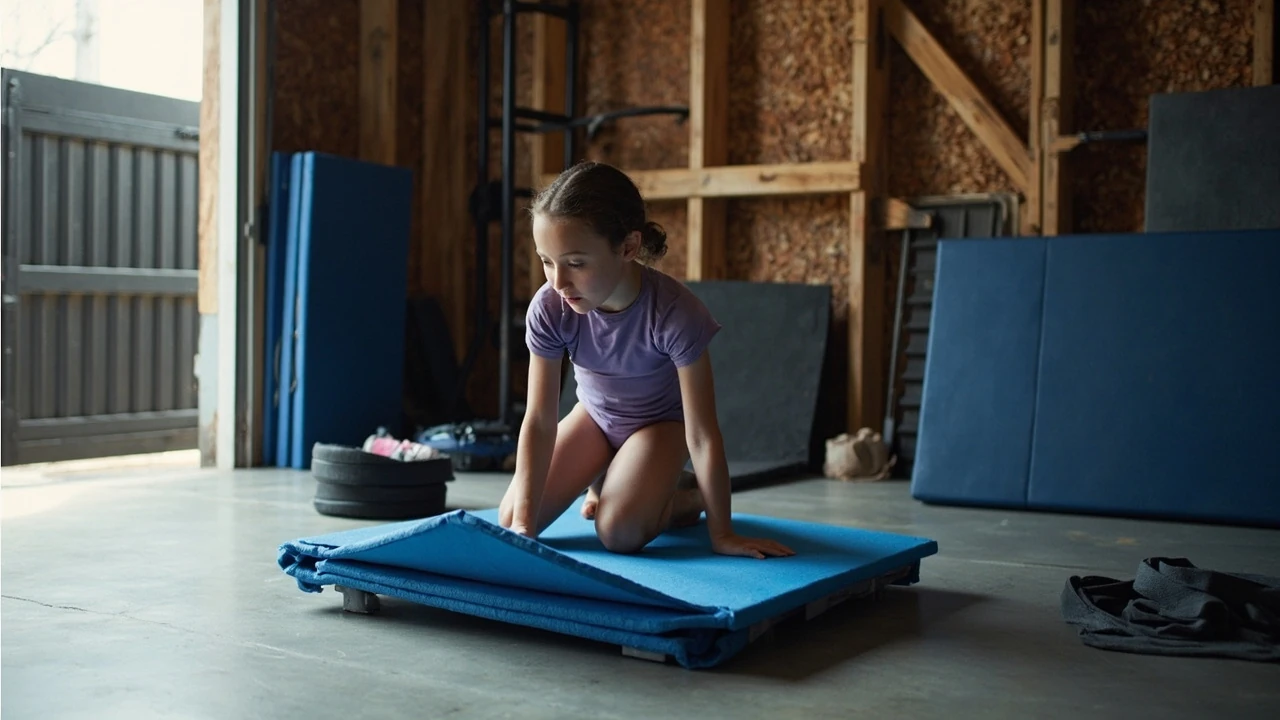
A parent stands in the doorway of a converted garage, three rolled mats leaning against the wall, a folding incline tucked behind the lawn mower, and a cart full of gymnastics terms: panel mat, landing mat, folding incline, 8-pound cross-link foam, 1.5-inch density, closed-cell vs open-cell. The goal is simple enough to say out loud and surprisingly hard to act on: figure out how to choose a gymnastics mat for home practice without buying three wrong ones first. The decision is mostly about matching the surface to the skills being trained, the floor it sits on, and the room it has to live in, not about finding a single best mat for everything.
Most home setups need two distinct mats that serve different jobs, not one expensive mat that tries to do both. A thin tumbling surface for cartwheels, handstands, and bridge work is a different product from a thick landing mat for back handsprings, drop drills, and jump training. Treating the choice as a single purchase is the most common mistake parents and athletes make, and it usually ends with a mat that is too soft for skill development or too firm to absorb impact.
Start with the skills, not the mat
Before looking at brands, foam densities, or price tiers, write down the actual skills the mat will be used for. The list will do most of the decision-making work. A gymnast who is doing only handstands, bridges, and split work on a hard floor needs a thinner, firmer surface than a gymnast who is practicing back handsprings or drop landings, even if both lists look like “home gymnastics practice” from the outside.
Useful skill groupings for mat selection:
- Static and flexibility work: bridges, splits, handstands against a wall, pancake stretches, walkovers with a spot.
- Floor skills on a hard surface: cartwheels, round-offs, handstand drills, forward rolls, jump drills, leap practice.
- Backward and aerial skills: back handsprings, back tucks, aerials, back walkovers, dive rolls, drop drills from low surfaces.
- Apparatus-style training: bar grips work on a low bar, beam shaping on a low beam, vault approach drills into a soft target.
Most home practice is a mix of the first two groups, sometimes with the third group supervised by a coach or experienced parent. The mat decision has to cover the highest-impact skill in the regular rotation, not just the most common one. A handstand-only setup and a back handspring setup are not solved by the same mat.
Match mat type to the skills being trained
Once the skill list is honest, the rest of the choice collapses into a few well-known mat categories. Each one is built for a specific job, and the labels can be confusing because manufacturers use different names for similar products.
Panel mats and folding panel mats
Panel mats are the workhorse of home gymnastics setups. They are flat, usually 4 to 8 feet long, fold in 2- or 3-foot sections, and are filled with cross-linked polyethylene foam. The standard density is around 1.5 inches at 8 pounds per cubic foot, which is firm enough to push off for handstands and cartwheels while still being softer than a hardwood floor. For pure floor skills, a 1.5-inch firm panel mat is the baseline.
Thicker 2-inch panel mats exist, but they are noticeably softer under foot and change the feel of a cartwheel. Beginners often want more cushion, while athletes who are polishing form usually want a firmer, more responsive surface that does not let the foot sink.
Landing mats and crash mats
Landing mats are dense, thick, and designed to absorb the energy of a drop or a hard landing. They typically run 4 to 8 inches thick and use a firmer foam layered with softer foam on top, sometimes called a dual-density or sandwich construction. They are heavier, more expensive, and do not fold as compactly as a panel mat, which is why they are usually a second purchase rather than a first one.
For a home practice area, a 4-inch landing mat is a common starting point. Anything thinner functions more like a panel mat; anything thicker is closer to a competition landing mat and takes up significant floor space.
Folding inclines and cheese mats
A folding incline, often called a cheese mat or wedge mat, is a triangular foam piece used for drills that need a slight downhill: forward rolls, dive rolls, handstand shaping, and certain bar dismounts. They are not a replacement for a flat mat. For home practice, a single small incline is useful for specific drills, not as the main training surface.
Personal and travel mats
Personal mats are thin, single-person mats around 1 to 1.5 inches thick, similar in feel to a thicker yoga mat. They are useful for stretching, individual stations, or protecting a hard surface during a single skill. They are not a substitute for a panel or landing mat for tumbling. A home setup that owns only a personal mat and tries to do cartwheels on it will find it slides, compresses too much, and does not protect joints from repeated impact.
Thickness, density, and what they actually feel like
Two numbers do most of the work in mat selection: thickness in inches and foam density in pounds per cubic foot. Both matter, and they interact in ways that are easy to misread from a product page.
Thickness controls how much the mat compresses under load. A 1.5-inch mat will compress more under a back handspring than a 2-inch mat of the same foam, and an 8-inch landing mat will compress and rebound in a way that feels almost slow compared to a 4-inch one. For most home training, the right thickness is the smallest one that still absorbs the impact of the hardest skill being practiced, because thicker mats are heavier, more expensive, and take up more room.
Density controls how much the mat pushes back. A 1.5-inch mat at 8 pounds per cubic foot is the industry baseline for gymnastics panel mats because it pushes back hard enough for a clean cartwheel but still gives under a poorly landed skill. Cheaper mats often use lower-density foam at 4 to 6 pounds per cubic foot, which feels plushy out of the box but bottoms out quickly and loses its rebound within a season.
| Skill focus at home | Minimum thickness | Recommended foam density | Best mat type |
|---|---|---|---|
| Static and flexibility work | 1 to 1.5 in | 6 to 8 lb/ft³ | Panel mat or personal mat |
| Floor skills on hard floor (cartwheels, round-offs, handstands) | 1.5 in | 8 lb/ft³ (cross-link) | Folding panel mat |
| Backward skills, drops, low-bar dismounts (with supervision) | 4 in | Dual-density, top layer soft, base firm | Landing mat |
| Mixed home practice with occasional aerial work | 1.5 in panel + 4 in landing | 8 lb/ft³ panel; layered landing foam | Two-mat setup |
For anyone who already has a gymnastics background, the numbers above match what coaches call an “8-pounder” and a “4-inch” in shorthand. For parents who are new to the equipment, the table is a shortcut: pick the row that matches the highest-impact skill, and start there.
Size, footprint, and how the room actually works
Thickness and density decide how a mat feels under foot. Size decides whether the mat is actually usable. A 4-foot panel mat is fine for stretching and short drills but is too short for a running cartwheel or a round-off. Most home setups benefit from a 5- or 6-foot panel mat as the minimum useful length for floor skills, and an 8-foot mat if there is room.
Width matters more than it looks. A standard panel mat is 4 feet wide, which is enough for a single line of work but tight for a cartwheel that drifts. A 5-foot-wide mat gives real breathing room and is easier to share between an athlete and a spotter. Wider mats also leave more usable surface if the skill does not land exactly in the center.
Room fit checks before buying:
- Measure the open floor space, not the room perimeter, and subtract any obstacles like tool benches, equipment racks, or door swing.
- Leave at least 2 feet of clearance on each side of the mat for a spotter or a step-out.
- Check ceiling height for any drill that involves a handstand or jump: a low basement ceiling can make a 1.5-inch mat feel much thicker when the athlete is upside down.
- Confirm the mat can be moved by the people who will be setting it up; an 8-foot firm panel mat can weigh 40 to 60 pounds, and a 4-inch landing mat can run 70 to 100 pounds.
For more on how floor space, ceiling, and shared practice affect home training, the practical setup notes in Gymnastics Flexibility: A Practical Guide for Athletes, Coaches and Parents cover the spacing around stretching and conditioning work, which usually sits next to the mat area.
Cover material and what it does over time
The foam inside the mat is what makes it safe. The cover is what decides whether the mat is still usable in two years. Most gymnastics mats use either vinyl-coated nylon or a heavier vinyl. Both are fine for home use, but the cover quality shows up in three places: tearing at the fold lines, slipping on the floor, and cleaning after a season of chalk, sweat, and floor dust.
A reinforced vinyl cover, often described as 18 oz or 22 oz, holds up better at fold lines than a thin cover that looks similar in a product photo. Slip resistance is partly the cover and partly the underside: a bottom surface with a rougher finish grips carpet and concrete better than a smooth PVC bottom, which tends to skate on a sealed garage floor.
Useful cover-related questions to ask before buying:
- Is the cover stitched or heat-sealed at the seams? Stitched seams are more common and easier to repair.
- Is the foam wrapped in a separate inner liner? A separate inner liner protects the foam if the outer cover is ever cut.
- Can the cover be wiped clean, or does it absorb sweat and chalk? Wipe-clean covers are far easier to keep sanitary in a garage or basement.
- Does the manufacturer list a warranty on the cover and on the foam separately? Foam warranties are usually shorter than cover warranties, which is a sign the manufacturer understands how each part ages.
Safety decisions that go beyond foam thickness
Mat choice is a safety decision, and the safety side of that decision is mostly about how the mat is used rather than what is printed on the spec sheet. The biggest injuries on home setups tend to come from off-mat landings, not on-mat failures, and a thicker mat makes that worse, not better, because the athlete steps off the edge unexpectedly.
Three habits make a measurable difference in home practice safety:
- Mark the edges. A bright tape line along the mat edges gives an athlete a clear visual target for where the surface starts and stops, which is the single most useful safety feature a home setup can add.
- Anchor the mat. Even a firm panel mat can slide on a smooth floor during a powerful cartwheel. A thin non-slip rug pad under the mat, or a mat with a rougher underside, prevents most of the slide.
- Match the mat to the skill being done that day. A 1.5-inch panel mat is the right surface for a round-off drill, but it is the wrong surface for an unsupervised back handspring, regardless of the foam density. The mat is part of a safety system, not a replacement for one.
The general approach to landing and absorption, including how to think about absorption across different surfaces, is covered in Landing technique in gymnastics: how to stick the dismount and the floor pass, which is useful context for deciding how much cushion a home setup actually needs.
Common buying mistakes and how to avoid them
Most home mat purchases fail for the same handful of reasons. Recognizing them in advance is faster than replacing a mat six months later.
The first mistake is buying the thickest affordable mat. A 6-inch “everything mat” sounds appealing, but it is too soft for clean floor skills, too heavy to move, and too tall to step on and off safely. The right answer is almost always a firm 1.5-inch panel mat for skill work plus a separate 4-inch landing mat for impact work.
The second mistake is choosing a yoga mat or a children’s “tumbling mat” for serious skill work. Yoga mats are too thin and too slick for cartwheels, and foam-only children’s mats bottom out under a 90-pound athlete within weeks. The foam density rating is the simplest filter: if a mat does not list density in pounds per cubic foot, it is not built for repeated gymnastics loading.
The third mistake is skipping the floor check. A 1.5-inch mat on carpet behaves differently than the same mat on concrete or a sealed garage floor. Carpet compresses under the mat and adds apparent cushion, concrete does not, and a slick floor makes the mat want to slide. Testing a mat on the actual floor before committing to a size is worth a trip to a local gym or a careful read of the return policy.
The fourth mistake is underestimating storage. A 6-foot panel mat folded once is still a 3-foot-long object that lives somewhere when not in use. A landing mat may not fold at all. Working out where the mat will live between sessions is part of the purchase decision, not a separate problem to solve later.
Building a two-mat home setup that actually works
For most home practice situations, a two-mat setup covers the realistic range of skills without overbuying. The two mats have different jobs and are used at different times, not stacked.
| Mat in the setup | Role | Typical size | Typical weight |
|---|---|---|---|
| Folding panel mat, 1.5 in, 8 lb/ft³ | Primary training surface for floor skills, handstands, bridges, and conditioning | 5 ft × 10 ft (folded) or 4 ft × 8 ft | 40 to 60 lb |
| Landing mat, 4 in, dual-density | Target mat for back skills, drops, low-bar dismounts, and supervised jump drills | 5 ft × 10 ft or 4 ft × 8 ft | 70 to 100 lb |
With this setup, the panel mat is the daily surface and the landing mat comes out for specific drills. Athletes who are only doing flexibility and handstand work can use the panel mat alone, and athletes who are introducing backward skills can train on the panel mat with the landing mat placed at the end of the run as a backstop. The two-mat pattern is closer to how gyms actually use their equipment than a single all-purpose mat.
Care, storage, and getting a realistic lifespan
A home gymnastics mat that is used two or three times a week will usually last two to four years before the foam starts to bottom out or the cover starts to tear at the folds. A few habits extend that window significantly.
- Store the mat flat or on its side, not folded tight in the same position for weeks. A mat that is left in a tight fold compresses the foam permanently at the fold line.
- Wipe the cover with a damp cloth and a mild cleaner. Avoid harsh solvents, which dry out vinyl and lead to cracking at the seams.
- Keep the mat out of direct sunlight when not in use. UV is the single fastest cover degrader, and a mat stored in a sunny garage will crack long before the foam fails.
- Rotate the mat end-for-end occasionally so the same section is not always at the takeoff point. The takeoff end sees more compression than the landing end in most home drills.
Foam fatigue shows up first as a loss of rebound rather than as a visible defect. A mat that feels flat under a handstand but looked fine last month is at the end of its useful life, even if the cover is still clean.
Quick checklist before ordering
Before clicking buy, run through this short list. It is the same set of questions a coach would ask in person, condensed into one pass.
- What is the highest-impact skill that will be done on this mat, and how often?
- What is the foam thickness and density in the product specs, not in the marketing description?
- What is the floor surface, and does the mat have a non-slip underside or a non-slip pad recommendation?
- What are the mat dimensions when unfolded, and does the room have at least 2 feet of clearance on each side?
- Can the people who will set it up actually move it, and is there a place to store it between sessions?
- Is the cover reinforced at the folds, and can it be wiped clean?
- Is there a second mat in the budget for impact work, or is one mat doing two jobs?
If most of those answers are clear, the mat choice is essentially made. If several of them are unclear, the setup is not ready for that mat yet, and it is worth a week of planning before spending the money.
Frequently asked questions
What thickness of gymnastics mat is best for home practice?
For floor skills like cartwheels, handstands, and bridges, a 1.5-inch firm panel mat is the standard starting point. For backward skills, drops, and supervised impact drills, a 4-inch landing mat is the minimum useful thickness. Most home setups end up with a 1.5-inch panel mat as the daily surface and a 4-inch landing mat as a second, more specialized mat.
Is a thicker gymnastics mat always safer?
No. A mat that is too thick for the skill makes takeoff and landing mechanics worse, increases the step-off height around the edges, and can lead to ankle or knee injuries from unstable footing. The right thickness is the smallest one that absorbs the impact of the hardest skill being practiced, not the largest one that fits the budget.
Can a yoga mat replace a gymnastics mat for home practice?
A yoga mat is fine for stretching and light conditioning, but it is not a substitute for a gymnastics mat for tumbling. Yoga mats are too thin, too slick, and too compressible for repeated cartwheels, round-offs, or any skill that involves a hard landing. The foam density of a yoga mat is well below the 6 to 8 pounds per cubic foot typical of a gymnastics panel mat.
What does foam density actually mean on a gymnastics mat?
Foam density is the weight of a cubic foot of foam, usually listed in pounds per cubic foot. A higher number means the foam pushes back more under load and resists bottoming out. The 8 pounds per cubic foot cross-link foam used in standard panel mats is the long-standing baseline for gymnastics training because it balances rebound and absorption.
How do I keep a gymnastics mat from sliding on a smooth floor?
Use a thin non-slip rug pad under the mat, choose a mat with a textured or rougher underside, or place the mat on a low-pile carpet strip. A bright tape line along the mat edges also helps the athlete stay on the surface, which is the larger part of the slide problem in most home setups.
How long does a home gymnastics mat usually last?
A home gymnastics mat used two or three times a week typically lasts two to four years before the foam loses its rebound or the cover starts to tear at the folds. Storing the mat out of direct sunlight, rotating it end-for-end, and wiping the cover down after sessions all extend that window.
Do I need a landing mat if I am not doing back handsprings at home?
Probably not as a first purchase. A 1.5-inch firm panel mat is enough for handstands, cartwheels, round-offs, and bridge work, which is the majority of home gymnastics practice. A landing mat becomes useful the moment backward skills, drop drills, or low-bar dismounts enter the regular rotation, and that is the right time to add one.
What size gymnastics mat do I need for a garage or basement setup?
Measure the open floor space, subtract any obstacles, and leave at least 2 feet of clearance on each side of the mat for a spotter. A 5-foot-wide mat is easier to share with a spotter than a 4-foot-wide one, and a 6- to 8-foot length is the practical minimum for any running or round-off work. Ceiling height also matters for handstand and jump drills, especially in basements.
Are expensive gymnastics mats worth the higher price for home use?
For most home setups, a mid-priced panel mat from a manufacturer that lists foam density and cover weight in the specs is a better value than either a budget no-name mat or a competition-grade mat. The expensive mats are built for daily use by dozens of athletes, which is more mat than a home practice area needs, and the budget mats often cut corners on foam density and cover reinforcement, which are the two parts that determine lifespan.
Where should a gymnastics mat be placed in a home practice area?
The mat should sit on the flattest available floor, away from door swings, tool benches, or any edge where a foot could catch on the way off. Leave room to step off on every side, keep the takeoff end clear of walls, and store the landing mat at the opposite end of the run so the surface the athlete lands on is the one they aimed at. That last point is the single most common layout mistake in home setups.