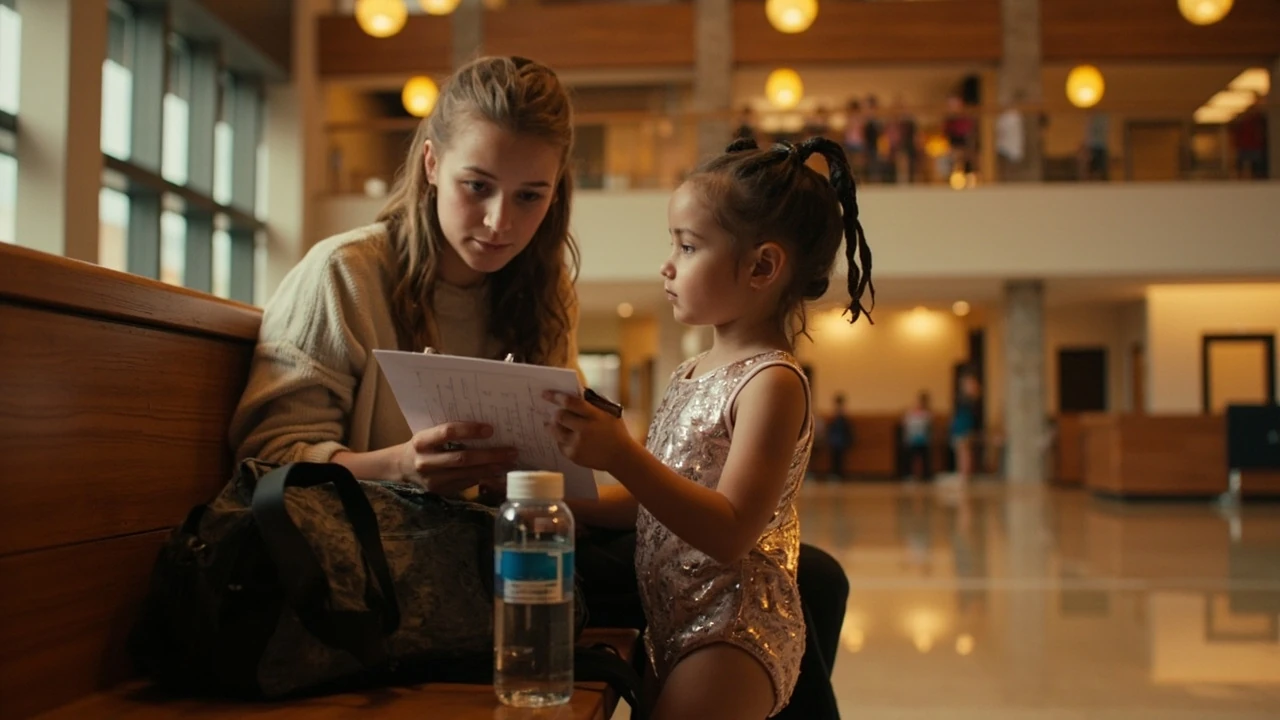
Gymnastics meet day checklist for first time parents
The first time you sit in the bleachers of a gymnastics meet, the sport looks like a different language. The announcer calls rotations, the scoreboard flashes two numbers separated by a decimal, a child in a sparkly leotard waits under a beam with chalk on her palms, and a coach walks backward holding a clipboard. The day is fast, loud, and surprisingly emotional, especially when your own kid is up next. A short, honest plan is more useful than hours of googling the night before, so this guide walks you through the realistic pieces of a gymnastics meet day checklist for first time parents, from what goes in the bag to how to read a score sheet without panicking.
You are not trying to become an expert by session one. You are trying to remove the small, avoidable friction that turns a long day into a stressful one: a forgotten hair tie, a missing grip, a parking lot dash because you did not know which entrance the athletes use. Read it once the week before the meet, print the packing section, and bring it with you.
What a gymnastics meet actually looks like
Most recreational and pre-team meets in the United States follow a modified compulsory or optional format, where every gymnast performs a short routine on each of four events: vault, bars, beam, and floor. Sessions usually run between two and three hours per age group, and a single child may be in and out of the gym for an entire morning or afternoon. Your child will rotate with her team, warm up on each event as a group, then compete one at a time while teammates and parents watch.
Younger levels use a 10.0 scoring system, while higher levels and some optional meets use a code of points structure with no theoretical maximum. You do not need to memorize the scoring system to be a useful parent on day one. You do need to know when your child is scheduled, what the team uniform looks like, and where the athletes wait between rotations.
Two weeks before the meet: the quiet preparation
Most of the stress of a first meet is set up long before you walk into the gym. The two weeks before the competition are when the routines are learned, the small fears come out, and the family routine shifts around a single Saturday. Treat those two weeks like preparation for a school play.
- Confirm the date, start time, and session with the coach. Meets often have a morning and afternoon session, and a small typo on the schedule can mean you arrive four hours early or four hours late.
- Ask whether the meet is sanctioned by USA Gymnastics or run by a club, a recreational league, or a school. Sanctioned meets have specific rules about warm-up time, attire, and event order; unsanctioned meets are more flexible and friendlier to first-timers.
- Check the host gym’s address and parking instructions. Some meets use a separate athlete entrance, and the parent entrance is on the other side of the building.
- Read the meet handbook or the host’s email. The fine print usually lists the photography policy, the team banner rule, and whether the facility has concessions or only a water fountain.
- Talk to your child about nerves in a calm, specific way. “You might feel butterflies before beam” is more useful than “don’t be nervous.”
What to pack: the meet day bag
Pack the bag the night before, not the morning of. The morning of a meet is loud, someone is missing a sock, and the toaster is on fire. A packed bag is a small gift to your future self.
| Category | Items | Why it matters |
|---|---|---|
| Athlete gear | Competition leotard, team warm-up suit, two hair ties, hair spray, bobby pins, sports tape, grips if used, chalk if your gymnast brings her own | Backup hair ties save an entire warm-up. Grips and chalk policies vary by gym and level. |
| Food and drink | Water bottle, electrolyte drink, easy snacks (banana, granola bar, goldfish, apple slices, string cheese), small meal for after the session | Long meets mean a real lunch, not just crackers. Avoid anything heavy, greasy, or new to her stomach. |
| Comfort | Light jacket, team blanket, flip flops or slides for the lobby, a small towel | Gymnasiums are cold. Locker rooms are wet. A blanket becomes a pillow on the bus ride home. |
| Parent kit | Printed schedule, paper and pen, phone charger, small folding chair if bleachers are tight, cash for concessions or vendor tables | You will be there longer than you expect. A phone charger is not optional. |
| Medical and safety | Band-aids, blister pads, a small ice pack, child pain reliever, hand sanitizer, tissues | Most meet injuries are blisters, twisted ankles, or small scrapes. A parent with an ice pack is a quiet hero. |
The snack strategy in detail
Gymnastics meets burn more energy than parents expect. Your child will warm up, compete four events, wait through two rotations, and try to focus through the score reveal. The blood sugar dip right before beam is real, and a granola bar at the right moment can reset an entire mood. Pack two small snacks per session: one for the middle of the meet and one for immediately after the last event. The post-meet snack should be slightly more substantial, because the adrenaline crash hits hard on the way to the car.
Avoid heavy dairy, fried food, and anything with a strong smell. You will be sitting elbow-to-elbow with other parents in the bleachers, and a quiet bag of almonds is a much better neighbor than a warm slice of pizza.
Hair, leotard, and the small details that decide the morning
Most compulsory and level 1 through 4 meets require a competition bun that stays tight under motion. A bun that flops during a floor routine is not a disaster, but it is a distraction your child does not need. Practice the bun twice during the week before the meet so the morning is not the first time you have tried the specific style.
- Use a bun maker or a thick elastic, not just a single hair tie, for a competition-ready look.
- Hairspray and water-based gel keep flyaways down. Avoid anything oily that will smear the leotard neckline.
- No jewelry, no nail polish, and no charm bracelets. Many meets are strict about this, and your child will be sent to remove a stud earring before the award ceremony.
- Inspect the leotard the night before. A pulled thread on the back strap is the kind of small thing that becomes a big problem at 7:30 a.m.
Bring a backup hair kit, even if you never need it. The parent whose daughter forgot a hair tie will become a fast friend with the parent who brought twelve.
Arriving at the gym: what to do in the first thirty minutes
Arrive at least thirty minutes before your child’s session is scheduled to start, and forty-five minutes if it is a sanctioned meet. Coaches are usually focused on setting up the team area, and the gymnasts need to stretch, check in, and find their rotation group. The first thirty minutes are also when the host gym assigns warm-up groups, and a late arrival can mean your child warms up on vault in her socks instead of in her grips.
Walk the building with your child before the session starts. Find the restrooms, the team meeting spot, the warm-up gym if there is one, and the place where you will sit as a parent. Children settle faster when they know where everything is. Parents settle faster when they have a confirmed exit route for the inevitable bathroom break during floor.
How rotations actually work
A typical meet uses two warm-up rotations followed by one competition rotation per event, though the exact order depends on the host. In simple terms, the whole session works like a relay: every team starts on a different event, performs, then rotates to the next event after a set number of minutes. The scoreboard shows the running order by team, not by individual gymnast, so the announcer is your best friend if you lose track.
| Rotation | What is happening | What the parent should do |
|---|---|---|
| Warm-up rotation 1 | Team stretches, then rotates through two events for a short timed warm-up | Let the coach lead. Stay in the bleachers or the team area, do not call advice from across the gym. |
| Warm-up rotation 2 | Team finishes the warm-up, gets the final corrections from the coach | Keep snacks and water within reach. A quick “you’ve got this” eye contact is enough. |
| Competition rotation 1 | First gymnast competes; team watches or waits in order | Watch, but do not coach. Your child is not listening to you. She is listening to the judge. |
| Competition rotation 2 to 4 | Each event is judged, scores posted in batches | Quiet cheers only. Applause between routines, not during a flight on beam. |
| Award ceremony | Final standings announced per age group, medals or ribbons given | Show up. Even a 14th place ribbon matters on a first meet. |
What the scoring actually means
At compulsory levels, you will see a single number out of 10.0 on the scoreboard, with two decimal places. That number is the sum of a difficulty score and an execution score, minus deductions for falls, bent knees, steps on landings, and other specific errors listed in the USA Gymnastics code of points. A 9.4 is a strong score at many lower-level meets, not a low one. A 9.0 is a solid meet. Anything below 8.0 is a rough day, and a gymnast’s first meet is rarely about the score anyway.
At optional and higher levels, scores rise into the high 12s, low 13s, and beyond. Do not compare a compulsory 9.3 to an optional 13.1. They are different scoring systems, and the only honest comparison is within the same session, same level, same age group.
If you want a deeper look at how difficulty and execution are added together, the basic structure of the sport is well explained in the overview of gymnastics on Wikipedia, which covers the evolution of scoring from a perfect 10 system to today’s open-ended code of points. It is also worth knowing that the wrist and forearm demand of the sport, especially at higher training volumes, can lead to overuse injuries, and a review of common wrist overuse pathology in young gymnasts describes the kinds of repetitive stress that coaches and parents should keep in mind when the season becomes dense.
How to be a good parent in the bleachers
The most useful thing a first-time gymnastics parent can do on meet day is also the hardest: stay in your chair and stay quiet during the routines. A gymnast mid-routine is doing a complex motor task, and the voice of a parent calling out from across the gym is a real distraction, even when it is well-intentioned. The coach is on the floor for exactly this reason.
- Clap and cheer between routines, not during.
- Save video for the end of the rotation. The light from a phone screen is visible to a gymnast on the beam.
- Do not compare your child to anyone else’s child, out loud, in the bleachers, ever. Another parent will hear you, and so will the gymnast two rows up.
- Bring water to the team area during a water break if the coach allows it. Small acts of care from parents are remembered.
- Save the post-meet feedback conversation for the car ride home, and lead with what you noticed, not with what the scoreboard said.
Common first-meet mistakes and how to dodge them
Every first-time parent makes at least one of these. They are not character flaws. They are just the predictable mistakes of being new to a sport with its own quiet rules.
| Mistake | Why it happens | What to do instead |
|---|---|---|
| Coaching from the stands | You have watched 200 practices. You know what a straight leg looks like. | Trust the coach. Your job today is the snack, the water, and the calm face. |
| Worrying about the score in real time | The scoreboard is right there and updates every four minutes. | Look at the gymnast, not the screen. The score is the coach’s problem today. |
| Overpacking the bag | You are trying to control a day you cannot control. | Stick to the packing list. One bag, one chair, one plan. |
| Skipping breakfast | The meet starts early, the cafeteria is closed, and you are running on coffee. | Eat before you leave. A granola bar in the car is not breakfast for a parent on hour four. |
| Forgetting the post-meet plan | You are so focused on the meet itself that you forget to think about the hour after. | Decide on a meal or an activity after the session. The decompression is part of the day. |
After the last routine: how the day should end
The first meet ends the way any big day ends, with a tired kid, a long line for a team photo, and a parent who suddenly does not know what to say. The simplest good answer is “I loved watching you.” The score will come up on its own. If it does, and your child is disappointed, acknowledge the feeling before you talk about the routine. A child who feels heard about the disappointment is far more willing to hear “and here is what we can work on next” from the coach next week.
Drive straight to a meal that feels like a small celebration, even if the score was not what your child hoped. The post-meet meal is the first tradition of a gymnastics season, and it teaches your child that the meet is a chapter, not a verdict.
Building a small support kit for the whole season
The first meet is the loudest day of the season, but it is not the only one. Most competitive gymnasts will compete between four and eight times a year, and the same packing list and the same post-meet routine will repeat with small variations. A few habits make the whole season easier.
- Keep a permanent meet box in the car with extras: hair ties, safety pins, snacks, a phone charger, and a small first-aid kit.
- Save the host gym’s address and the meet handbook PDF in a single folder on your phone so the schedule is one tap away.
- Connect with two or three other parents from the team. A group text the morning of a meet is faster than any email chain.
- Track your child’s events and scores in a small notebook. By the third meet, the pattern tells a real story that the season summary alone cannot.
Frequently asked questions
What time should I arrive at my child’s first gymnastics meet?
Arrive at least thirty minutes before the session start time, and forty-five minutes if the meet is sanctioned by USA Gymnastics. The extra time lets your child stretch with her team, find the warm-up area, and adjust to the noise of the gym before the competition rotation begins.
Can parents stay in the gym during the meet?
Yes, in most recreational and pre-team meets, parents sit in the bleachers or a designated parent area throughout the session. Some larger sanctioned meets limit access to the warm-up gym, but the competition floor is almost always open to spectators.
How long does a gymnastics meet usually last?
A single age group session typically runs two to three hours, and a full meet day with multiple sessions can run from early morning to late afternoon. Plan for the full window. Many parents are surprised by how long the day feels, even for a level 1 gymnast.
What should my gymnast eat before and during the meet?
A light, familiar breakfast one to two hours before the session, then small snacks during the meet such as a banana, a granola bar, goldfish crackers, or string cheese. Avoid heavy, greasy, or new foods, and keep water flowing through the day.
Is it okay to film my child’s routine?
In most meets, yes, but only from your seat in the bleachers, only between routines, and only if the host gym allows it. Some sanctioned meets restrict flash photography near the equipment, and a few high-level competitions prohibit filming entirely. Check the meet handbook before you press record.
What does the score on the scoreboard actually mean?
At compulsory levels, the number is a total out of 10.0, made up of a difficulty score plus an execution score minus deductions for form breaks, falls, and landing errors. A 9.0 to 9.5 is a strong score at most recreational meets, and anything below 8.0 usually reflects a fall or a missed element rather than a bad day.
How do I handle a disappointing score without making it worse?
Lead with what you saw, not what the scoreboard said. A simple “I loved your beam series today” gives your child something to hold before the conversation drifts into a critique. Save the real talk for the car ride home, and let the coach handle the technical feedback at the next practice.
What is the difference between a sanctioned and an unsanctioned meet?
A sanctioned meet is run under the rules of a national or regional governing body such as USA Gymnastics, with formal judging, specific warm-up times, and a published code of points. An unsanctioned meet is run by a club or a recreational league and tends to be shorter, more flexible, and friendlier to first-time families.
What should I bring for myself as a parent at a gymnastics meet?
A printed schedule, a phone charger, a small folding chair if bleachers are tight, water and snacks, a light jacket, and cash for concessions or team merchandise. The day is long, the gym is cold, and the phone battery is the first thing to die if you do not plan for it.
How do I know which events my child is competing in and in what order?
The meet director publishes a session schedule that lists each team’s starting event and rotation order, and your coach will hand out a copy at the team meeting. The announcer also calls the rotations out loud, so even without a schedule you can follow the day by ear.