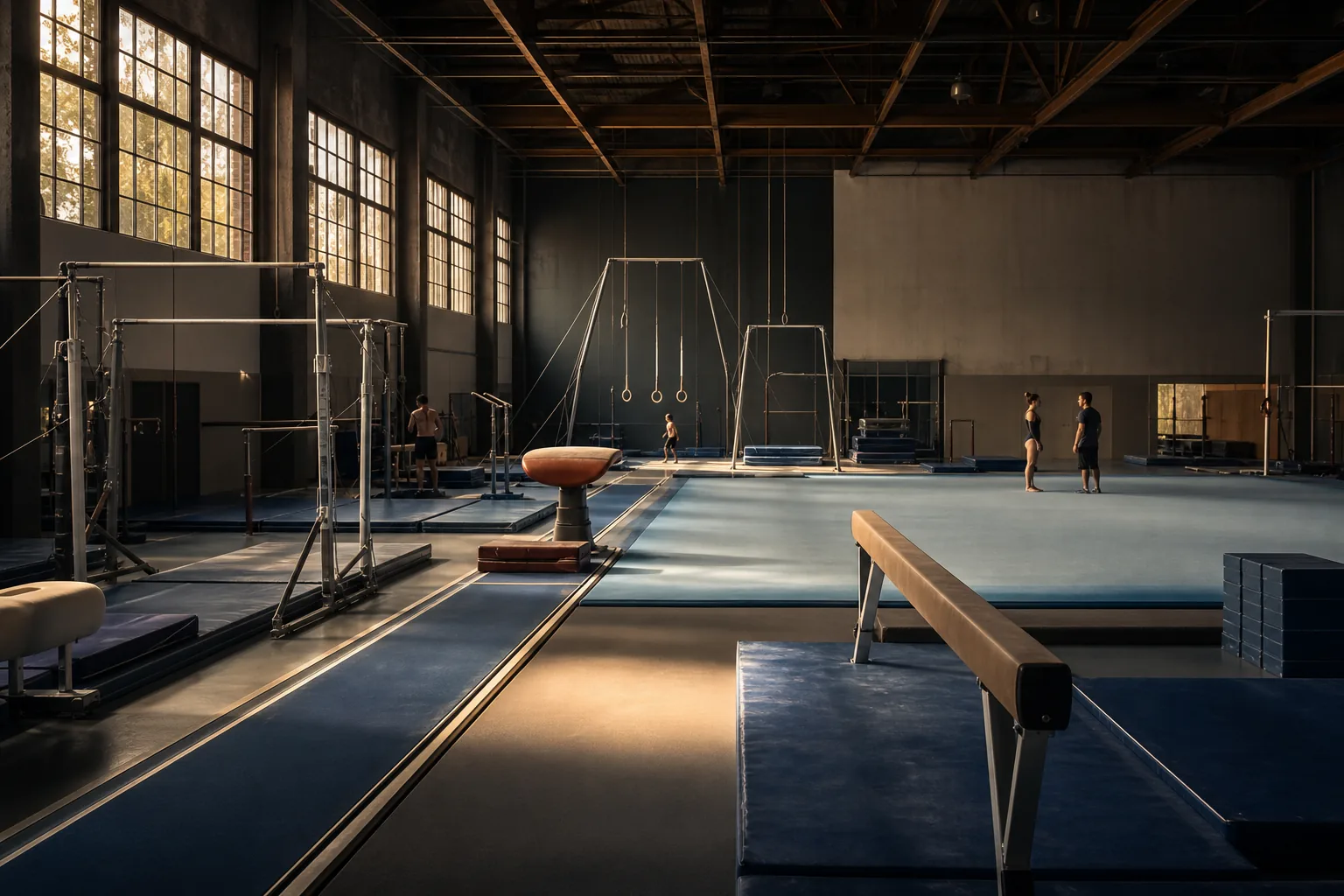
Artistic gymnastics can look like one sport performed on many pieces of equipment. In practice, each apparatus creates a different movement problem. Vault compresses a performance into seconds. Beam makes precision visible. Rings demand strength with almost no help from momentum. Floor combines power, rhythm and composition over a larger space.
Understanding the apparatus makes competition easier to follow and helps beginners see why early classes spend so much time on shapes, landings and support positions before full skills appear.
Women’s artistic gymnastics apparatus
Women’s artistic gymnastics is commonly organized around four events: vault, uneven bars, balance beam and floor exercise. Program names, equipment settings and routine requirements vary by level and governing organization, but the central movement problems are consistent.
Vault
A vault begins with a run and converts horizontal speed into a brief, powerful contact with the takeoff board and vault table. The athlete must coordinate approach rhythm, takeoff, hand contact, block from the table, flight and landing.
Beginners do not start by performing complete competitive vaults. They learn running mechanics, hurdle rhythm, safe landing, body tension, hand support and shapes on lower or adapted stations. These pieces allow speed to be added without losing the position that makes the vault safe and efficient.
Uneven bars
Uneven bars combine hanging, support, swing, release and transition between two rails at different heights. Grip, shoulder movement, timing and body shape are central. A successful swing is not created by simply pulling harder; the gymnast changes shape in rhythm with the apparatus.
Foundational work includes hangs, supports, casts, controlled swings and safe ways to mount and dismount. Hand protection, grips and bar preparation may become relevant as level and training volume increase, under club guidance.
Balance beam
The beam is narrow, but the larger challenge is performing a complete routine without letting that fact shrink every movement. Gymnasts combine leaps, turns, acrobatic elements, choreography, mounts and dismounts while showing alignment and control.
Beginners usually learn positions and skills on a line, floor beam or low beam before height is introduced. This is an important coaching principle: the athlete should understand the movement problem before fear and consequence are increased.
Floor exercise
Women’s floor exercise combines tumbling, leaps, turns and choreography. The spring floor returns energy, but it also demands timing. Power must be directed into a usable takeoff and followed by an organized landing.
Early floor training includes shapes, rolls, hand support, cartwheel patterns, jumps and landing. Dance preparation is not decoration around tumbling; it is part of the event’s rhythm, range and composition.
Men’s artistic gymnastics apparatus
Men’s artistic gymnastics is commonly contested on six events: floor exercise, pommel horse, still rings, vault, parallel bars and horizontal bar. The same gymnast must solve very different demands, from continuous circular work to static strength and high-speed release.
Floor exercise
Men’s floor routines emphasize tumbling, strength, balance and non-acrobatic transitions across the floor area. Direction changes and controlled landings connect the routine. Foundational training again begins with shapes, rolling, hand support and basic tumbling progressions.
Pommel horse
Pommel horse is built around continuous circular movement, support through the hands and travel across the apparatus. The gymnast has to shift weight from one arm to the other while the legs continue moving around the body.
Beginners build support strength, body position and circle patterns on adapted equipment such as mushroom trainers before combining full travel and more complex elements.
Still rings
Rings are suspended and move independently, so the athlete must stabilize them while performing swings, strength holds and transitions. The apparent stillness of a hold is produced by substantial control through the shoulders, trunk and arms.
Basic hangs, supports and assisted positions establish the prerequisite strength. Advanced strength elements should not be treated as casual fitness challenges; they are specific skills developed through long progression.
Vault
The central phases of men’s vault are similar to women’s vault: approach, board contact, table contact, flight and landing. Competitive vault families and requirements differ by program, but speed must still be organized through a precise sequence.
Parallel bars
Parallel bars allow work above, between and below two rails. Routines combine supports, swings, flight, strength and a dismount. The gymnast must manage pressure through both hands while keeping the body connected through changes in direction.
Horizontal bar
Horizontal bar, often called high bar, is a single elevated rail used for large swings, turns, releases, catches and dismounts. Timing and grip are obvious demands, but body shape controls how energy is created and redirected.
Apparatus in other gymnastics disciplines
Artistic gymnastics is only one part of the sport. Rhythmic gymnastics uses hand apparatus such as hoop, ball, clubs and ribbon in combination with dance and body difficulty. Trampoline gymnastics centers on repeated flight and controlled landings on a trampoline bed. Acrobatic gymnastics uses partner balance, tempo and combined routines. Other disciplines and local programs add their own equipment and formats.
This article focuses on artistic apparatus because it is what many people picture when they hear “gymnastics,” but a family choosing a program should ask which discipline the club actually teaches.
Why apparatus basics repeat across the gym
A beginner may wonder why the same hollow shape, landing drill or handstand line appears in several rotations. Repetition is deliberate. A handstand supports future work on floor, vault, bars and beam. A stable landing matters at the end of almost every event. Hanging and support create a base for bars and rings while also developing general control.
Gymnastics coaching connects apparatus through shared fundamentals, then makes those fundamentals specific. The skill is not only performing a movement once; it is producing the right version in the right environment.
How to watch a gymnastics routine
Difficulty is only one layer. Watch the approach into a skill, the shapes during flight or swing, the rhythm between elements and what happens on landing. Notice whether a routine looks like a connected sequence or a collection of separate moments.
Rules and scoring systems differ across levels and change over time, so use the applicable federation or event materials for exact requirements. The enduring questions are simpler: What problem does this apparatus create? How does the athlete manage shape, force, rhythm and control to solve it?