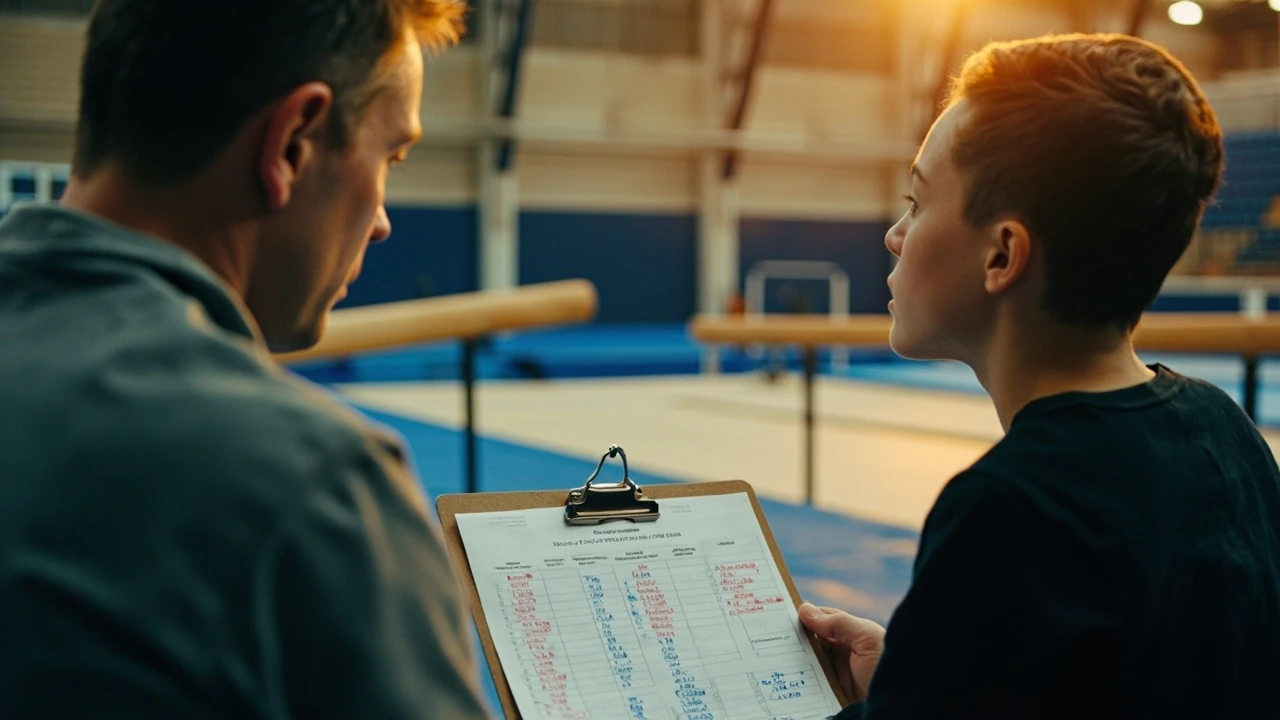
How to read a gymnastics score sheet: a clear guide for parents, coaches, and athletes
You sit in the bleachers, the gymnast lands a clean double back on floor, and the announcer calls a score you did not expect. The meet program in your hand lists three numbers, not one, and the sheet on the judges’ table is full of short codes, arrows, and abbreviations. This guide explains how to read a gymnastics score sheet so that what the judges write makes sense before, during, and after the routine. It is written for the people who most often feel lost in that moment: parents tracking a child’s progress, club coaches reviewing meet results with athletes, and adult gymnasts decoding their own scores.
Across most international and U.S. competitions, the document judges mark is essentially the same. A panel of officials watches each routine, writes shorthand notes, and turns those notes into a final number with two visible components: a difficulty score and an execution score. Once you can see those two parts on the page, the rest of the sheet becomes a record of judgment rather than a puzzle. The goal of this article is to help you read a meet sheet the way a coach reads it, including deductions, neutral deductions, and the small notes that explain why one gymnast scored 13.450 and another scored 13.150.
What a gymnastics score sheet actually contains
Every sanctioned gymnastics score sheet, whether printed for vault, bars, beam, or floor, is built around a small number of fixed blocks. The page looks dense, but it follows a template. Once you identify the blocks, you can read any sheet from a local invitational or a national final.
The first block is identification. It lists the gymnast’s name, club, competition, division, apparatus, and rotation or group number. This is the part parents usually scan for first. The second block is the difficulty panel, where the judges confirm the start value, list counted elements, and note special requirements. The third block is execution, where every visible fault, from a bent knee to a step on landing, is written in short form. The final block is the totals area, where the chair judges of the panel add the difficulty and execution components, apply any neutral deductions, and write the final score.
Most sheets also include a place for the chief judge’s signature, the time of the routine, and any remarks. The remarks line is where unusual events are written, such as a fall that required medical review, a broken element, or a coach’s inquiry. If you want to understand how to read a gymnastics score sheet in the way judges intend, start by locating those four blocks on the page in front of you.
The two-part scoring system: D score and E score
Modern artistic gymnastics uses a system that separates what a gymnast attempted from how well they did it. The D score is the difficulty score, and the E score is the execution score. Together they produce the final total, before any neutral deductions are applied for things like timing violations or out-of-bounds steps.
The D score reflects the difficulty of the routine. Judges credit specific skills, bonus connections, and requirement elements. For most meets, the D score starts at zero and is built up as the judges confirm the eight or ten highest-value counted elements. On a printed sheet, the D panel usually shows the element number, its difficulty value, and a running total. The E score starts from a maximum of 10.000 in most meets, although some national and youth systems use a 9.500 starting base. The execution judges deduct for form, technique, height, and amplitude. Their notes look like a stream of short symbols because speed matters when a routine lasts less than ninety seconds.
When a meet is run under current Fédération Internationale de Gymnastique rules, the open-ended code means there is no fixed cap on the D score. In a typical junior meet, the D score might fall between 3.0 and 5.0, while a senior elite meet can see D scores of 5.5 or higher. The printed sheet will show the actual numbers, not a pre-set maximum. The artistic gymnastics program at the overview of artistic gymnastics on Wikipedia is a good place to confirm which governing body is in charge of the rules your sheet follows.
How the four judging panels work
To read a score sheet, it helps to know who is writing on it. Most meets run with two panels per apparatus. The D panel evaluates difficulty, and the E panel evaluates execution. The difficulty panel usually has two judges. One writes the elements as they happen, the other checks the count. The execution panel has three or more judges, and the highest and lowest scores are dropped to protect against single-judge bias. The average of the remaining scores becomes the published E score.
| Panel | Main job | Typical number of judges | What is written on the sheet |
|---|---|---|---|
| D panel (Difficulty) | Confirm elements and build the D score | 2 | Element codes, connection values, requirement check marks |
| E panel (Execution) | Score technique and form | 3 to 6, with top and bottom dropped | Deduction values, bent knee, flexed foot, hop, step, fall |
| Chair of judges’ panel | Finalize totals and sign the sheet | 1 | Final score, signature, time of routine |
| Line judges (floor) | Watch the boundary line on floor | 2 | Line indicator marks and neutral deductions |
When you look at a sheet after the meet, the E scores you can read are already the average of the middle judges. The dropped scores are usually not shown to the public. The two D judges’ notes can sometimes disagree by a small amount, because one writes elements as they appear and the other reviews the routine. The final D score is the average of the two D judges, rounded to a defined precision.
The shorthand judges use on the page
Judges do not write full sentences during a routine. They use a shorthand that has been passed down through coaching and judging courses for decades. The shorthand varies slightly by federation, but the core symbols are consistent. Reading the shorthand is the single biggest step in learning how to read a gymnastics score sheet like a coach rather than a spectator.
- 0.1, 0.3, 0.5 — standard deduction values for small, medium, and large errors. These are written next to a short description of the fault.
- ✓ — a check mark, used to confirm a requirement has been met, not a deduction.
- x — indicates a broken connection or a missed bonus.
- circle — drawn around a deduction to mark a fall or a major error.
- / — a slash used to separate two related notes, such as “knee / flex” for a bent and flexed leg on the same skill.
- arrows — used on beam and floor to mark direction of travel or a wobble.
The descriptions next to the symbols are also compressed. Common abbreviations include BK for bent knees, FF for flexed feet, sep for separation, fl for a fall, hop for a hop on landing, and st for a step. If a deduction refers to a specific element, the element’s number is written first, then the fault, so the coach reading the sheet knows exactly where the loss came from. The most useful thing a parent can do with a copied sheet is to look for the few biggest deductions and ask the coach to explain them.
Step-by-step: how to read a score sheet during a meet
Even before a meet ends, you can follow a sheet as it fills in. The judges’ panel writes in real time, and the announcer’s score is the final read of the same data. Here is a sequence you can use while sitting in the stands or standing with a clipboard near the awards table.
- Find the gymnast’s row. Sheets are usually grouped by rotation, so look for the apparatus name and the order of competition.
- Confirm the start value. The D panel will already have a tentative start value written, based on the gymnast’s planned routine.
- Watch the E panel during the routine. Each deduction is written as it happens. The sum of those deductions is your preview of the E score.
- Check the final E column. It is normally the start of 10.000 minus the total deductions, averaged across the E panel.
- Read the final D column. This is the D score after element verification, including connections and any required special elements.
- Look for neutral deductions. These are written separately and are not part of the D or E panels.
- Add the two scores. Final score = D score + E score, then minus any neutral deductions.
If the announcer’s number does not match the sheet, it is usually because a quick oral addition is being rounded, or because the inquiry window is still open. Most meets display a digital board that matches the chair of judges’ panel’s final write-in. When the digital board and the announcer’s number agree, the routine is officially scored.
Where the deductions come from
Deductions are not random. They are tied to specific faults, and each fault has a defined value. Most governing bodies publish a deduction chart that judges reference during training and meets. Knowing the common values helps you understand why a clean-looking routine can still lose half a point.
| Fault category | Typical deduction per occurrence | Example in a routine |
|---|---|---|
| Bent knees | 0.1 (small) to 0.3 (severe) | Tucked position on a tucked Yurchenko is too open at the knees |
| Flexed feet | 0.1 each, up to 0.3 total | Toes not pointed in a leap series |
| Leg separation | 0.1 to 0.3 | Legs apart in a handstand pirouette |
| Flexed arms | 0.1 to 0.3 | Bent arms in an uprise on bars |
| Hop on landing | 0.1 | Small hop after a Yurchenko double full |
| Step on landing | 0.2 | Step backward to control a stuck landing |
| Wobble on beam | 0.1 to 0.5 | Arm adjustments to stay on the beam after a leap |
| Fall | 1.0 (or 0.5 in some youth systems) | Comes off the apparatus completely |
Note that the values in the table are typical ranges. The actual deduction in any given meet depends on the federation and level. Some federations still use a fixed maximum E score of 10.000, while others have moved to an open-ended top. The cleanest way to verify the exact deduction scale is to check the rule book your meet operates under, or the published document on the governing body’s website.
What neutral deductions are and where to find them
Neutral deductions are penalties that are separate from the difficulty and execution of the routine. They are written in their own block on the sheet, often at the bottom. They cover things that are not part of the gymnast’s choreography or form, but that affect fair play, safety, or presentation rules.
- Out of bounds on floor: 0.1 per occurrence, with an additional 0.3 if the gymnast steps entirely outside the line and the coach has already received a warning for that rotation.
- Time violations on floor: 0.1 for a short routine under time, and 0.1 for going over the time limit.
- Line of choreography issues: deductions for using signals, props, or verbal cues that are not part of the routine.
- Incorrect attire or equipment: in some systems, a gymnast who competes without proper identification can receive a small neutral deduction.
- Violation of apparatus rules: for example, touching the mat on vault before the signal, or stopping the routine past the 30-second time allowance on bars.
Neutral deductions are subtracted from the final total after the D and E scores are added. This is why a gymnast with the highest D and E scores in a group can still place lower than expected. The two most common neutral deductions at youth meets are the floor out-of-bounds and the time violation, so always check the floor block first when the final number seems off.
How the final number is written and announced
The final number on a gymnastics score sheet is a three-decimal value, rounded in the standard way. The chair of judges’ panel writes the final number in a clearly marked box. The announcer reads that number, often after a short pause, and the digital scoreboard updates within a second or two. The official printed sheet, signed at the end of the competition, is the legal record. Posted results on a meet host’s app or website are generated from those signed sheets.
It is also common to see a separate column for the rank within the session. That rank uses only the gymnasts on that apparatus in that session, so a strong routine in a stacked group can produce a low rank even with a high score. The all-around total is the sum of the four or six apparatus finals within the session, and is written in its own line. When looking at an end-of-meet results page, the apparatus scores and the all-around scores are two different products of the same sheets, and both come from the same set of judge notes.
How to compare two score sheets side by side
When two gymnasts are close in score, the way to understand the gap is to compare the D and E components, not just the totals. The total can hide the fact that one gymnast took more risk while the other played it safer.
| Comparison angle | What to look for on the sheet | What it tells you |
|---|---|---|
| Risk versus execution | D score and E score side by side | A higher D and a lower E means the gymnast went for harder skills; a higher E and a lower D means a clean but simpler routine |
| Big-ticket skills | Element codes and values | Identify which skills produced the D score, and which ones lost E score through faults |
| Connection value | Bonus marks written next to linked elements | Connections add difficulty when done correctly and deduct when broken |
| Special requirements | Check marks next to required element groups | Missing a requirement can lower the D score, even if the skill was performed cleanly |
| Neutral deductions | Bottom block of the sheet | Sometimes the entire gap between two routines is one out-of-bounds step |
This kind of side-by-side review is one of the most useful coaching tools a parent can borrow. Instead of asking “why did she lose,” you can ask “did she lose the E score, or did the D score not show up the way the plan suggested?” The answer changes the next practice plan.
What to look for when reading your own child’s sheet after a meet
After the meet, the most useful first step is to identify the three largest deductions, regardless of which element they are on. The brain of a tired gymnast will focus on the fall or the missed skill, but judges saw a long list of small things that, together, often cost more than the visible mistake.
- Form deductions on the strongest event. The event where the gymnast feels the most confident is often where form slips, because the athlete is pushing for higher difficulty and forgetting technique.
- Landing deductions across all four events. Landing technique is the easiest place to lose the same 0.1 to 0.3 on every routine. If the same loss shows up on bars, beam, and floor, it is a habit, not a bad day.
- Connection bonuses that did not credit. A “no connection” or “broken” note in the D panel often points to a small adjustment that broke a bonus, not a missed skill.
- Requirements that were not checked. A missed requirement shows up as a D score that looks lower than the visible skills would suggest.
Bring the copied sheet to the next practice and ask the coach to walk through it with the gymnast. Most coaches appreciate the work, and a one-page summary of deductions is a better training plan than a vague feeling about a missed meet.
How to read an inquiry or a score change
Sometimes a score changes after the initial announcement. This happens when a coach files an inquiry. The inquiry process is defined in the rules and usually includes a small fee that is returned if the inquiry is successful. On the sheet, an inquiry is marked in a dedicated column and a revised D or E score is written with a clear note. The original number is usually crossed out with a single line, not erased, so the change is part of the record.
If you see a changed score at a meet, it does not mean the original score was unfair. It usually means the coach and the judges reviewed one specific element or connection and reached a different conclusion. Most inquiries are about connection value, identification of a skill, or the counting of a special requirement. Few are about execution deductions, because execution is a visual judgment and is rarely overturned.
Why score sheets look different across meets and levels
Although the underlying system is consistent, the actual printed sheet can look different. A U.S. Development Program meet uses one template, an NCAA meet uses another, a JO-level meet uses a third, and a senior FIG meet uses a fourth. Each template shows the same components in slightly different layouts, with different boxes for different rule sets. Some templates include columns for bonus values, some include a line for time of routine, and some include a slot for coach and gymnast signature.
The differences are not random. They reflect the rules the meet is scored under. A deeper overview of the gymnastics competition at the Olympic level shows the same D and E components but with a fully open-ended D score. Local and youth meets use abbreviated sheets that match the simplified rules of that level. When you know which rule set a meet is using, the sheet makes sense almost immediately.
Common mistakes when reading a gymnastics score sheet
Even experienced parents can misread a sheet. A few common mistakes are worth flagging because they lead to unhelpful conversations after the meet.
- Confusing the start value with the final score. The D panel writes a tentative start value before the routine, and a confirmed D score after. The two can differ by 0.5 or more if a connection is broken or a requirement is missed.
- Comparing across rule sets. A 9.5 E score in one system is not the same as a 9.5 in another. Always compare within the same meet and level.
- Ignoring neutral deductions. A clean routine can place lower than expected because of one floor out-of-bounds step. Always look at the bottom block.
- Reading the D score alone. A high D score with a low E score is a risk-reward outcome. The total matters more than either component.
- Treating the announcer’s number as final. Some meets show a preliminary number on the scoreboard and the official number only after the panel signs. A small difference is normal.
Once these patterns are familiar, reading a sheet is much less stressful. The page becomes a record of what the judges actually saw, and the deductions become a training plan rather than a verdict.
How to use a score sheet as a coaching tool at home
You do not need a judging course to use a sheet well. A simple workflow with a copy of the sheet and a notebook is enough to turn a meet into a useful training cycle.
- Photograph every sheet. The judges’ panel often takes the original back, but a photo is allowed in the spectator area at most meets.
- Mark the three biggest deductions in each routine. Use a highlighter so the gymnast can see where the score went.
- Mark any connection or requirement that did not credit. These are training goals, not losses.
- Add the neutral deductions to the highlights. A 0.1 out-of-bounds can be a habit that lives in the warm-up, not the routine.
- Bring the marked sheet to the next training session. Ask the coach to design a short drill block for the top two deductions.
Parents who do this for an entire season typically see a clear pattern by mid-season: the same two or three deductions show up at every meet. Those become the family’s training focus, and the score sheet stops being something to read after the fact and becomes a tool to plan ahead.
Where gymnastics scoring fits in the broader training picture
Reading a score sheet well is one part of a larger habit of treating gymnastics as a measurable sport. The same approach that helps you read a sheet also helps you read a body composition chart, a strength program, or a flexibility log. The art is in knowing what to measure, and the discipline is in measuring it the same way every time. The site’s guide on gymnastics flexibility for athletes, coaches, and parents applies the same idea to a different training area, and the overview on how routines are judged and counted is a useful companion for the parts of the scoring system that go beyond the printed sheet.
Frequently asked questions
What is the D score on a gymnastics score sheet?
The D score is the difficulty score. It is the sum of the values of the credited elements, plus any connection bonus, in the routine. It is written in the D panel of the sheet and reflects what the gymnast attempted, not how well it was performed.
What is the E score on a gymnastics score sheet?
The E score is the execution score. It starts at a defined maximum, usually 10.000, and the judges deduct for form errors, technique faults, and landing mistakes. The published E score is the average of the middle judges after the high and low scores are dropped.
How is the final gymnastics score calculated?
The final score is the D score plus the E score, minus any neutral deductions. For example, a D score of 4.5 plus an E score of 8.7, with a 0.1 neutral deduction, gives a final score of 13.1.
Why are some scores on a sheet three decimals and others not?
Official gymnastics results are always written to three decimals. Two-decimal numbers on TV graphics or apps are usually rounded for display, while the printed sheet and the official results show the full precision.
What is a neutral deduction in gymnastics?
A neutral deduction is a penalty that is not part of the difficulty or execution of the routine. Common neutral deductions are stepping out of bounds on floor, exceeding the time limit, or breaking a presentation rule. They are written in a separate block on the sheet.
How do judges write so fast during a routine?
Judges use a standardized shorthand with symbols, short codes, and standard deduction values like 0.1, 0.3, and 0.5. The system is taught in judging courses, and the written notes are then turned into numbers by the chair of judges’ panel after the routine.
Can a coach challenge a score on the sheet?
Yes. Most meets allow a coach to file an inquiry, usually for a small fee that is returned if the inquiry is successful. Inquiries are typically about difficulty credits and connection value, not about execution deductions.
Why do two gymnasts with the same final score have different placements?
Placement is based on the tie-breaking rules of the meet. In most rule sets, the gymnast with the higher E score wins the tie, because execution is treated as a more reliable measure than difficulty. If the E score also ties, the judges review the D panel notes, and a final tie is shared.
How can I get a copy of my gymnast’s score sheet?
Most meet hosts allow photography of the judges’ table from the spectator area, and many meets publish the official results with the apparatus scores within a few days. Some clubs also receive digital copies of the signed sheets from the meet director.
Do all gymnastics meets use the same score sheet?
No. The components are the same, but the printed template can vary by federation, level, and host. The D and E panels are always present, but the layout, columns, and the inclusion of items like connection values or time of routine can differ between meets.