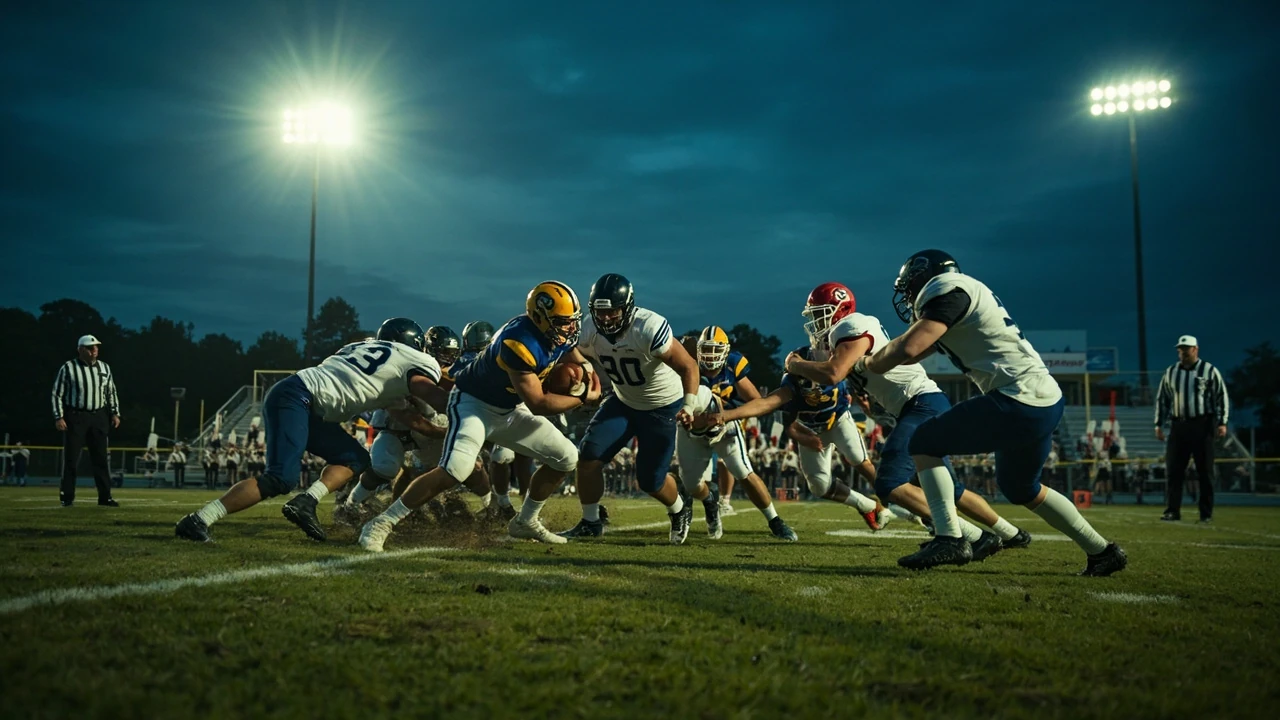
High school football: what every player and parent should know
A Friday night stadium, a marching band warming up, a quarterback reading the defense before the snap. High school football is the entry point where most American players first learn the sport under real game conditions, and it is also the level where habits, expectations, and safety decisions start to matter. The rules, the season, the equipment, and the physical demands all look different from youth leagues, and the gap catches a lot of first-year families off guard.
This guide covers the practical ground that players, parents, and new fans actually need: how the season is structured, how the game is officiated, what each position does, how the equipment fits and is maintained, what the major safety topics are right now, and how a new player can prepare during the off-season. The aim is to give you a clear picture of the sport at this level, not a sales pitch for any program.
How the high school football season is organized
In the United States, high school football is governed by state athletic associations that follow the rules of the National Federation of State High School Associations (NFHS). The exact calendar varies by state, but the structure is broadly the same across the country. Most programs run a single fall season, with optional spring practices, a summer conditioning period, and an off-season focused on strength training and skill development.
The regular season usually starts in late August or early September, depending on climate, and runs for about ten weeks of Friday night games. A few states play on Thursday or Saturday to manage field availability, and some larger programs play on multiple nights per week. After the regular season, teams enter a postseason bracket that usually ends with a state championship game in December. The longest high school football game in regulation history is not a useful benchmark, but a few states have experimented with overtime formats that cap shootouts to keep player safety manageable.
Because each state sets its own calendar, a player transferring between states will often see different rules on practice contact, heat acclimatization, and the number of regular-season games. A parent should always check the local state association handbook for the specific year, since several associations update contact rules every season.
The rules that shape the game
The NFHS rulebook is the base document. It is similar in spirit to the NCAA and NFL rulebooks but has important differences. The field is 100 yards long with two 10-yard end zones, the ball is a standard Wilson or similar leather football, and there are four 12-minute quarters at the varsity level, with a halftime of about 20 minutes. A few details matter more than they look:
- Game clock: The NFHS uses a 40-second play clock and a running game clock in most situations. Unlike the NFL, the clock continues to run on first downs inside the final two minutes of a half unless a timeout is called, which keeps game length manageable for student-athletes.
- Overtime: Each state sets its own overtime format. Many use a modified version where each team gets a possession from a fixed yard line until a winner is decided, and some impose a cap on the number of overtimes to protect player health.
- Player down: A ball carrier is down by contact at the high school level, similar to the NFL. This is different from many youth leagues, where simply touching a player with two hands ends the play.
- Targeting and contact rules: The NFHS has tightened defenseless-player and blind-side block rules over the last decade. Officials can now eject players for targeting a defenseless opponent above the shoulders, and a second personal foul of certain types leads to automatic disqualification.
Parents sitting in the stands for the first time often notice that high school football feels closer to a college game than to a youth game. Pace, spacing, and the number of plays per quarter are all higher than at the youth level, and the rules reflect that.
Positions and roles on the field
A varsity high school football team usually dresses between 40 and 60 players depending on the state and the size of the school. The two main units are offense and defense, with specialists handling kicking. Most players focus on one side of the ball, but smaller rosters expect two-way play, especially at the skill positions.
| Unit | Position group | Main responsibilities | Common physical profile |
|---|---|---|---|
| Offense | Quarterback (QB) | Reads the defense, calls protections, throws or hands off | Average to above average arm strength, accurate, quick decision-making |
| Offense | Running back (RB) | Carries, pass protection, route running out of the backfield | Lower body power, balance, vision |
| Offense | Wide receiver (WR) | Release off the line, route running, catching in traffic | Speed, acceleration, reliable hands |
| Offense | Tight end (TE) | Inline blocking, seam routes, red zone target | Larger frame, willing blocker, soft hands |
| Offense | Offensive line (OL) | Pass protection, run blocking, communication on protections | Height, length, core strength, footwork |
| Defense | Defensive line (DL) | Control the line of scrimmage, rush the passer, stop the run | Explosive first step, leverage, hand technique |
| Defense | Linebacker (LB) | Run fits, pass coverage, blitz timing | Range, football IQ, tackling form |
| Defense | Defensive back (DB) | Man or zone coverage, run support, ball-hawking | Speed, hips, ball skills |
| Special teams | Kicker, punter, long snapper, returners | Field goals, kickoffs, punts, coverage, returns | Leg strength, accuracy, mental composure under pressure |
Some schools also run a 4-3 base defense, others a 3-4, and a growing number use multiple fronts in a single game. Offensively, the spread and run-pass option schemes have spread through high school football in the last 15 years, mostly because they simplify reads for younger quarterbacks and create space for athletes.
Equipment, fitting, and maintenance
Equipment is a real expense, and a poorly fitted piece is both a performance and a safety problem. At the high school level, the school usually issues a helmet, shoulder pads, game jersey, and pants. Parents typically buy cleats, a chinstrap or mouthguard replacement, an athletic supporter with a cup, and often a base layer. Some programs also require players to supply their own gloves or visors, depending on state rules.
- Helmet: Must be NOCSAE-certified. Programs must recondition helmets on a regular cycle. Helmets should sit about two finger-widths above the eyebrows, with the chinstrap snug and the jaw pad contact even on both sides. A helmet that rocks back and forth or sits too high should be re-fitted before any contact practice.
- Shoulder pads: Should cover the sternum and shoulder cap without pinching the neck. A good rule is to press on the top of the shoulder; the pad should compress slightly without the arch pressing into the trapezius. A common mistake is wearing varsity-sized pads at the JV level because they are available. The right size always matters more than the style.
- Mouthguard: Required in most states for any contact activity. A boil-and-bite mouthguard is the minimum standard. Custom dental mouthguards are widely available and provide a better fit, especially for players with braces.
- Cleats: Detachable cleats are common but now restricted to specific lengths in many states. Parents should check the state association’s footwear rules, since 1-inch metal-tipped cleats are not allowed in many leagues, even though they are still sold for baseball and lacrosse.
Parents new to the sport often underestimate how much sweat, grass, and dirt affect equipment over a season. Jerseys and base layers should be washed after every game, helmets wiped down with an antibacterial wipe, and pads aired out. A damp pad left in a locker is the kind of thing that ends a season early with a skin infection.
Safety, contact, and concussion management
Concussion management is the most discussed safety topic in high school football right now, and for good reason. The most recent data published by the NFHS and partner research groups suggest that concussion rates in high school football have been relatively stable over the last decade, but the trend line is influenced by better reporting, not necessarily fewer incidents. The protocol that matters is the one your state and your school’s athletic trainer actually use.
Every state now requires some version of the following:
- Pre-season baseline testing. Most programs use a computerized neurocognitive test or a short symptom checklist to establish a player’s baseline before contact practices begin.
- Recognition and removal. Coaches, officials, and medical staff are trained to recognize signs of concussion. Any player with a suspected concussion is removed from play and not allowed to return the same day.
- Graduated return-to-play. A player who is diagnosed with a concussion follows a stepwise return: light aerobic activity, sport-specific exercise, non-contact drills, full-contact practice, and then competition. Each step takes a minimum of 24 hours, and a medical provider must clear the player before full return.
Beyond concussions, the other major safety conversation in the sport is about the volume of full-contact practice. Several states have moved to limit full-contact practices to a small number of days per week, and the NFHS has published guidance recommending that contact be introduced gradually during preseason to reduce the risk of both head and soft-tissue injuries. Parents should ask the head coach, or the athletic director if the coach is not accessible, how many full-contact practices per week the program runs in-season. A well-run program will answer that question directly.
Heat illness is the other risk that deserves attention. Late-August two-a-days used to be common and are now restricted or eliminated in most states. Acclimatization periods, mandatory water breaks, and wet-bulb temperature cutoffs are now standard. The CDC’s heat-illness guidance is a useful reference for parents who want to understand the thresholds, and the NIOSH heat stress page lays out the physiological background in plain language.
How the off-season actually works
High school football is not a three-month sport. The off-season is where development happens, and the strongest programs treat the calendar year as one continuous cycle rather than a fall season with a long break around it. A typical annual plan looks something like the structure below, though the specific timing shifts by state and school.
| Period | Length | Primary focus | Typical contact level |
|---|---|---|---|
| Post-season | 2-3 weeks | Active recovery, movement quality, sleep | None |
| Winter | 8-10 weeks | Strength, conditioning, position technique | None to limited |
| Spring | 4-6 weeks | Skill work, install, scrimmages or 7-on-7 | Limited or no contact |
| Summer | 6-8 weeks | Strength, conditioning, 7-on-7, team camps | Limited, often in helmets only |
| Preseason | 2-3 weeks | Acclimatization, install, padded practices | Graduated, capped by state rules |
| In-season | 10-12 weeks | Game prep, recovery, maintenance | Limited full contact |
For a new player, the most useful off-season habit is consistent strength training. A linear progression of squat, hinge, push, pull, and single-leg work, two or three days a week, builds the base that allows the on-field work to be productive. Sprinting mechanics, agility, and position-specific drills come next, layered on top of the strength base rather than in place of it. Parents often ask whether private trainers are necessary. They can help, but a well-run school weight room with a qualified strength coach and a clear progression is usually enough for a high school player.
Time commitment, academics, and the reality for families
High school football is a real time commitment. Most programs expect a player to be available for:
- Practice every weekday after school, typically two to two and a half hours
- Team meetings and film sessions, often one or two mornings or lunch periods per week
- Game day on Friday, with arrival often two hours before kickoff
- Off-season workouts two to four days a week
- Summer camps, which can be 7-on-7 events or full team camps
That schedule needs to be balanced against schoolwork. Coaches who run a sustainable program usually publish a study table or supervised study hall, and most states enforce an academic eligibility check that runs on a weekly or grading-period basis. A player who is failing a class at the eligibility check is usually not allowed to play until grades recover, which is a feature rather than a bug of the system.
For families, the practical questions are usually about transportation, meals, and recovery. Late practices mean late dinners, and a high school player who lifts and then practices in the heat has real nutritional needs. The standard guidance is straightforward: a carbohydrate- and protein-rich meal two to three hours before practice, a recovery snack within an hour after practice that includes protein, and a normal dinner that prioritizes sleep rather than heavy food close to bedtime. Hydration is the most basic and most often neglected piece. A player who shows up to a hot August practice already dehydrated is the player who ends up in the training room.
How the college path actually works
Every high school football player is not a college recruit, and that is a good thing to say out loud. Most programs field a roster of 60 to 100 players across all levels, and only a small fraction of those will play at the next level. The honest path is that high school football is a developmental league, and the goal is improvement, exposure, and preparation for whatever comes next, whether that is college athletics, a sport at a different level, or simply a strong high school experience.
For the small group who are realistic college prospects, the NCAA’s recruiting rules govern when and how college coaches can contact them. The basic milestones to know are:
- Freshman and sophomore year: college coaches may not initiate contact, but athletes can fill out recruiting questionnaires and attend camps.
- Junior year: coaches can begin sending mail and electronic communication starting September 1 of the player’s junior year. Phone calls are allowed at specific times under the current NCAA rules.
- Senior year: official and unofficial visits are permitted within the rules of each division. The NCAA’s recruiting calendar is the controlling document, and parents should read it directly rather than rely on third-party summaries.
The honest advice is to focus on film and development more than on camps. A junior who has full game film at quarterback with consistent mechanics will get more real recruiting attention than a sophomore who has been to six camps with no game tape. The camps matter, but they are not a substitute for playing well on Friday nights.
Common mistakes first-year players and parents make
Most of the early-season problems that show up in a training room are predictable. They usually trace back to a handful of recurring mistakes:
- Skipping the off-season. A player who does not lift or condition between November and August is the player who pulls a hamstring in week one.
- Specializing too early. A 15-year-old who has only played football is fine, but a 15-year-old who has dropped every other sport to focus on football is usually less developed athletically than a multi-sport peer. Multi-sport athletes transfer movement skills into football surprisingly well, and there is a good reason that many college coaches still prefer multi-sport backgrounds.
- Buying the wrong equipment. Oversized shoulder pads, a helmet that has not been re-fitted, or a mouthguard that lives in a helmet bag rather than a mouth are all small problems that become big ones.
- Ignoring nutrition and sleep. A high school player needs more sleep than a non-athlete of the same age. Eight to ten hours is a real recommendation, not a poster on the wall.
- Skipping the trainer. The athletic trainer is the person in the building whose entire job is to keep the team healthy. A player who hides a ding or a pulled muscle to avoid missing practice is the player who ends up missing four weeks instead of one.
A first-year parent who watches the team, asks direct questions of the coach and the trainer, and supports the basic habits of sleep, food, and recovery will do more good than a parent who tries to coach from the stands.
How football connects to other sports
High school football players benefit from off-season exposure to other sports more than they benefit from a year-round football-specific training cycle. The movement patterns in gymnastics, basketball, wrestling, and track all transfer in specific ways. Body control, spatial awareness, proprioception, and the ability to absorb contact are all skills that show up in multiple sports, and a player who plays basketball in the winter and runs track in the spring usually returns to football in the fall faster and more coordinated than a peer who spent the entire off-season in the weight room. The transfer of these kinds of movement skills is well documented in the strength and conditioning literature, and the practical version of the lesson is simple: variety in the off-season tends to produce a more durable, more capable football player by the time senior year rolls around.
Choosing the right program for a first-year player
Choosing a high school program is a different decision than choosing a youth league. The school is set by where the family lives, but the choice that exists is whether to come out for the team at all, and if so, at what level. The honest list of what to look at:
- Coaching stability. A head coach in their first or second year is not automatically a problem, but a program that has cycled through four head coaches in five years usually has organizational issues that affect the player experience.
- Staff size. A well-staffed program has position coaches for offense and defense, a dedicated strength coach, and a full-time athletic trainer. A program where the head coach runs every position group is a flag, especially at the varsity level.
- Weight room access. Is the room open during the school day, after practice, or only with scheduled times? Players who lift on a consistent schedule get stronger. Players who show up when they remember do not.
- Academic support. Study tables, grade checks, and a clear eligibility policy are all signs of a serious program.
- Culture. The single best question a parent can ask is what the program does when a player gets hurt. The answer tells you almost everything about the culture. A program that pressures an injured player to play is a program to avoid, regardless of its win-loss record.
For a first-year player, the right level is usually the level where the coaching staff knows their name. A player who is clearly a starter on JV usually has a better development path than a player who is buried on the varsity depth chart as a sophomore. The transfer from JV to varsity happens naturally over two or three years for most players.
Frequently asked questions
How long is a high school football game?
Most varsity games last about two and a half hours, including halftime. The four quarters are 12 minutes each, the clock stops for incomplete passes, out-of-bounds plays, and scores, and a typical game has 50 to 70 total plays per team.
When does the high school football season start?
In most of the United States, regular-season games begin in late August or the first week of September. Preseason practices start two to three weeks before the first game, usually after a heat acclimatization period. Southern states often begin slightly earlier, and northern states often begin in early September.
How many games are in a high school football regular season?
Most states allow 10 regular-season games, with some allowing 9 or 11 depending on classification and playoff format. Postseason games add another 1 to 4 contests, depending on how far a team advances in the state bracket.
What is the most important piece of equipment in high school football?
The properly fitted helmet is the single most important safety item, but the set works as a system. A well-fitted helmet, correctly sized shoulder pads, a properly formed mouthguard, and a supportive athletic supporter together reduce the most common injury risks. Skipping or poorly fitting any one of those pieces is a real problem.
Can a freshman play varsity high school football?
Yes, in most states freshmen are eligible for varsity rosters. In practice, freshmen most often play on the freshman or junior varsity team to allow physical and technical development, but a small number of programs start exceptional freshmen at the varsity level. The decision depends on the player’s size, skill, and the program’s depth chart.
What is the difference between high school and college football rules?
The main differences are in clock management, overtime format, and a few specific penalty definitions. College uses a 10-minute overtime period with a chance for each team to possess, while high school overtime rules vary by state. The field dimensions and core rules are similar.
How can a player improve during the off-season?
Consistent strength training, sprint work, and position-specific skill drills are the most reliable off-season improvements. A linear progression in the weight room two to three days a week, plus one or two sprint sessions, produces measurable gains over a 12-week cycle. Camps can help, but the work in the weight room and on the field is what actually shows up on Friday nights.
Are two-a-day practices still allowed in high school football?
Most states have restricted or eliminated two-a-day practices in recent years, and the NFHS has recommended a single daily practice with a walkthrough in the second session. Heat acclimatization rules also limit how much contact is allowed in the first week of preseason. Parents should check the specific rules in their state.
What is the best way to reduce concussion risk?
There is no way to eliminate concussion risk in football, but a few practices reduce the rate. Limiting full-contact practices to a small number of days per week, teaching proper tackling technique that keeps the head out of contact, and reporting symptoms early are the most consistent evidence-based steps. Neck strengthening has also been linked to lower concussion rates in some studies.
What should a parent do if a player wants to quit mid-season?
The first step is a direct conversation between the player and the coach. A surprising number of mid-season frustrations are fixable with a clear conversation about playing time, position, or a specific incident. If the frustration is about safety or the coaching environment, the parent should escalate to the athletic director. Quitting in the middle of a season is a decision that should be made carefully and with adult input, especially for younger players.
Practical next steps for players and parents
The most useful thing a first-year player can do this week is the simplest: walk into the weight room, introduce themselves to the strength coach, and ask what the off-season plan looks like. The most useful thing a first-year parent can do is to make sure the player has a properly fitted helmet and mouthguard, a clear sleep schedule, and meals planned around practice. The combination of those four things handles roughly 80 percent of what a new high school football player needs in the first season.
The rest of the season is built one Friday night at a time, and the habits that show up in those Friday nights are the habits that show up in the weight room during the week. High school football rewards consistency more than talent, and the families that treat the sport as a year-round development process rather than a fall event tend to get the most out of the experience.