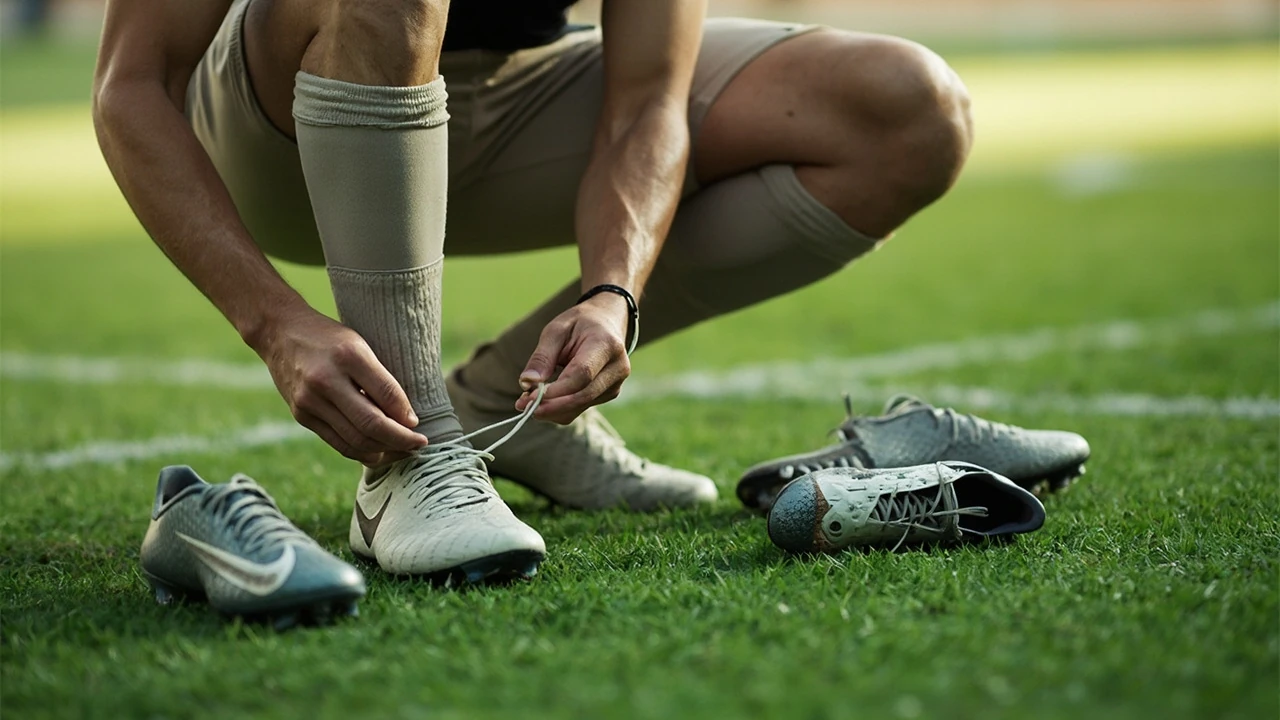
Football cleats: how to choose the right pair for your position and surface
A wide receiver plants his outside foot, cuts back inside, and feels the studs grip the turf cleanly. A youth player, by contrast, slips on a damp Saturday morning because the wrong sole pattern was matched to a wet field. The difference between those two moments usually comes down to one decision: which pair of football cleats the player pulled from the bag. Choosing well is less about brand loyalty and more about matching the shoe to the position, the field surface, and the shape of the foot wearing it.
This guide walks through how football cleats are built, how the stud pattern changes the way a player moves, and which features actually matter for specific positions. It also covers fit, sizing between brands, when to replace a worn pair, and how parents can avoid the most common mistakes when buying a first pair for a child who is still growing.
What counts as a football cleat
A football cleat is a low-profile athletic shoe with studs or blades on the outsole that bite into grass, synthetic turf, or dirt to give a player traction during quick starts, hard cuts, and sudden stops. Unlike a running shoe, a football cleat is built around lateral movement rather than straight-line cushioning. The upper is reinforced at the toe and the heel because the foot absorbs a lot of side-to-side stress when a defender redirects a runner or a lineman fires off the line.
Cleats differ from athletic trainers in three ways that matter to the player:
- Traction. Studs dig into the surface instead of relying on rubber friction alone, so a player can push off without slipping on soft ground.
- Stability. The lower heel-to-toe drop and reinforced midsole keep the foot from rolling when a player plants and cuts.
- Reinforcement. Toe caps, heel counters, and side overlays protect the foot from contact with other cleats, which is a normal part of play at every level.
Outside the United States the same type of shoe is often called football boots, and the sport itself is referred to as soccer. In American football, the term “cleats” covers shoes worn by players in positions from quarterback to kicker. The construction principles, however, are similar: a stiff sole plate, a snug upper, and a stud layout designed for the surface the player trains and competes on.
The main parts of a football cleat
Most buyers focus on color and price, but the parts that affect performance are the same on every pair. Understanding them makes it easier to compare two models and to know when a salesperson’s claim is meaningful.
| Part | What it does | What to look for |
|---|---|---|
| Upper | Wraps the foot and holds it to the sole | Synthetic mesh for breathability, leather or synthetic skin for structure |
| Toe box | Protects toes from contact and provides ball feel | Reinforced at the front; wider for linemen, narrower for skill players |
| Heel counter | Stabilizes the back of the foot | Firm but not rigid; should cup the heel without pinching |
| Midsole | Cushions and absorbs impact | Lightweight foam; low profile for stability |
| Sole plate | Connects the studs to the upper | Stiff enough to spread load, flexible enough to flex naturally with the foot |
| Studs or blades | Provide traction on the playing surface | Length and shape matched to field type and position |
Synthetic uppers are common at every price point now because they are lighter and dry faster than full-grain leather. Leather still has a place for players who want a softer feel and a more custom break-in, especially at the high school and college levels. The trade-off is weight and water absorption after a wet practice.
Cleat cuts: low, mid, and high
Cut refers to how high the upper rises around the ankle. Each cut suits a different style of play and a different injury profile. The right cut is usually a personal decision, but a few general rules help narrow the choice.
| Cut | Ankle support | Weight | Typical positions |
|---|---|---|---|
| Low-cut | Minimal | Lightest | Wide receiver, defensive back, running back, kicker |
| Mid-cut | Moderate | Middle | Quarterback, linebacker, tight end, multi-position players |
| High-cut | Highest | Heaviest | Linemen on both sides of the ball, players recovering from ankle sprains |
Skill players usually prefer low-cut football cleats because the lighter weight and free ankle motion support sharp cuts. Linemen often prefer mid or high cuts because the added structure reduces the risk of rolling an ankle when the foot is caught in a pile. Younger players and those with a history of ankle sprains can benefit from a higher cut, but fit matters more than the height of the collar.
Stud patterns and why the surface matters
Stud configuration is the single biggest variable in how a cleat performs. The two broad families are molded studs and detachable studs, and within each there are patterns designed for grass, synthetic turf, or a mix of both.
Molded cleats
Molded football cleats have studs that are part of the outsole, made of rubber or TPU plastic. They are durable, require almost no maintenance, and are allowed at every level of play from youth leagues through the NFL. Molded patterns are the standard choice for younger players because there are no loose parts to lose and the studs cannot be changed to an illegal configuration.
Detachable cleats
Detachable football cleats use a threaded sole plate that accepts screw-in studs. Players can swap studs of different lengths and shapes to match the field. This is most useful at the high school, collegiate, and professional levels where the same player may train on grass and then play on a different surface the following week. Detachable systems are not typically allowed in youth leagues because the studs can be replaced with non-compliant pieces.
Common stud shapes
Different shapes produce different traction:
- Cone studs give a soft, all-around grip that releases easily. Good for skill players who plant and cut often.
- Blades are flat and wide, providing aggressive grip on softer ground. Common on linemen’s shoes.
- Round studs are a middle-ground option that balances grip and release.
- Heel studs add braking force when stopping from a sprint.
Many modern football cleats mix stud shapes on the same sole to give the player both grip when pushing off and release when cutting. Reading the sole pattern from underneath before buying is more useful than reading the marketing copy on the box.
Matching cleats to the field surface
Using the wrong stud pattern is a common cause of knee and ankle injuries because the foot either locks into the surface or slips unpredictably. Below is a practical way to match the shoe to where the player actually plays.
| Surface | Best stud type | What to avoid |
|---|---|---|
| Natural grass, dry | Molded or detachable with slightly longer studs | |
| Natural grass, wet | Detachable with longer, fewer studs to shed mud | Many short molded studs that clog with mud |
| Modern synthetic turf | Short rubber studs or turf shoes with nubs | Long detachable studs that can catch on the surface |
| Indoor or hard surface | Indoor soccer-style shoes or turf shoes | Any traditional football cleat; studs damage the floor and slip on hard ground |
Most youth players will spend the majority of their season on natural grass or a hybrid field, so a standard molded pattern works well. Players who train and play on different surfaces, including newer rubber-filled turf systems, should ask the coach or athletic director whether metal or long studs are allowed. Many facilities now limit stud length for safety and surface protection.
How cleats fit
A common mistake is buying a pair a half size larger so the player can “grow into them.” That shortcut leads to blisters, black toenails, and slower cuts because the foot slides inside the shoe. Football cleats should fit snugly from heel to toe with about a thumb’s width of space at the front, similar to a running shoe.
Three checks help confirm a good fit before a player takes the field:
- Heel lock. The heel should not lift when the player walks or does a few quick cuts. If the heel slides, the upper is too loose even if the toe room looks right.
- Width across the ball of the foot. The widest part of the foot should sit on the widest part of the sole. Pressure on the sides of the little toe is a sign the shoe is too narrow.
- Toe break. When the player bends the knee and lunges forward, the shoe should flex at the ball of the foot, not in the middle of the arch. A stiff midsole that does not flex here will cause soreness and slow reactions.
Brands do not size identically. A size 10 in one model can fit like a 9.5 in another. Trying the cleat on with the same socks the player will wear in games is the simplest way to catch a sizing problem before it turns into a wasted season.
Position-specific notes
General-purpose cleats work for most recreational players, but athletes who specialize often want a shoe that matches the demands of their role.
Skill positions: receiver, running back, defensive back
Players who change direction the most usually want a low-cut, lightweight football cleat with a responsive sole plate and a moderate molded stud pattern. The lower weight helps acceleration, and a snug upper keeps the foot stable during sharp cuts. A wide toe box helps players who drag their toes when juking.
Quarterback
A quarterback needs a balance of support and feel. Many prefer a mid-cut cleat that still allows the ankle to roll through a throwing motion. A detachable stud pattern lets the quarterback tune the grip for grass or turf without changing shoes.
Linemen
Offensive and defensive linemen need traction when firing off the ball or anchoring against a run. Heavier, more structured football cleats with a high or mid cut and a stiffer sole plate are common. Some linemen prefer wider models because extra room across the forefoot spreads load on long drives.
Specialists: kicker, punter, long snapper
These players plant a single foot dozens of times in a game, so consistent traction is more important than explosive grip. Molded cleats with a balanced stud pattern and a comfortable midsole help reduce joint stress over a long game.
How to break in a new pair
Modern synthetic uppers do not need a long break-in, but a few small habits will keep the feet healthy and extend the life of the shoe.
- Wear the new pair around the house for short sessions with socks before the first practice.
- Start with limited practice time, then work up to a full practice before wearing the cleats in a game.
- Use the laces to fine-tune fit. Players with a high arch often skip the second-from-top eyelet, while players with a narrow heel use a heel-lock lacing pattern.
- Remove the cleats between drills to let the feet air out. Bacteria grow quickly in a warm, damp shoe.
Custom insoles or thin heel cups can correct mild fit issues for players with flat feet or high arches. A typical molded insole that ships in the box is acceptable for most recreational players, but a fitted insole can be a worthwhile upgrade for athletes who train year-round.
Care, cleaning, and when to replace
Football cleats last longer when they are cleaned after every practice. Mud, grass, and field paint dry out the upper and clog the studs. A simple routine is enough:
- Knock loose dirt off the studs with an old toothbrush or a stiff brush.
- Wipe the upper with a damp cloth and a small amount of mild soap.
- Remove detachable studs occasionally and clear out debris from the threaded holes.
- Stuff the cleats with newspaper and let them dry at room temperature. Avoid direct heat, which can warp the sole plate.
Replacement timing is more about the player’s growth and the condition of the sole than a fixed number of months. Three signs that a pair is done:
- Studs are worn flat so the sole feels smooth on grass.
- The toe cap has separated from the upper or the sole plate has visible cracks.
- The player reports heel slip or new blisters in places that did not bother them before.
For youth players, the shoe should also be replaced when the toes reach the front of the toe box or when the foot presses against the sidewalls, even if the cleats still look fine from the outside.
Safety rules and league limits
Most organized leagues publish a list of allowed and banned cleat types. The details vary, but the patterns are similar:
- Metal studs are often restricted at the youth level and may be limited in length at the high school and college levels.
- Conical and blade studs are usually allowed, but some leagues cap the number of studs or require a minimum tip diameter to reduce injury risk.
- Detachable cleats are commonly limited to older age groups because of the risk of an illegal stud being installed by accident.
Coaches and equipment managers typically post a current rule sheet at the start of the season. Checking that sheet before buying a new pair avoids a last-minute swap the day before the first game.
Common mistakes when buying football cleats
Most fit and performance problems come from a small set of recurring decisions. A quick checklist helps avoid them:
- Buying by size alone. Two models at the same stated size can fit very differently. Always try the shoe on with sport socks.
- Choosing the cut for looks. A high-cut cleat does not automatically prevent ankle injuries. A correctly fitted low-cut cleat with a heel-lock lace pattern can be just as safe for a flexible athlete.
- Ignoring the field. Long studs on hard turf cause knee pain, while short molded studs on wet grass cause slips. Match the shoe to the surface the player actually trains on.
- Skipping the toe break check. A shoe that does not flex at the right spot will slow a player down and create soreness in the arch.
- Holding on to a worn pair too long. Studs flatten with use, and traction drops off long before the upper looks worn out.
Budget and value
Price tracks closely with weight, material quality, and the cleat system. A useful way to think about budget is to match the cleat to the level of play:
| Level | Typical features | What to prioritize |
|---|---|---|
| Youth and recreational | Molded studs, synthetic upper, basic midsole | Fit, correct stud pattern, easy cleaning |
| High school varsity | Lighter synthetics, detachable options, more supportive midsoles | Position-appropriate cut, durable sole plate |
| Collegiate and beyond | Premium materials, detachable studs, custom insoles | Specific traction tuning, long-term comfort |
A mid-priced molded cleat from a reputable brand is usually enough for a youth or high school player who is still growing. Premium models are most valuable for athletes who play multiple surfaces, log a heavy practice schedule, or have specific foot shapes that need a particular last.
Frequently asked questions
How should football cleats fit around the toe?
There should be about a thumb’s width of space between the longest toe and the front of the cleat. A snug heel and a stable midfoot are just as important, because too much forward room allows the foot to slide during cuts and leads to black toenails and blisters.
Can I use soccer cleats for football?
They look similar, but soccer cleats are not built for the lateral stress of football. The toe box is thinner, the midsole is more flexible, and the stud pattern is tuned for grass rather than for the variety of surfaces used in football. For a casual kickaround they may be fine, but for organized play it is better to wear a cleat designed for the sport.
What is the difference between molded and detachable cleats?
Molded cleats have studs that are part of the outsole and cannot be removed. Detachable cleats use a threaded sole plate that accepts screw-in studs, so the player can change the length and shape of the studs to match the field. Detachable systems are typically limited to older age groups because of league rules.
Are metal football cleats allowed?
It depends on the league. Youth leagues often ban metal entirely. High school and college associations usually allow them but may limit stud length. NFL players can wear metal in most stadiums. Always check the current rule sheet for the league in question before buying or wearing metal studs.
How do I clean mud out of football cleats?
Let the mud dry, then knock the cleats together and use a stiff brush or an old toothbrush to clear the studs. Wipe the upper with a damp cloth and mild soap, remove detachable studs to clear the threaded holes, and let the shoes dry at room temperature away from direct heat.
How long do football cleats usually last?
For a youth player who is still growing, a pair usually lasts one season or until the foot outgrows it. For a high school or college player, a well-cared-for pair can last one to two full seasons. Replace the cleats when the studs are flat, the upper is separating, or the fit has loosened.
Do wide-foot players need a special cleat?
Several brands offer wide versions of their most popular models. Players with a noticeably wide forefoot should look for cleats that list a wide option, or choose a brand known for a roomier last. Trying the cleat on with the socks used in practice is the simplest way to confirm enough room across the ball of the foot.
What cleat is best for a young player just starting out?
A mid-priced molded football cleat in a low or mid cut is usually the best starting point. It covers the widest range of surfaces, requires no maintenance, and is allowed in every youth league. Fit and correct stud length for the field matter more than the brand name on the box.
How do football cleats compare to baseball cleats?
Both have studs for traction, but baseball cleats often have a toe cleat near the big toe for batting and base-running, while football cleats place studs only at the ball and heel to support lateral cuts. The stud pattern is tuned for the dominant movements of each sport, so using a baseball cleat for football can feel unstable when changing direction.
Do football cleats help prevent injuries?
A correctly chosen cleat reduces slips and rolls, which lowers the risk of ankle and knee injuries on grass and turf. It cannot prevent contact injuries or replace proper training. The biggest protective effect comes from matching the stud length to the surface and keeping the studs in good condition.
Choosing the right pair of football cleats comes down to three questions answered honestly: what position does the player actually play, what surface do they practice on, and how does the shoe fit when laced up with game socks. Once those are settled, the marketing language on the box matters far less than the stud pattern on the bottom and the shape of the last around the foot. For a broader look at how athletic skills move between sports, including the role of balance and body control built through training, see how gymnastics skills transfer to football, basketball and hockey and why gymnastics is the foundation for every sport.