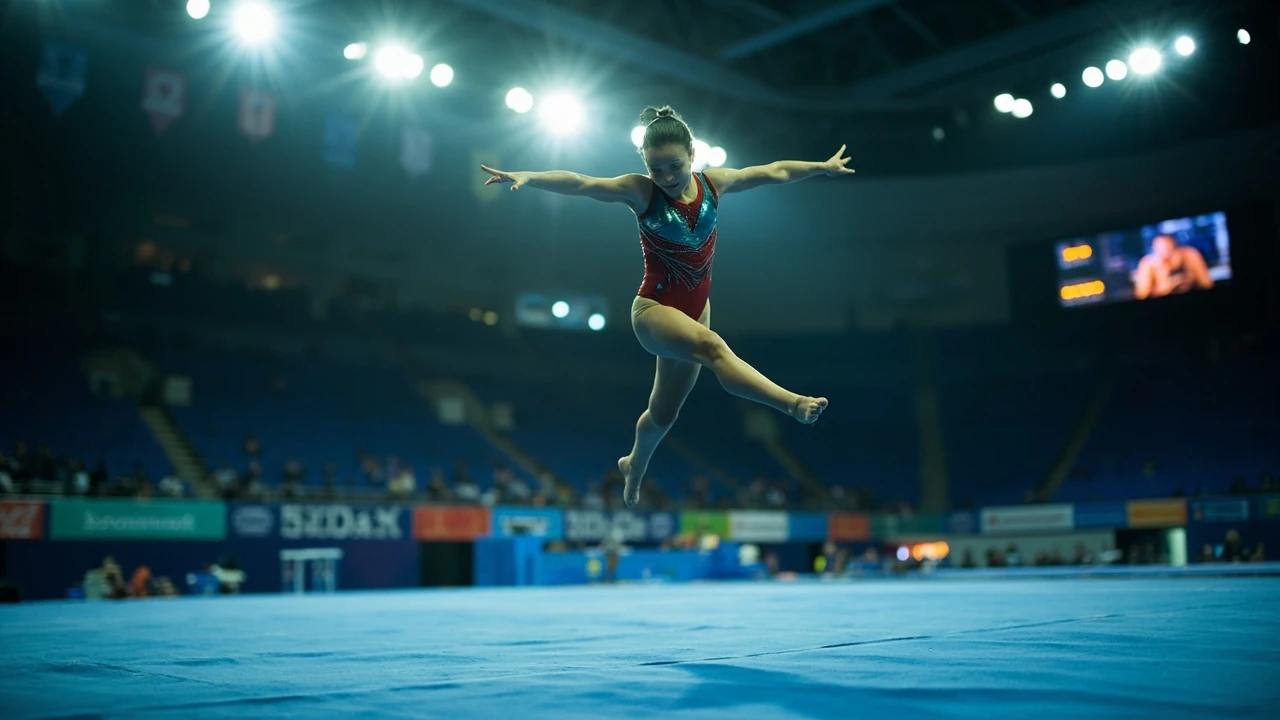
A score of 13.966 on balance beam or 14.200 on floor exercise can feel abstract to a parent watching from the stands for the first time. Those numbers are the visible product of a very specific gymnastics scoring system, one that combines a difficulty rating added to an execution score and then subtracts any deductions a panel of judges records during the routine. Once you know what each part represents, the scoreboard stops looking random and starts reading like a structured evaluation of a routine.
This guide walks through how gymnastics scoring works for artistic gymnastics, the discipline most readers picture when they think of the Olympics or a club invitational. It covers the difficulty score, the execution score, neutral deductions, the role of the inquiry process, the timing rules that matter on floor exercise, and the small differences between how a regional meet and a senior international event handle the same routine. The goal is practical: by the end, you should be able to read a final score, predict where deductions come from, and explain to a young athlete why a routine scored the way it did.
Gymnastics scoring: how the modern system works
Since the open-ended perfect 10 was retired after the 2004 Olympic cycle, artistic gymnastics scoring has used a two-part formula. The final score is calculated as D-score + E-score − neutral deductions. The D-score represents the difficulty and content of the routine, the E-score reflects how cleanly it was performed, and neutral deductions cover outside-the-arena penalties such as stepping out of bounds or exceeding a time limit. The system is administered internationally by the Fédération Internationale de Gymnastique (FIG), and most national federations adopt it with minor modifications for their domestic competitions.
For the casual viewer, the most useful shortcut is this: if you want a higher score, you either need a harder routine performed more cleanly, or both. A routine with high difficulty and visible wobbles can still outscore an easy routine performed perfectly, which is part of why coaches keep pushing athletes into riskier combinations as they mature.
The D-score: difficulty and content
The D-score, sometimes called the difficulty value, captures the hardest elements in the routine plus the value of the connection skills performed between them. Two components feed into it:
- Element value. Every recognized skill in the FIG Code of Points is assigned a difficulty rating from A (easiest) through I (hardest). Eight of the highest-counting skills across the routine are summed, and the total is added to the D-score. If a gymnast performs more than eight counting skills, only the eight most difficult are kept; if she performs fewer, no bonus or penalty is applied.
- Connection value. When specific elements are performed back-to-back, the gymnast earns an extra connection bonus. A common example is a back handspring followed immediately by a layout step-out: each element has its own difficulty, but the connection is worth an additional 0.1 or 0.2 depending on the skills involved.
Composition requirements also feed into the D-score indirectly. On each apparatus, the Code of Points lists specific element groups that must be present, such as a 360-degree turn on the turntable side of beam or a circle element with the hips leaving the bar on uneven bars. If a routine is missing a required group, a neutral deduction applies later; if it is missing entirely, the routine cannot receive credit. In adult competition, there is no cap on the D-score, which is why senior elite totals have climbed steadily since 2005.
The E-score: execution and artistry
The E-score starts at 10.0 and falls with every visible flaw. A panel of judges, traditionally two on each side of the apparatus, watches in real time and records deductions in 0.1, 0.3, or 0.5 increments. The high and low marks for each routine are dropped and the middle values are averaged, which protects against an unusually strict or lenient judge.
Common execution deductions include:
- 0.1 for small form breaks, slightly bent knees, flexed feet, or imprecise arm circles.
- 0.3 for clear wobbles, hops on landing, or extended arm bends on a handstand.
- 0.5 for major balance checks, a large step on landing, or touching the apparatus with a hand to stay on.
- 1.0 or more for a fall, where the gymnast comes off the apparatus or onto the mat.
Artistry deductions sit inside the E-score as well. On floor exercise, lack of synchronization with the music, an empty corner, or a visibly unengaged choreography are recorded separately from the technical execution. On beam, pauses longer than two seconds or an obvious moment where the gymnast resets mentally can also trigger an artistry deduction. Coaches spend a lot of time teaching athletes that the work does not stop when the last tumbling pass lands.
Neutral deductions and other penalties
Neutral deductions are taken by a separate judge, usually seated at the head table, and are subtracted from the final total rather than from the E-score. They cover rules that exist outside the routine itself:
- Out of bounds. Touching or stepping outside the designated line on floor exercise costs 0.1 per occurrence.
- Time violations. Floor routines that run more than 90 seconds for seniors, or 60 to 90 seconds for juniors, receive a 0.1 deduction. Beam routines over 90 seconds are similarly penalized.
- Line violations on beam. Both feet leaving the beam surface costs 0.3; one foot leaving costs 0.1.
- Attire or coach presence. Unauthorized jewelry, an untied leotard, or a coach stepping on the mat during a routine can each trigger a fixed deduction.
Neutral deductions are small in size but matter when the difference between first and second place is 0.05, which it routinely is in elite finals.
How judges actually evaluate a routine
Before a competition, judges attend a course run by their national federation where they study the Code of Points, watch video examples, and take written and practical exams. At the meet, the judging panel includes a D-panel, which confirms the difficulty value submitted by the coach, and an E-panel, which records execution deductions in real time. The chief judge on each apparatus resolves disputes and signs off on the final calculations.
Behind the scenes, the D-panel checks the coach’s submitted skill list against what the gymnast actually performed. If a coach lists a skill the gymnast did not complete, the D-score is adjusted down. This is one reason a coach can sometimes be more conservative with the value sheet than the routine itself: it is worse to claim a skill that did not happen than to undervalue a clean performance.
What an inquiry does and when to file one
If a coach believes the panel missed an element or miscalculated a connection, they can file an inquiry, usually within a strict window after the score is posted. The inquiry is reviewed by the D-panel using video, and the score can go up, down, or stay the same. Filing an inquiry that fails costs the coach a fee in some federations, which encourages careful use.
For parents and athletes, the inquiry process is worth understanding because it occasionally changes a medal order, and because the brief pause after a score is posted is not a sign that anything is wrong. The system is built to allow a quiet second look without a public challenge.
How apparatus differ in scoring weight
Every apparatus uses the same D + E − neutral formula, but the kinds of skills that earn difficulty credit vary widely. The table below shows the dominant skill groups judges look for on each event.
| Apparatus | Key difficulty elements | Common E-score deductions | Special rules |
|---|---|---|---|
| Vault | Yurchenko family, Produnova, Cheng, Amanar | Form on pre-flight, distance and dynamics on landing | Two vaults allowed in finals; final score is the average |
| Uneven bars | Release moves (Tkatchev, Gienger, Jaeger), pirouettes, inbars | Handstand angles, amplitude on releases, close-grip catches | Dismounts must be from the high bar; fall on low bar only ends that element, not the routine |
| Balance beam | Aerial cartwheels, layout series, back handspring layouts, full turns | Wobbles, bent knees in leaps, foot form on turns | Both feet leaving the beam costs 0.3; one foot costs 0.1; routine capped at 90 seconds |
| Floor exercise | Triple twisting doubles, double layouts, combinations with Arabian elements | Landing steps, out of bounds, choreography with the music | Diagonal corners must be used; music must include a clear finish |
| Pommel horse (men) | Thomas flares, Sivado, Magyar, spindle work | Height of travels, center, pauses | No handstands required, but amplitude and clean travel are heavily rewarded |
| Still rings (men) | Iron cross, Maltese, planches, strength holds | Held positions shaking, swing amplitude, dismount | Strength elements must be held for two seconds |
| Parallel bars (men) | Diamidov, Healy, peach baskets, pirouettes | Bent arms, handstand alignment, swing rhythm | Dismount acrobatics scored like floor difficulty |
| Horizontal bar (men) | Release moves (Tkatchev, Kolman, Yamawaki), Adler lines | Release amplitude, handstand lines, dismount form | Giant swings, not casts, are the connective tissue |
The point of the table is not to memorize every skill but to notice a pattern: the more difficult the typical skill set, the more a small form break costs, because the athlete is already working near the limit of what is possible.
Difficulty levels at a glance: compulsory, optional, and elite
Not every level uses the full open-ended D-score. Most clubs and federations run at least three layers of competition, and the gymnastics scoring system changes between them.
| Level | Typical age | Scoring method | Skill expectations |
|---|---|---|---|
| Compulsory levels (1–5, JO) | 5–14 | Pre-set routines scored out of 10.0 with set deductions | Standardized across the country; emphasis on clean execution |
| Optional levels (6–10, JO) | 8–18 | Open-ended D-score plus E-score up to 10.0, capped in some levels | Custom choreography and chosen elements, with limits on difficulty |
| Pre-elite and elite | 13+ | Full open-ended D-score, no cap | Most difficult international elements; qualifying path to World Cups and the Olympics |
If you are watching a Level 4 meet and a senior elite meet in the same weekend, you will see very different gymnastics scoring behavior. At Level 4, every athlete performs the same routine, and the highest score belongs to whoever executes it most cleanly. At the elite level, a clean routine on easy skills can lose to a wobblier routine on a much harder set, because the difficulty gap is wider than the deduction gap.
A worked example: reading a final score
Suppose a senior elite gymnast finishes beam with the following result on the scoreboard: D-score 5.8, E-score 8.366, neutral deductions 0.1. The total posted is 14.066, calculated as 5.8 + 8.366 − 0.1.
- The 5.8 means the eight most difficult skills summed to roughly 4.6 and the connection work added 1.2, with composition requirements met.
- The 8.366 execution score implies about 1.634 in deductions, which is consistent with a routine that had a couple of 0.3 wobbles, a 0.1 bent-knee on a leap series, and a 0.1 step on the dismount landing, plus a small artistry note.
- The 0.1 neutral deduction could be one foot leaving the beam on a dance series, or a 0.1 time violation on a routine that ran slightly long.
If the same routine had been performed with no balance checks at all but with one of the difficult skills downgraded to an easier version, the D-score might drop to 5.2 while the E-score climbs to 8.766, producing a final of 13.866. The harder, wobblier version wins, which is precisely the trade-off coaches manage throughout a career.
Common mistakes that drag down a score
Most deductions at the club and developmental level are not the spectacular falls that grab attention. They are the small, repeated form breaks that add up. Coaches looking at score sheets tend to flag the same patterns:
- Flexed feet and soft knees on leaps. The split jump and switch leap are worth real difficulty, but the E-score demands a stretched position. A leap that looks fine to a parent can easily be 0.3 to 0.5 in deductions by the time judges finish with the form.
- Short handstands on bars and beam. A handstand that is two degrees off vertical looks like a handstand to a casual observer, but judges see it as an obvious form break, and on bars it can affect the value of the next element.
- Late twists on tumbling. A double tuck that finishes its rotation on the second flip looks clean in slow motion but the late landing often costs 0.1 to 0.3 in execution.
- Choreography gaps on beam. Standing still between elements for more than two seconds can read as artistry loss even when the next skill is performed well.
- Landing control on beam. A small arm adjustment on the dismount costs 0.1. A noticeable step costs 0.3. A deep squat or a stumble out of the routine can run much higher.
Tracking these in training, even on a simple clipboard, gives coaches a clear view of which habits will quietly drain points at a meet.
Why the difficulty score keeps climbing at the elite level
Each four-year Olympic cycle, the Code of Points is updated, and several factors push the average D-score upward. New skills get added at the top of the rating scale, older skills are re-evaluated, and the connection bonuses are restructured to reward specific combinations that are now considered standard. As a result, the difficulty score that would have won an Olympic all-around in 2008 would not reach the podium in 2024.
For families, this is worth knowing because progress is not linear across generations. A skill that was once elite-only can become the entry point for a national-level program, and an athlete whose parents were once impressed by a 6.0 D-score is now expected to compete at 5.0 or higher in the junior optionals. Coaches managing expectations benefit from explaining that the system itself is moving, not that the athlete is behind.
How a club meet and an international final actually differ
At a typical club invitational, the panel usually includes one D-judge and two to four E-judges, with the high and low scores dropped. At a World Cup or Olympic final, the panel is larger, the technology is more precise, and the difficulty values are verified against multiple video angles. The math is the same, but the precision of the evaluation increases, and so does the cost of any mistake.
Parents often notice that the same routine scores higher at a local meet than at a regional qualifier. There is no conspiracy behind this: the local panel may be more lenient, the regional meet may attract judges with stricter calibration, and the D-score may be higher because the gymnast is performing harder skills. All three of these effects are at work at once.
If you want to understand the way a particular judging panel tends to call the sport, ask the coach which meets the panel has worked previously and how the deductions have trended. Coaches pay close attention to this because the choice of which meets to attend, especially in qualifying years, can be as much about the panel as about the athlete’s form on the day.
How a coach uses scoring to plan a season
A coach does not just look at the final score on Saturday. They break the score apart and use each piece as a training target. The D-score tells them whether the planned routine content was achieved. The E-score tells them where execution is leaking points. The neutral deductions tell them whether the athlete is managing the mental and logistical side of competition.
Useful season planning tends to look like this:
- After each meet, list the three largest E-score deductions by event.
- Identify whether the lost D-score is from missed connections, missed composition requirements, or downgraded skills.
- Set a one-month training block to address the largest single deduction, rather than spreading attention across all of them.
- Re-evaluate at the next meet and adjust the priority list.
Athletes, especially in the optional levels, benefit from being shown this process. When a young gymnast understands that 0.3 in bent-knee deductions on leaps is a different problem from 0.5 in late twists on tumbling, the work in the gym becomes more specific and less frustrating.
Reading the scoreboard during a meet
The electronic scoreboard at a gymnastics meet can be confusing, especially early in the program. A few practical tips help:
- Look for the running running order. The D-score is typically displayed after the routine, once the D-panel has confirmed the value sheet, and the E-score is displayed after the execution panel has averaged its marks.
- Watch the chief judge if you are near the floor. A raised hand usually means a deduction has been recorded; a long pause often signals a calculation rather than a problem.
- Wait for the official posting before reacting to an announced score. Scores on the board can briefly flash the running average before the final mark is locked in.
- Note the time stamp on the scoreboard. Some meets post scores in a different order than the running order, and a quick look at the time prevents confusion.
For first-time meet parents, the most useful adjustment is simply to let the first few scores go by without trying to interpret them. By the second or third routine on each apparatus, the rhythm of the panel becomes easier to read.
The role of the athlete in the scoring conversation
Scores can be emotional, especially for teenagers. A useful approach is to treat the score as a piece of information about a specific routine on a specific day, rather than as a verdict on the athlete. Coaches who build a habit of reading the score together with the athlete, going through each event and identifying what changed since the previous meet, tend to keep the conversation constructive.
For younger athletes, parents can help by asking what the athlete is most proud of in the routine and what they want to fix in the next training week, rather than focusing on the final number. The number is the end of the chain, not the beginning.
What gymnastics scoring looks like in other disciplines
The focus here is artistic gymnastics, which is what most readers picture when they search for gymnastics scoring. Two adjacent disciplines use very different systems:
- Rhythmic gymnastics uses the same D + E − neutral structure, but the difficulty elements are body difficulties, apparatus difficulties, and dance-style combinations. The D-score is open-ended, and the E-score starts at 10.0 with deductions for technical execution and artistry.
- Trampoline gymnastics evaluates a routine primarily on the difficulty of the ten skills performed, the time of flight, and the horizontal displacement of the landings. Falls and out-of-bounds landings are heavily penalized, often costing more than in artistic gymnastics.
- Acrobatic gymnastics, tumbling, and double-mini trampoline use their own difficulty tables and tariff sheets, and the judging panels include specialists for the partnership skills that are unique to those events.
If you follow more than one discipline in the same household, the easiest way to keep them straight is to track the highest possible D-score on each event. The fact that artistic beam can reach a 6.5 D-score, while a high-level rhythmic clubs routine might top out around 4.0, is one quick way to spot which discipline a particular meet is running.
How parents can use scoring language productively
The language families use at home shapes the way athletes interpret their scores. A few small shifts help:
- Talk about routines, not just results. A clean routine that scored well because the content was easy is different from a wobbly routine that scored well because the content was hard, and the difference matters when planning the next month of training.
- Use the specific terms. Saying “the E-score dropped 0.4 today, mostly on bent knees” gives the athlete something concrete to work on, where “you had a rough beam” does not.
- Distinguish between training and competition scores. Practice scores often include deductions coaches are deliberately adding to build habits, and they should not be compared to meet scores directly.
- Be patient with the difficulty curve. Most athletes add difficulty unevenly across the season, and a stretch of lower scores while a new skill is being added is normal.
None of this requires a technical background. Coaches are usually happy to walk a parent through the score sheet once, and from that point the vocabulary is enough to keep the conversation grounded.
When to ask the coach for a scoring breakdown
A brief, structured conversation after each meet is more useful than a long debrief at the end of the season. Asking the coach for the largest single deduction per event, the largest composition gap, and any change in the D-score from the previous meet produces a clear picture in under five minutes. Most coaches appreciate the question because it saves them from having to reframe the entire meet later.
For meets where the result felt surprising, ask the coach whether the surprise came from the panel, the routine, or the difficulty sheet. Each of those has a different fix, and a good coach will be able to point to one of them quickly.
Frequently asked questions
What are the two parts of a gymnastics score?
The final score is the sum of the D-score, which represents the difficulty of the routine, and the E-score, which starts at 10.0 and is reduced by execution and artistry deductions. Neutral deductions, such as out-of-bounds steps or time violations, are then subtracted from that total.
Why is the perfect 10 no longer used in elite gymnastics?
The open-ended perfect 10 was retired after the 2004 Olympic cycle because the difficulty of routines had grown past the ceiling of a single number. The current D + E system allows difficulty to keep rising while execution is still scored on the familiar 10.0 scale.
How many skills count toward the D-score?
Up to eight of the highest-difficulty skills in a routine count toward the D-score. If a gymnast performs more than eight, only the most difficult are kept. Connection bonuses are added on top of the element values.
What is the difference between a D-score deduction and an E-score deduction?
A D-score issue means the panel did not credit the skill as performed, which lowers the difficulty value of the routine. An E-score deduction is taken for imperfect execution or artistry of a skill that was credited. Both are real losses, but the fix in training is different.
How is vault scored when an athlete performs two vaults?
At events where two vaults are permitted, such as major international finals, the final score on vault is the average of the two marks. Most domestic meets only allow one vault, in which case the single mark is the score.
What is a fall worth in gymnastics scoring?
A fall, defined as the gymnast coming off the apparatus, off the side of the beam, or onto the floor, costs at least 1.0 in E-score deductions. The exact value depends on the apparatus and the severity of the fall, and a fall is one of the few deductions that a single mistake can produce on its own.
Can a coach challenge a score after a routine?
Yes, through a written inquiry that is reviewed by the D-panel using video. The score can go up, down, or remain the same. Some federations charge a fee for an unsuccessful inquiry, which encourages careful use of the process.
Do compulsory levels use the same scoring system as elite?
No. Compulsory levels use pre-set routines scored out of 10.0 with fixed deductions, so the D-score is not really a variable. Optional levels introduce the open-ended D-score with caps in some levels, and only the elite level uses the full open-ended system without a cap.
How long is a typical floor routine, and what happens if it runs long?
Senior floor routines are limited to 90 seconds, and the music must include a clear finish. A routine that runs more than the time limit receives a 0.1 neutral deduction, which is small but can matter in close competition.
Why do two judges on the same panel see different deductions?
Judges sit in different positions, focus on different skill groups, and may catch different details. The high and low scores are dropped and the middle values are averaged, which is one of the safeguards built into gymnastics scoring to keep a single judge from deciding the result alone.