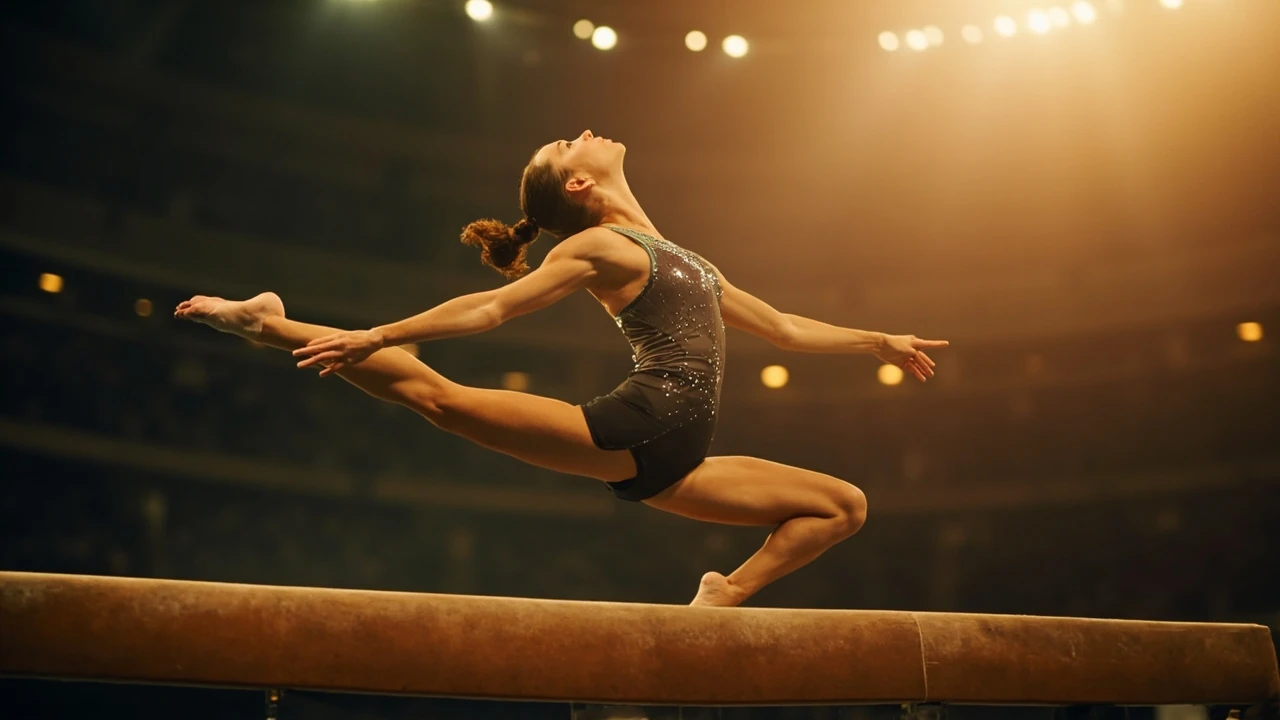
Why gymnasts point their toes in routines
A pointed foot is one of the first corrections a judge notices in a gymnastics routine. Before the difficulty of a skill is even counted, the line of the leg and the shape of the foot signal whether the gymnast has trained with care. Pointed toes finish a leap the way a period finishes a sentence, and that is exactly why gymnasts point their toes in routines, from compulsory levels through elite international competition. The same cue shows up in dance, figure skating, and synchronized swimming because the position changes how a moving body looks and how it feels to land.
This article walks through the biomechanics of a pointed foot, the judging consequences of a flexed one, the way coaches drill the habit, and the small training choices that build it. It is written for gymnasts, parents, coaches, and judges who want a clear, practical explanation rather than a slogan.
The biomechanics behind a pointed foot
A pointed foot is not a single muscle action. It is a coordinated effort through the ankle, the small muscles of the foot, and the long muscles of the lower leg, all working in a specific range of plantarflexion.
Plantarflexion describes the movement of the foot as the toes move away from the shin. In a standing position the ankle sits close to a 90-degree angle. In a fully pointed position the angle between the top of the foot and the front of the shin closes to roughly 150 to 170 degrees, depending on joint mobility and training. The movement is driven by the gastrocnemius and soleus in the calf, supported by the tibialis posterior, the peroneal muscles, and the long flexor tendons that run through the arch and into the toes.
Several physical variables determine how far a gymnast can point:
- Ankle joint range of motion. The talocrural joint limits the angle. Some gymnasts have naturally mobile ankles; others build range through slow, careful stretching over months.
- Flexibility of the calf complex. Tight gastrocnemius and soleus muscles block the foot from reaching its full range, so the line of the leg looks short.
- Strength of the deep foot muscles. The small intrinsic muscles of the foot, including the flexor digitorum brevis and the lumbricals, hold the toes in a long, active position rather than letting them collapse into a sloppy curl.
- Toe mobility. The metatarsophalangeal joints need to flex so the toes extend forward. Tight toe extensors can make even a flexible ankle look bunched.
When all of these systems work together, the foot forms a continuous line with the front of the shin. From the audience seats or a judge’s table, that line reads as control. A flexed foot breaks the line and instantly draws attention to the joints instead of the skill.
How a pointed foot changes the line of a skill
Coaches talk about “line” because judges, scoring systems, and spectators all read line before they read anything else. A pointed foot is the smallest unit of line. Without it, the leg looks broken at the ankle, and the eye stops there instead of traveling along the movement.
Consider a switch leap on beam. The back leg drives up and through, the front leg reaches forward, and the whole body forms a near-180-degree split in the air. If the back foot is flexed, the leg looks as if it has been chopped off at the ankle, and the leap appears shorter than it is. With a pointed foot, the back leg reads as one long shape, the split looks wider, and the leap looks higher. Nothing about the actual range of motion has changed; the perception has.
The same logic applies on floor exercise. A double tuck with tight legs and pointed feet looks sharper, faster, and more controlled than the same skill performed with loose feet, even when the tuck shape is identical. Coaches use the cue “long toes” because it works on perception.
| Skill | Flexed foot appearance | Pointed foot appearance | Visual effect |
|---|---|---|---|
| Switch leap on beam | Back leg looks short, split reads smaller | Back leg forms one line, split reads larger | Line extension, cleaner separation |
| Double tuck on floor | Feet look heavy, rotation looks rushed | Feet look light, rotation looks controlled | Tighter shape, sharper finish |
| Yurchenko timer | Block looks compressed | Block looks extended | Higher trajectory, better post-flight |
| Toe-on Tkatchev on bars | Hip contact looks awkward | Body reads as compact and long | Cleaner repulsion, better amplitude |
| Tour jete half on floor | Free leg looks short | Free leg reads as a continuation of the body | Improved horizontal line |
What judges look for in foot and toe position
Judging in artistic gymnastics follows the Code of Points published by the Federation of International Gymnastics (FIG). The current code separates execution scoring from difficulty scoring. Foot position falls almost entirely under execution, which is the side of the score that punishes form breaks rather than rewarding difficulty.
Common execution deductions related to foot shape include:
- Flexed or sickled feet. A small but consistent deduction taken every time a foot is visibly not pointed in a leap, jump, or acrobatic series.
- Legs apart in tucked or piked positions. Loose feet often travel with loose knees, and judges bundle these deductions together.
- Bent knees on landing. A pointed foot is much easier to hold with a stable, fully extended leg, so foot position correlates with the quality of the landing.
- Shape breaks during flight phases. Flexed feet in a salto or leap count against the aesthetic shape, and the deduction is repeated if the break happens more than once in the same element.
At compulsory levels, where every gymnast performs the same routine, deductions for foot position are one of the easiest ways to separate athletes who look polished from those who still need technical work. At optional and elite levels, the deductions remain but get added to a much longer list of execution criteria, which is why foot position can quietly cost several tenths across a routine without a single dramatic error.
Why a pointed foot actually makes some skills easier to perform
Perception is only part of the story. A pointed foot also changes the physics of certain skills. A few examples make this concrete.
1. Leaps and jumps. Pointing the foot lengthens the lever of the leg. A longer lever moves more mass further from the hip joint, which gives the leap a more stretched shape and, in many cases, slightly more time in the air because the rotation of the limbs contributes to the body’s overall angular momentum. A flexed foot shortens the lever and makes the leap look and feel less extended.
2. Round-offs and back handsprings. The set, or the push from the floor, depends on a long, rigid line from the hands through the legs and into the toes. A flexed foot at the end of the set costs the gymnast the last few centimeters of amplitude and tends to bring the hips low on landing.
3. Bar work and release moves. Long toes during a cast, a hip circle, or a release move create a visual impression of height and a real impression of control. The hollow body position that coaches drill on bars depends on the toes being driven in one direction and the head in the other. A flexed foot shortens the line and makes the hollow shape harder to hold.
4. Dance elements on beam. Beam dance work is judged very strictly on foot shape. A full turn, a split jump, or a wolf hop looks dramatically different with pointed feet, and the deduction schedule is unforgiving on that apparatus because beam already has its own balance penalties.
| Apparatus | Skills most affected by foot position | Main benefit of a pointed foot |
|---|---|---|
| Floor exercise | Tumbling passes, leaps, dance combinations | Cleaner shape, longer-looking leaps, sharper landings |
| Balance beam | Acro series, leaps, full turns, dismount | Better line, fewer execution deductions, cleaner beam contact |
| Uneven bars | Casts, hip circles, releases, dismount | Stronger hollow shape, more amplitude on releases |
| Vault | Run, hurdle, block, post-flight | More dynamic block, cleaner body line off the table |
| Pommel horse | Scissors, flairs, circles, dismount | Smoother circles, controlled leg extension |
How coaches build the habit
Most gymnasts do not have naturally perfect feet. A pointed foot is built the same way any other technical habit is built: through consistent daily work, specific cues, and progressive overload on the relevant joints and muscles.
A common progression in a recreational or pre-team program looks like this:
- Ankle and calf flexibility with slow, supported stretches, such as a press-up on the wall with heels down or a band-assisted ankle stretch held for 30 to 60 seconds.
- Toe strength with towel scrunches, marble pickups, and short-foot drills that wake up the small muscles of the arch.
- Active pointing in long-sitting positions, where the gymnast points and flexes the foot slowly to learn the difference between a real point and a curl.
- Standing pointed positions at the barre or in front of a mirror, where the gymnast holds a tendu or a relevé and learns to keep the toes long under load.
- Skill-specific drills on each apparatus, where the foot shape is cued during the exact skills that will be performed in competition.
Coaches usually pick a single verbal cue and use it across the whole program. “Long toes,” “reach through the toes,” “toes to the wall,” and “paint the ceiling with your big toe” are all variations of the same idea. The cue is less important than the consistency with which it is delivered.
Visual feedback matters as much as verbal feedback. Many gyms use mirrors at the barre, video review on a tablet, and slow-motion playback of skills so the gymnast can see the difference between a flexed foot and a pointed one at full speed. The brain learns faster when the eye can confirm what the coach is describing.
Common mistakes that keep feet from pointing
Even with daily drills, a few habits sabotage foot position. Coaches usually address these first because they show up everywhere in the routine.
- Tight shoes outside the gym. Gymnasts who wear stiff or narrow shoes during the day can lose ankle mobility over time, particularly during growth spurts.
- Skipping warm-up. The calf and foot respond to a slow warm-up better than a cold stretch. A five-minute jump rope set, a quick dynamic ankle series, and a few active points are usually enough to bring the foot to its working range.
- Crunching the toes instead of reaching them. Many beginners try to “point harder” by curling the toes, which actually shortens the foot. The cue is to reach the toes in one direction while the ankle does the work.
- Forgetting the foot on landings. The flight phase is usually well coached, but the moment the foot touches the ground, the toe collapses. Drills that emphasize a held point through the landing are the simplest fix.
- Training the foot in isolation only. A foot that points beautifully on the floor can still collapse under the stress of a real skill, so the cue has to be carried into every event.
The role of foot position in artistry scores
The FIG code rewards artistry separately from difficulty, particularly on floor exercise and balance beam. Artistry covers the way the routine looks, the musicality of the choreography, and the use of the performance area. A pointed foot is part of that package. Dancers call it “extending the line,” and gymnastics borrows the same vocabulary for the same reason.
Judges in artistry roles are not scoring the foot in isolation. They are responding to the cumulative impression of a clean, long, expressive body. Flexed feet add small interruptions to that impression. Pointed feet support it. In close finals, where difficulty totals can be near identical, artistry is one of the tiebreakers, and foot position quietly contributes to the score.
How a pointed foot protects joints over time
There is a practical, long-term reason that coaches insist on pointed feet beyond how the routine looks. A pointed foot in the air and on the floor distributes force more evenly through the ankle and the front of the lower leg than a flexed foot does. A flexed foot in a hard landing or a sharp direction change concentrates force in the heel and the back of the ankle, which is one of the more common places for overuse injuries in young gymnasts.
Active pointing also recruits the small stabilizing muscles of the foot, which support the arch and reduce the strain on the plantar fascia during repeated spring work. None of this turns a poorly trained foot into a bulletproof one, but it is part of the broader argument for training foot position as a habit rather than a detail.
Drills that improve foot position quickly
The drills below can be added to a regular training session without extra equipment. Most take only a few minutes.
- Towel foot pulls. Sit with legs extended, loop a towel around the ball of the foot, and gently pull the foot into a point while pressing the toes forward against the towel.
- Toe taps with a partner. A partner taps the sole of the foot with a finger; the gymnast responds by reaching the toes toward the tap. The drill is fast, engaging, and easy to scale.
- Slow-motion leaps. Perform a leap at quarter speed on a soft surface, holding the pointed position at the top of the jump for a count of two before landing. The slow tempo forces the muscles to hold the shape.
- Pointed relevés. Rise onto the balls of the feet in parallel, then turn out, holding a stable line through the toes for 10 to 20 seconds at a time.
- Beam toe-touches. Walk across the beam with exaggerated toe reaches, focusing on the moment the toe leaves the beam and the moment it returns.
How foot position fits into the larger Code of Points
Foot position is a small line item inside a much larger execution system. The current FIG execution score starts at 10.0 and is reduced by judges for every visible form break. The deductions are small individually, often only 0.1 or 0.3 per occurrence, but they accumulate across a routine. A gymnast with three flexed-foot deductions in a routine has already lost a full tenth, which can be the difference between two adjacent places in a final.
For gymnasts who do not yet compete under the FIG code, the same logic applies. Compulsory and JO-level routines have their own execution expectations, and judges at those levels are often more strict on foot shape because the difficulty is lower and the form has more room to stand out.
How parents can support foot position at home
Parents cannot coach from the sideline, but they can support the habit at home with small, simple choices.
- Encourage barefoot time. The foot works through a fuller range of motion without shoes, and the small muscles stay more active.
- Pick flexible, well-fitted shoes for daily wear. A shoe that bends easily at the ball of the foot is friendlier to ankle mobility than a rigid one.
- Support a short, regular stretching routine. A two-minute calf and foot stretch in the evening, done consistently, adds up over a season.
- Talk about the why. A gymnast who understands the connection between foot position and scoring is much more likely to focus on it during practice.
How this connects to the rest of a gymnastics program
Foot position is one of the small technical habits that ties a program together. A gym that cues long toes on the floor will usually also cue long toes on beam, in leaps, in choreography, and in dance. The cue becomes a thread that runs through the season, and the gymnast carries it into every new skill.
That same thread shows up in adjacent topics, from beam drills that build confidence and clean lines on the artistic beam, where foot position is part of every dance series, to gymnastics scoring explained: how routines are judged and counted, where the small execution deductions for foot shape are spelled out in detail. Reading these alongside the current article gives a fuller picture of why the smallest cues matter so much in this sport.
Frequently asked questions
Do judges really deduct for flexed feet?
Yes. Flexed or sickled feet are a standard execution deduction in the FIG Code of Points and in most national and developmental codes. The deduction is small per occurrence, usually 0.1, but it can add up across a routine.
How long does it take to improve a pointed foot?
Most gymnasts see meaningful change in four to eight weeks of consistent daily work, with bigger changes over a full season. Flexibility responds slowly, so patience matters more than intensity.
Can older gymnasts still improve foot position?
Yes. Adult gymnasts, masters competitors, and dancers all continue to refine their foot position well into their careers. The training just looks different because the warm-up is longer and the joint care is more deliberate.
Is pointing toes the same as sickling?
No. A pointed foot is a long line through the ankle, with the toes reaching away from the shin. A sickled foot turns the sole inward or outward, usually because the ankle rolls instead of flexing cleanly. Both are execution deductions.
Do boys point their toes in gymnastics too?
Yes. Foot position is judged on men’s floor, pommel horse, rings, parallel bars, and horizontal bar as well. The cue is the same even though the choreography is different.
Should gymnasts stretch their feet every day?
Daily gentle work helps, but aggressive stretching can inflame the ankle joint or the plantar fascia. Slow, supported, pain-free work is more effective than a hard pull.
Does foot position affect difficulty scoring?
Indirectly. Difficulty is counted from the code symbol, but a skill performed with a flexed foot may be queried by the jury and may not receive full value if the shape is not recognized. The bigger risk is the execution deduction, which hits the other side of the score.
What is the best cue for a beginner?
Most coaches use a short cue like “long toes” or “reach through the toes.” Pick one cue, use it everywhere, and let the gymnast feel the difference between a real point and a curl.
How does foot position connect to artistry?
Artistry rewards the overall impression of the routine. Pointed feet support that impression by creating a long, uninterrupted line, which is one of the qualities judges respond to in artistry scoring.
What happens if a gymnast cannot point fully?
Limited ankle range is common, and most gymnasts can improve it with steady training. The improvement is rarely instant, so consistent work over months is the usual path. Coaches adjust drills to match each athlete’s range rather than forcing a shape the body cannot yet hold.