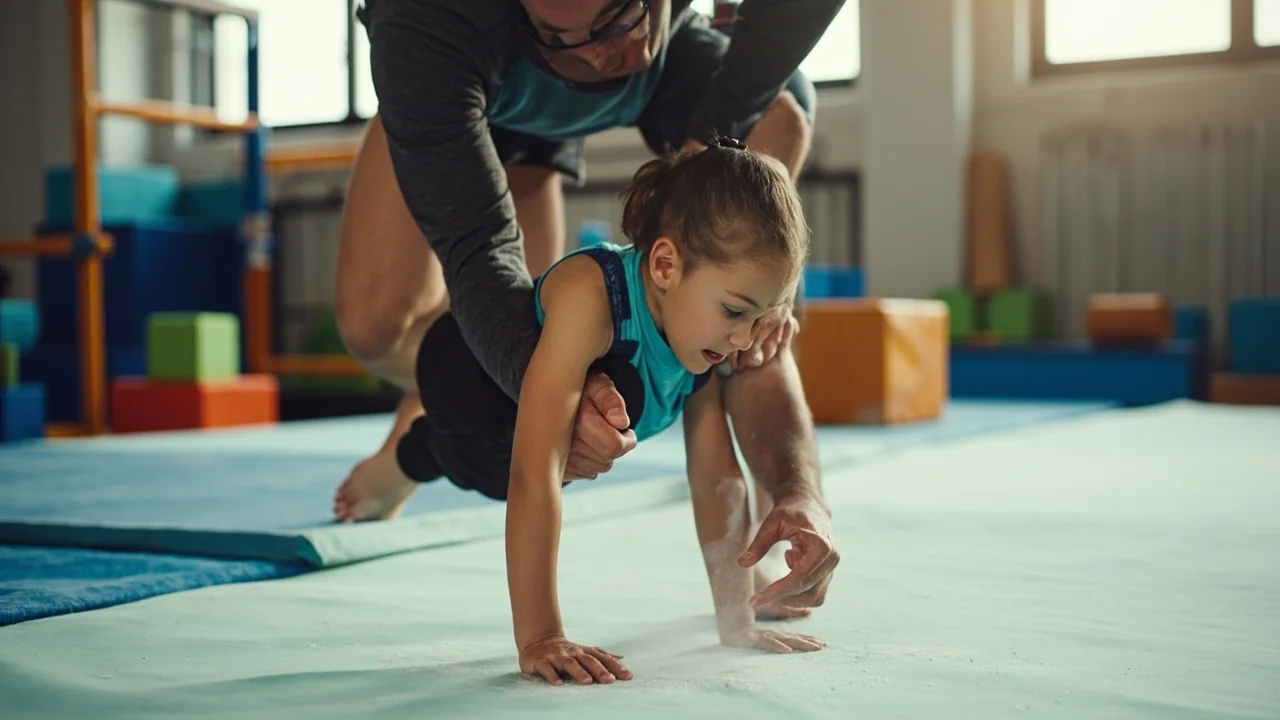
Gymnastics skills for beginners: what to learn first
A first gymnastics class can feel complicated because experienced gymnasts move quickly between handstands, rolls, leaps, and apparatus skills that beginners have never tried. The best starting point is much simpler: learn how your body balances, how your hands support weight, and how to control a movement before adding speed or height. Good gymnastics skills for beginners are built from repeatable fundamentals rather than from attempting the most difficult tricks first.
Beginners usually need a mixture of strength, coordination, flexibility, spatial awareness, and confidence. You do not have to be naturally flexible to begin. In fact, the ability to control a small range of motion safely is more useful than forcing a large split before the body understands the position. Progress comes from practicing each shape, landing, and transition with clear cues until the movement feels manageable.
This guide covers the first skills worth learning, how to recognize when you are ready to advance, what beginners commonly get wrong, and how to structure practice outside class. It is intended for adults, teens, and children working with a qualified coach in a properly equipped gym.
The beginner skill map: balance, support, and control
Every skill can be reduced to a few questions:
- Where is your body supported?
- Which joints stay straight, and which joints are allowed to bend?
- Where do you look?
- How do you enter and exit the position?
- Can you control the landing rather than simply stop falling?
These questions apply to a forward roll, a handstand, a cartwheel, a bridge, and a beam turn. A beginner should be able to explain the intended position before trying to perform it. Knowing where the shoulders, hips, and feet belong makes it easier to recognize an incorrect attempt and avoid reinforcing bad habits.
| Foundation | Beginning skill | What the coach is looking for | Common limitation |
|---|---|---|---|
| Postural control | Standing tall, sitting tall, and balancing on one foot | Steady shoulders, engaged trunk, and controlled movement | Stiffening the whole body instead of using small balance corrections |
| Floor awareness | Forward and backward rolls | Compact body shape, hand placement, and a controlled finish | Rushing through the roll without learning where to sit or stand |
| Weight bearing | Support position, table, or tripod | Strong shoulders and a stable base of support | Collapsing through the elbows or neck |
| Inversion awareness | Chest stand or wall-supported handstand | Stacked shoulders, stable hands, and controlled return | Looking forward instead of maintaining a hand-to-hip position |
| Dynamic movement | Handspring preparation and cartwheel | Planned entry, active legs, and balanced landing | Taking off with only one foot or landing with the feet too close together |
| Balance | Beam or low-beam walking | Soft knees, active feet, and steady gaze | Rigid posture and arms held too high |
The order of this map matters. A beginner who can balance in a tucked handstand is not necessarily ready to kick into a full handstand. The position should first make sense while supported, then become stable without support, and only later move through space.
Build the body positions before the big skills
Most impressive gymnastics combinations contain familiar shapes. A roundoff is built from a jump, a slight backward lean, a hand placement, and a jump back to the feet. A cartwheel uses a lunge, weight transfer, a vertical split, and a landing. Learning the positions inside the movement makes the whole skill more manageable.
Start with the shape
A tucked shape is compact, with the knees near the chest. A pike shape is straight through the hips and knees, but folded at the hips. A straddle or hollow position extends the legs or torso. You do not need to hold every position for a long period. The goal is to recognize how the body should look and how the shape changes a movement.
- Tuck for a compact roll and a controlled knee pull.
- Pike for a stronger shoulder position during forward entry skills.
- Straddle to make the legs visible and separate during the beginning phase of a cartwheel.
- Hollow or arched body only when your coach has explained why the shape is needed.
Use the floor before adding height
A roll becomes harder to control when performed quickly. Start slowly on a mat, place your hands where they need to go, and stop in a secure finish. Once the path is familiar, remove the speed gradually rather than adding it all at once.
Handstands should begin in a supported position. Place the hands shoulder-width apart, spread the fingers, and press the floor away. The shoulders should not collapse toward the ears. Many beginners find it useful to practice with the back against a wall or with the legs supported by a coach. A wall can help the body feel the vertical line, but it should not cause pain or force an awkward shape.
| Skill | Stage 1 | Stage 2 | Stage 3 |
|---|---|---|---|
| Forward roll | Practice tucking and placing both hands | Roll slowly with a clear finish | Link a squat or stand with control |
| Handstand | Hold a wall-supported line | Hold with light spotter support | Press away from the wall and return safely |
| Cartwheel | Work on the lunge and hand placement | Travel through slowly with wide legs | Link a controlled landing and turn |
| Back handspring | Develop the pike shape and shoulder strength | Work on controlled takeoff drills | Enter the back handspring with an appropriate preparation |
| Beam skills | Walk with level hips and soft knees | Hold brief balances and turns | Connect basic elements on the beam |
Progress is not measured by how quickly you reach the hardest version. It is measured by how consistently you can repeat the movement, understand your position, and recover when something feels slightly off.
Learn rolls, balance, and inverted positions safely
Rolling and inverted positions often appear in first classes because they help beginners develop spatial awareness and confidence. They should still be introduced with appropriate instruction. A mat can provide cushioning, but it does not make every attempt safe. The skill must match the learner’s ability, and the coach must control the environment.
Forward roll
A forward roll begins with the body in a rounded position. The hands support the body as the head passes between the arms, and the back contacts the mat in a controlled sequence. Finish with the feet behind the head and bring the body upright. Beginners often make the roll too flat or tuck too tightly. The coach should adjust the shape rather than asking the learner to move faster.
Backward roll
A backward roll requires the learner to look over the shoulder, place the hands, and bring the body over the shoulders without using the neck to force the movement. Beginners can practice the first part of the action separately, such as moving from a squat into a supported tuck, before attempting a full roll.
Handstand and wall-supported inversion
The handstand is not simply a straight body placed upside down. It requires the hands to push into the floor, the shoulders to remain active, and the legs to stack over the hips. Some beginners lack the shoulder strength or body awareness to hold the full position. A tucked or piked version, elevated hands, and spotter assistance can provide a safer introduction.
Balance skills
Standing on one foot teaches the body to make small corrections without falling. Try holding a wall with one hand, lifting the opposite foot, and keeping the spine long. Progress to unsupported balances on the floor, then repeat similar shapes on a narrow beam where the same position becomes more demanding.
- Choose a stable surface for first balance practice.
- Keep one foot lightly in front of the other for a longer balance.
- Practice balance in a tucked shape and in a straight-leg shape.
- Move the arms only after the feet and trunk are reasonably steady.
- Step down deliberately rather than jumping away from the apparatus.
Good balance depends on attention, not just ankle strength. Looking at a fixed point can help, while turning the head or looking at the floor often makes the position less stable.
Turn leaps, cartwheels, and other traveling skills
Once basic positions are familiar, beginners can work on traveling skills that connect one point on the floor to another. These movements demand coordination because the entry, body shape, and landing must happen in one continuous action.
Cartwheel
The cartwheel is often treated as a first “real” skill, but it should be broken into three parts: the lunge, the passage through the hands, and the landing. The front foot points toward the ceiling, the legs pass through a wide straddle, and the back foot lands in roughly the same line as the first. Beginners can walk the pattern slowly before adding momentum.
Turns
A beginner turn is built from a stable stance, a pivot on the balls of the feet, and a controlled finish. The arms may help create momentum, but excessive arm swinging can pull the body off balance. Practice quarter turns first, then increase the rotation only after the entry and landing are reliable.
Leaps
Gymnastics is a broad family of activities involving balance, strength, flexibility, agility, coordination, and control. Artistic gymnastics includes apparatus such as floor, vault, bars, and balance beam, while other forms use trampolines, tumbling, or acrobatic movements. This For additional context, overview of gymnastics explains the variety of disciplines, but a first lesson is usually about learning a shared movement vocabulary.
A leap is not judged only by how high the gymnast goes. The direction of travel, body shape, and landing all matter. Begin with a straight-arm or bent-knee position, lift one leg, and travel forward with a soft landing. Some beginners compensate for limited flexibility by throwing the chest or shoulders forward. A smaller, controlled leap is more useful than an unstable attempt for height.
| Checkpoint | Cartwheel | Turn | Leap |
|---|---|---|---|
| Preparation | Wide lunge and shoulders square to the direction of travel | Stable stance and balanced posture | Weight forward with the intended direction clear |
| Middle position | Legs separated and body moving through the hands | Pivot occurs through the feet rather than a jump | Legs lift in a clear shape |
| Landing | Both feet arrive with weight over the base | Both feet settle before the next movement | Both feet land with the torso controlled |
| Common error | Stepping with the second foot instead of landing | Rotating around the ankles | Landing with a stiff knee or excessive forward lean |
Do not measure a traveling skill by whether it looks impressive in isolation. A skill is more useful when it can be repeated, linked, and stopped safely. That is why coaches often slow down an otherwise simple movement before asking for a full-speed sequence.
Introduce gymnastics apparatus without rushing the progressions
Beginner apparatus work should follow the same principle as floor skills: learn the body position before adding the apparatus-specific action. Vaulting, bars, and beams may appear in recreational classes, but the exact order depends on the gym, the age group, and the coach’s assessment.
Vault
A beginner vault is not simply a running jump onto a table. The learner first develops an appropriate hurdle, a strong runway, and the ability to block with the feet or hands. A coach may use a raised surface, a spring board, or shaping drills before the gymnast performs a full flight. The important objective is to use the apparatus safely, not to achieve the largest possible distance.
Bars
For a low bar, beginners may work on grip, shoulder position, and the relationship between the body and the bar. The first goal is not to pull up with straight arms or perform a release. It is to learn how to mount the apparatus, position the body, and return to a safe support. Height and strength requirements increase with each progression.
Balance beam
Beam training can begin on the floor. Practice walking with level hips, placing one foot directly in front of the other, turning on the balls of the feet, and landing with quiet feet. The narrow beam reduces stability, so a gymnast who can hold a position on the floor may still need several sessions before repeating it on the apparatus.
Floor exercise
Floor routines combine the skills already being learned with transitions, flexibility, expression, and musical timing. For beginners, it is better to build a short routine from repeatable elements than to choose several difficult skills that cannot yet be performed consistently.
- Choose one familiar balance, roll, or traveling skill for each section.
- Use transitions that leave room to prepare for the next element.
- Practice the routine without music before adding performance expression.
- Record only with permission and use the footage to identify a safe technical goal.
- Avoid adding a new skill during every class.
Equipment should match the gymnast’s current level. Learning to adjust height, resistance, and support develops control, while an inappropriate setup can turn a manageable drill into an avoidable risk.
Fix common beginner mistakes before adding difficulty
Technical errors often become harder to change after they are repeated. Catching a mistake while it is still small is one of the most useful habits a beginner can develop. The following checks help turn a general movement into a specific correction.
| Mistake | What it may indicate | Useful correction |
|---|---|---|
| Looking at the floor during a balance | Loss of orientation | Choose a fixed point ahead and check whether the hips remain square |
| Hands too far apart or too close | Uncertain shoulder position | Mark hand placement on the mat before moving |
| Collapsing elbows in support | Weak active support or excessive body weight | Reduce the challenge, elevate the hands, or use a shallower shape |
| Rushing a roll | Skill not yet familiar enough for speed | Return to slow placement drills and a controlled finish |
| Landing with knees stiff | Late preparation for impact | Practice the landing separately with quiet feet and bent knees |
| Stiff arms on a beam | Attempt to balance with muscle tension | Soften the arms and use small, controlled adjustments |
A productive correction uses one cue at a time. Telling a gymnast to “fix everything” creates confusion. It is more effective to choose one observable issue, such as where the eyes look, and repeat the movement until that detail becomes more consistent.
Record a short practice note after each session. Useful notes include what skill felt easier, where confidence changed, whether an old habit returned, and what the next practice should focus on. Progress becomes easier to see when it is described in concrete terms instead of a general feeling that today was better or worse.
Build a practice plan that supports steady progress
More repetitions do not automatically produce better learning. Practice works best when it includes a clear goal, enough attention to fix one thing, and a safe stopping point. For gymnastics skills for beginners, short sessions with regular coaching are often more useful than occasional long sessions in which fatigue takes over.
Use a simple session structure
- Begin with an easy movement to check balance, breathing, and body awareness.
- Practice one foundational position in a stable version.
- Repeat the skill with a single technical cue.
- Add speed, height, or a link only after the basic version is reliable.
- Finish with familiar skills and note one goal for the next session.
For example, a beginner working on cartwheels might begin with walking the lunge and hand placement, perform several slow cartwheels, then add a controlled landing. Turning the same drill into a difficult series on the same day would add fatigue without creating a clear learning target.
Choose goals that can be observed
- Land both feet after five slow cartwheels.
- Hold a supported handstand for a specified number of seconds.
- Walk ten measured steps on a low beam without placing a hand down.
- Complete a forward roll with a stable stand at the finish.
- Practice a turn on the floor before moving it to the beam.
Avoid goals such as “be perfect” or “master gymnastics.” They cannot be measured easily and may increase pressure. An observable goal gives the coach and learner a shared reference for the next attempt.
Know when to stop
Fatigue changes technique. When the hips collapse in a handstand, the hands drift during a cartwheel, or landings become heavy, the session has reached a useful stopping point for that skill. More repetitions may create unnecessary strain rather than better control. A good practice plan ends while the learner can still reproduce the movement clearly.
Prepare for class and make safety part of the plan
Preparation begins before the gymnast enters the gym. Clothing should allow movement without restricting the shoulders, hips, or knees. Secure hair, remove jewelry, and bring water. Shoes and any required personal equipment should follow the gym’s rules. A complete overview of appropriate clothing appears in this guide to what to wear to gymnastics class.
At the gym, ask the coach which skills are appropriate for the learner’s age and current level. Beginners should use equipment designed for their size and experience. Surfaces should be clear of objects, and stretching should not require forcing a joint beyond its comfortable range.
Pay attention to the details that affect control:
- Keep fingernails, hair, and clothing away from moving equipment.
- Warm up before attempting unfamiliar inversions or traveling skills.
- Listen when a coach changes an exercise to match the learner’s readiness.
- Use spotting when required rather than treating it as a test of independence.
- Stop and tell the coach about sharp pain, dizziness, or unusual discomfort.
- Leave time to cool down and record any soreness that continues.
Safety is not separate from skill development. A controlled attempt gives the gymnast more information than a reckless one, and clear boundaries make it easier to return to practice with confidence. Forming the body correctly also reduces unnecessary impact on the wrists, shoulders, neck, and back.
For those beginning to notice pointed feet, the site’s explanation of why gymnasts point their toes shows how a small detail contributes to the appearance and continuity of gymnastics technique.
Frequently asked questions
What are the easiest gymnastics skills for beginners to learn first?
Basic balances, forward rolls, supported handstands, straight-leg stretches, and simple turns are often suitable starting points. The exact order depends on the learner’s age, strength, comfort, and the gym’s equipment. A skill is beginner-friendly when a qualified coach can explain the position and provide an appropriate amount of support.
How old should a child be to start learning gymnastics?
Children can participate in age-appropriate movement classes at different ages, but readiness matters more than a birthday. Look for a program that emphasizes fundamental movement, safe equipment, and qualified supervision rather than advanced skills for young children. Ask the gym how it modifies classes for different ages and developmental levels.
Do I need to be flexible before starting gymnastics?
No. Beginners can develop flexibility through consistent, comfortable mobility work and by practicing the positions required by gymnastics. Trying to force a full split or deep backbend on the first day may cause strain and does not help the body learn to control those positions. Flexibility should improve gradually alongside strength and joint stability.
How long does it take to learn a cartwheel?
The timeline depends on the learner’s coordination, confidence, strength, and previous movement experience. Some beginners need several classes to become comfortable with the hand placement and weight transfer, while others progress more quickly. The relevant goal is a repeatable movement with a balanced landing, not merely performing one attempt.
Is it safe for beginners to practice handstands?
Handstand preparation can be appropriate for beginners when it is taught progressively. Start with supported positions or elevated hands, learn to press through the shoulders, and avoid collapsing into the neck. A coach should assess the learner’s readiness and provide spotting or modified exercises when needed.
How many times should I practice each gymnastics skill?
There is no universal number of repetitions. Practice until the position and landing become more consistent, then consider changing one element, such as speed or direction. Too many repetitions at high fatigue can reinforce mistakes. Short sets, clear goals, and feedback usually produce better results than continuing until the technique deteriorates.
Should beginners learn gymnastics skills on a balance beam first?
Not necessarily. Beam skills can be prepared on the floor, where balance is easier, before moving to the apparatus. Begin with walking, foot placement, turns, and basic balances. A coach can then transfer those positions to a low or full beam when the gymnast demonstrates sufficient control.
What should I bring to my first gymnastics class?
Bring water, secure clothing suitable for movement, and any identification or forms requested by the gym. Wear your hair in a secure style and leave jewelry at home. Shoes should be used only if the program requires them. Arrive early enough to complete registration and learn the gym’s rules before class begins.
How do I know when I am ready to learn a harder skill?
You are generally ready when you can perform the prerequisite positions consistently, understand the intended shape, and land or support yourself with control. Confidence also matters because hesitation can alter timing and balance. Ask the coach to assess readiness rather than relying only on how difficult the new skill appears in a demonstration.