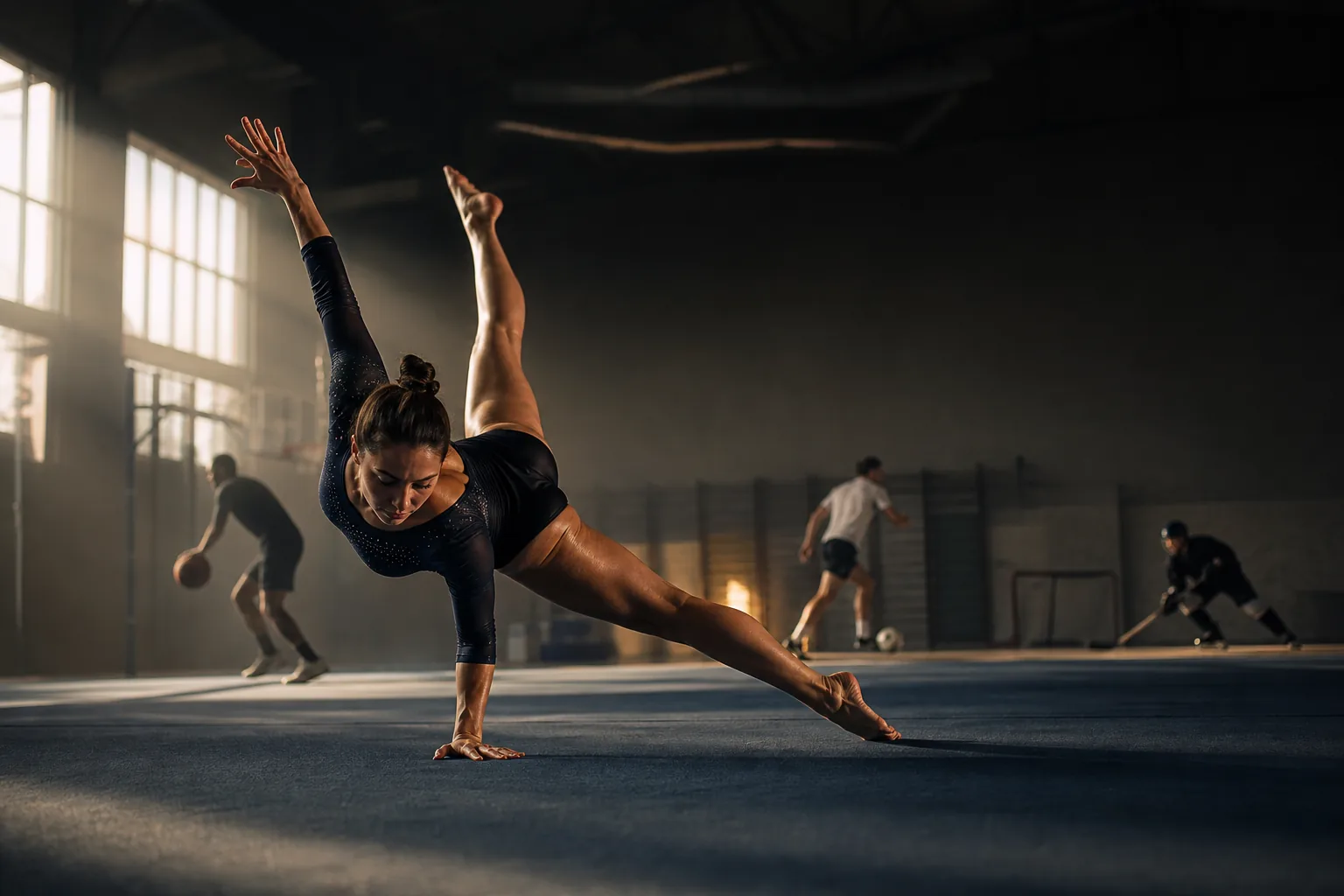
Gymnastics is often described as a foundation sport. The phrase can sound like promotion until we ask a more practical question: what does an athlete need before a playbook, a ball, a stick or a specialized technique becomes useful?
The answer begins with control. An athlete has to understand where the body is in space, create stable shapes, move through different levels, accept force and reorganize quickly. Gymnastics trains those problems directly. That does not mean every child must become a competitive gymnast. It means the movement education inside gymnastics has value far beyond the apparatus.
Why gymnastics builds a movement foundation
In many sports, the main object attracts the eye. We watch the basketball, football or puck and judge the visible result. Gymnastics makes the body itself the object of the task. A gymnast cannot outsource a missing position to equipment. The line, landing, rhythm and transition are part of the performance.
That environment develops a detailed movement vocabulary. Rolling teaches how to distribute contact. Hanging and support positions introduce shoulder organization and grip. Jumping and landing connect force production with deceleration. Balancing asks the athlete to control the center of mass over a small base. Rotation develops spatial awareness and the ability to find a safe finish.
Body control comes before sport-specific skill
Sport-specific practice is essential, but specialization cannot remove the need for general control. A football player still has to fall, brace and recover. A basketball player repeatedly jumps, lands and changes direction in traffic. A hockey player produces force while the base of support is narrow and moving. A swimmer uses shape, tension and rhythm to reduce drag. The setting changes; the athlete still manages position and force.
Gymnastics gives coaches a way to teach these ideas without pretending that one exercise perfectly copies another sport. The transfer is not “a cartwheel makes someone a better striker.” The transfer is that learning to organize the body through unfamiliar tasks can make future skill learning more efficient.
Strength-to-weight ratio and useful shapes
Gymnastics strength is closely connected to shape. A hollow hold, arch, support or controlled hang is not simply a test of effort. It asks the athlete to produce tension while maintaining a defined position. This creates a useful link between strength and awareness.
Young athletes do not need advanced strength skills to benefit. Age-appropriate crawling, climbing, supporting, hanging and locomotion can teach how the hands, trunk and legs work together. Progress should follow coaching quality and readiness, not social-media difficulty.
Landing and deceleration are athletic skills
Many training programs celebrate takeoff: the highest jump, fastest sprint or hardest shot. Durable performance also depends on what happens after force is produced. A gymnast learns that a skill is not complete until the landing is controlled.
Good landing practice introduces several ideas: see the surface, arrive with an organized trunk, allow the joints to share force and regain balance before the next task. In another sport the landing may be imperfect, contested or immediately followed by a cut. The gymnast’s advantage is not one frozen pose; it is experience finding control after flight.
Spatial awareness and confidence upside down
Gymnastics changes the athlete’s relationship with orientation. The head may be below the hips, vision may leave the landing for a moment, and the body must still know where it is. Coaches call this spatial awareness, but for the athlete it feels like an expanding map of possible positions.
That map can support confidence in ordinary sporting chaos: contact, a stumble, a dive, an unexpected rotation or a fall. The goal is not to teach risky skills without supervision. It is to make safe, progressive exposure to different orientations part of movement education.
How gymnastics skills transfer to other sports
- Football and soccer: bracing, falling, single-leg balance, acceleration shapes and recovery after contact.
- Basketball: jumping, landing, trunk control, rhythm, rotation and coordination in the air.
- Hockey: dynamic balance, hip control, force transfer and the ability to reorganize over a narrow base.
- Track and field: posture, stiffness, elastic contacts and confidence producing force through different takeoffs.
- Combat and action sports: rolling, orientation, mobility and controlled force through the whole body.
These are shared ingredients, not guarantees. A gymnast moving into hockey still has to learn to skate. A gymnast moving into basketball still has to develop perception, decisions and ball skill. General movement raises the range of options; specific practice teaches which option the game requires.
What a good foundation program should look like
A useful introductory gymnastics program is progressive, supervised and appropriate to the athlete’s stage. It should teach shapes and landings before difficulty, provide enough repetition to learn without turning every class into a test, and create a route for both recreational and competitive goals.
Parents and cross-sport coaches should ask how levels are assessed, how coaches manage safety and spotting, and how the program adapts for different experience. A polished facility matters less than a clear progression and attentive coaching.
The mistake: copying elite gymnastics
Calling gymnastics foundational does not mean copying elite routines or using advanced tumbling as conditioning. High-level skills are highly specific and carry real demands. The transferable value is usually found earlier: shapes, supports, hangs, locomotion, balance, rolling, low-level rotation and competent landing.
The best cross-sport use of gymnastics respects both disciplines. It borrows principles without pretending that every athlete needs the same destination.
Gymnastics is where the conversation begins
At CalifGym, gymnastics is not a decorative reference in the domain name. It is the central movement lens. It teaches us to look at the sequence before the highlight, the landing as well as the takeoff, and the connection between positions rather than one isolated action.
That is why gymnastics can be a foundation for every sport: not because it replaces the game, but because it helps build the athlete who is ready to learn it.