What gymnastics for toddlers should involve
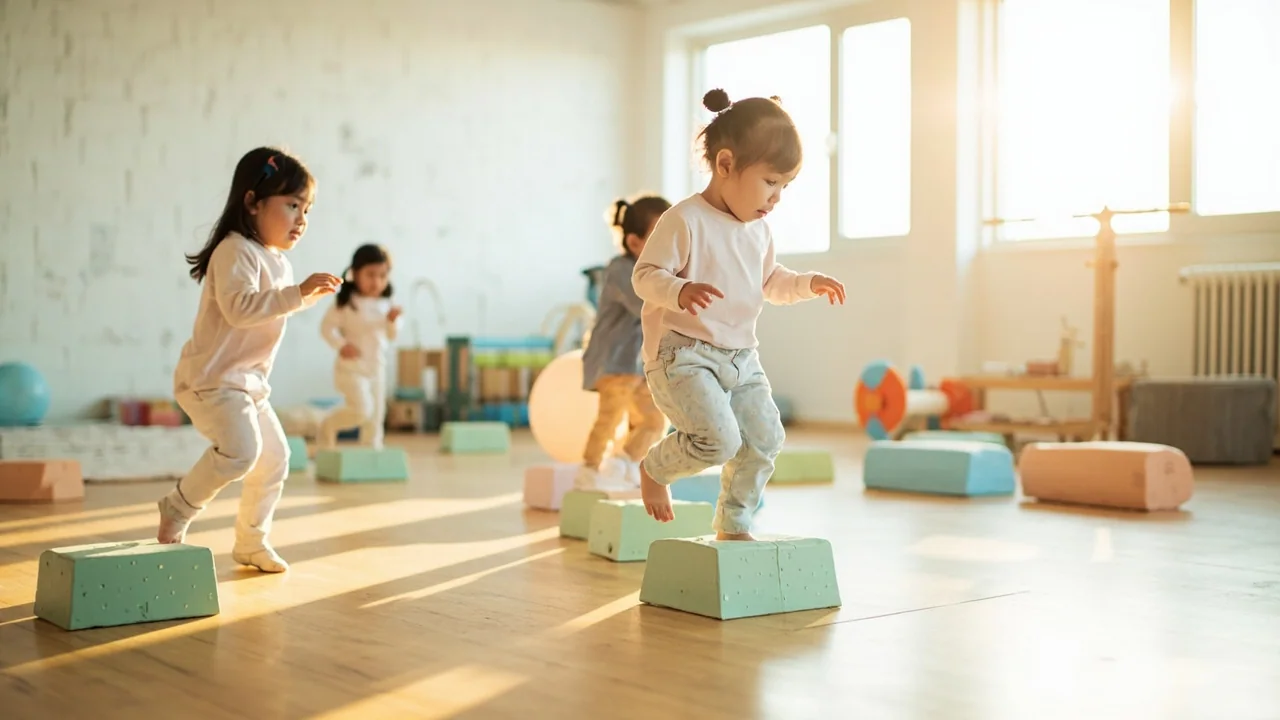
A toddler who follows the instructor during a balance activity, climbs onto a low block, or stops an object with one hand may already be doing the kind of foundational movement work that adults call gymnastics. These early sessions are not miniature versions of elite competition. They are play-based opportunities to practice balance, coordination, spatial awareness, strength, and confidence in a safe environment.
The distinction matters because many programs described as toddler gymnastics use a mixture of structured movement, balance games, obstacle courses, floor exercises, and songs. Some emphasize general coordination and confidence. Others introduce the vocabulary and movement patterns associated with artistic gymnastics. A parent does not need to decide between these approaches before understanding what the child can comfortably do and how the instructor teaches.
Useful toddler gymnastics also respects normal development. Children move at different speeds, may lose balance when tired, and often need repeated practice before a new skill feels secure. A good class offers choices, allows plenty of time to explore, and avoids treating a forward roll or handstand as a test that every child must pass. Progress is visible when a child becomes more willing to try a movement, remembers a routine, explores in more directions, or recovers when a balance challenge does not go as planned.
The broader fundamentals of the sport are summarized in this background overview of the sport’s history and major disciplines, which provides useful background for this point. That history helps explain why balance, flexibility, agility, coordination, and endurance appear in many descriptions of gymnastics. For a toddler program, however, the practical question is simpler: will the child have meaningful, age-appropriate movement practice while remaining physically and emotionally comfortable?
A practical class should provide four things:
- Varied movement opportunities: Climbing, jumping, crawling, balancing, turning, reaching, and locomotor patterns give children a broad movement base.
- Supported independence: Instructors guide children without taking over every action, allowing them to attempt, test, and repeat skills.
- Clear safety routines: Equipment checks, controlled spacing, sensible class size, and consistent transition rules reduce preventable risks.
- Respect for the child: Praise is directed at effort, control, exploration, and kind behavior rather than size, appearance, comparison, or fear.
If a program cannot explain its approach in these terms, it is reasonable to ask what children actually do during a session. “We teach gymnastics” is too broad. A parent should be able to hear about movement stations, skill choices, class structure, instructor qualifications, and how teachers respond when a child is unsure.
Deciding whether your child is ready
There is no single age at which every child should begin. Toddlers who can sit and move around a room can benefit from supervised play, while some children show interest in climbing, jumping, or copying movements earlier than others. Readiness is better judged by behavior than by a birthday alone. Watch how your child explores rather than how far they can jump or how long they can balance.
Positive readiness signs include a willingness to try new movement tasks, an ability to follow simple group instructions with support, and the freedom to leave and rejoin an activity. Children who repeatedly watch, imitate, and experiment often make good participants in a play-based class. A child who is not interested does not need to be pushed through the session. The instructor should offer an easy entry point and let curiosity lead the participation.
| What you notice at home | What it may suggest | How a class can respond |
|---|---|---|
| Climbs onto low household furniture and comes down carefully | Interest in elevation, routes, and body control | Use low climbing shapes, assisted step-ups, and supported balance stations |
| Enjoys copying arm and leg patterns during songs | Readiness to imitate movement sequences | Use simple movement patterns and repeat them with a gradual change |
| Frequently runs, changes direction, and plays actively | Developing locomotor control and spatial awareness | Add pathways, stop-and-go games, obstacle routes, and low jumps |
| Needs reassurance around unfamiliar equipment | Interest may exist, but confidence is still developing | Let the instructor model the activity and offer a less demanding choice |
| Cries, freezes, or leaves when movement becomes unpredictable | Activity may not fit the child’s present comfort or regulation | Pause participation, simplify the task, and check in with the child and family |
Start with one class a week rather than filling the schedule. A child benefits more from a positive experience that is repeated than from several sessions that end in fatigue or distress. The guide to preparing for a gymnastics evaluation day offers useful organizational advice that also applies to an early class: arrive early, keep clothing simple, bring water, and give the instructor accurate information about the child’s health and prior movement experience.
It is also reasonable to wait. Children with sensory sensitivities, mobility needs, recent injuries, or medical concerns may need a more individualized plan. A pediatrician or qualified health professional can advise when medical input is appropriate. Parents should not treat a class as a diagnostic or therapeutic service unless the provider explicitly has the relevant qualifications and explains its role clearly.
How development changes the class
Toddlers progress through broad stages that do not follow identical timelines. One child may master a motor pattern before gaining confidence in a group setting. Another may understand movement instructions but need more repetition to coordinate both sides of the body. The best program uses a sequence that looks right for the room rather than forcing every child to perform the same task in the same way.
Early sessions generally emphasize body awareness and sensory experience. Children learn where their hands and feet are, how to shift weight, how to stop, and how to move through space safely. As control develops, instructors can introduce more precise shapes, longer movement combinations, and transitions between stations. Challenge should come from many manageable options rather than from forcing a difficult skill.
Parents should understand the difference between motor skill, confidence, and readiness for a particular apparatus. A child may be able to produce a cartwheel shape in a spacious floor area but still lack the spatial awareness to do it safely beside other children. Another may enjoy the balance beam concept through a low line on the floor without being ready to step onto an elevated beam. These are not failures. They are distinct stages of learning.
Observe whether the class:
- Uses floor mats and soft, age-suitable equipment rather than adult-scale apparatus.
- Introduces skills through play that has an obvious purpose for the child.
- Allows children to choose between several ways to complete a movement.
- Returns to familiar activities so children can experience mastery.
- Adjusts the range of the activity without drawing attention to the child who needs support.
Children should also have permission to participate without performing. Watching a classmate try a movement is a valid part of class. The instructor can demonstrate what is possible, invite the observer when ready, and let the child return to an easier station. Such flexibility supports inclusion without lowering the overall expectations of the session.
Parents sometimes search for the earliest possible start because they want their child to develop coordination or prepare for competition. There is no need to accelerate that process. Toddler periods are valuable for establishing movement confidence, attention to safety rules, enjoyment of group routines, and a positive relationship with an instructor. Those qualities support later learning in many physical activities.
What a good toddler class looks like
The best classes are active, but they are not chaotically busy. A useful rhythm includes a welcoming arrival, a short warm-up, several movement or skill activities, a simple routine or game, and a calm finish. The exact minutes vary by program, but children benefit from transitions that are predictable and from enough practice time to revisit a skill.
Observe the instructor rather than only the children. Effective teaching involves frequent eye contact, concise verbal cues, demonstration, and careful positioning around the room. The instructor should explain the activity in language a toddler can understand and demonstrate before asking children to perform a difficult sequence.
| Feature of a quality class | What you should see | What it supports |
|---|---|---|
| Clear opening routine | A familiar song, greeting, or sequence that helps children settle | Participation, memory, and a predictable start |
| Choice-based stations | Several ways to roll, balance, crawl, jump, or reach | Independent problem-solving and varied motor practice |
| Gradual progression | The same movement is first practiced on the floor and later adapted to a raised or unstable surface | Skill development without unnecessary pressure |
| Active supervision | The instructor positions children by ability and watches transitions closely | Safer movement and earlier assistance |
| Positive correction | Directions focus on what to do next rather than what was done poorly | Motivation and willingness to try again |
| Deliberate finish | Children return equipment, settle their bodies, and receive a predictable closing activity | Self-regulation and a consistent class experience |
Equipment quality matters, but the way it is used matters more. A bright new training center cannot compensate for an instructor who rushes transitions or ignores the room. Conversely, a modest space with clean mats, stable low blocks, cones, balance paths, and well-organized storage can provide excellent learning. Parents should ask how often equipment is checked and how children are positioned around it.
Music can support rhythm and transitions, but it should not distract from the movement goal. A lively song may encourage children to jump, freeze, spin, or travel across the room. The class should also include quieter moments so children can hear instructions and notice their body position. Constant noise and rapid pacing can make it difficult for a toddler to understand what happens next.
A further sign of quality is how the program handles ordinary mistakes. Children wobble, forget directions, and land differently. The instructor should use those moments to adjust the activity, not shame the child or turn the error into a performance test. Over time, repeated safe experiences of correction build the confidence to attempt harder tasks.
Safety and readiness questions for parents
A parent should evaluate safety before discussing class schedules or competition pathways. The central questions are whether the environment is suitable for small bodies, whether supervision is consistent, and whether the program responds appropriately to each child’s behavior and ability. No verbal assurance is more persuasive than seeing the practices in action.
Ask the following during a trial or orientation:
- What is the instructor-to-child ratio, and does it change by age group?
- Are children grouped by age and developmental readiness?
- What training and first-aid preparation do staff members have?
- How are equipment surfaces and connections inspected?
- Are mats and landing zones used for appropriate movements?
- How do instructors respond to fatigue, fear, pain, and refusal?
- What happens if a child needs to rest, leave the activity, or sit out?
- How will injuries, illness, or delayed development be communicated to families?
- Are emergency contacts and relevant health information collected before participation?
- Is there a clear policy for equipment changes and skill progression?
Clothing should allow movement without restricting the child. Securely fitted bottoms, a leotard or flexible top, and bare feet or the footwear required by the program are common choices. Avoid jewelry, watches, dangling earrings, and clothing with loose cords. Hair should be secured when the activity involves inversion or apparatus. Label every item and check the facility’s footwear policy before the first visit.
Also ask how the program defines a skill as ready to be attempted. For example, a cartwheel should not simply be taught because the children are old enough. The instructor should consider the child’s shoulder control, awareness of the floor, ability to stop safely, and comfort with the activity. Competence on one apparatus does not automatically transfer to another, particularly when the surfaces or movement demands change.
Families should watch for warning signs that require a closer conversation:
- The instructor repeatedly compares children or uses fear to obtain effort.
- Children are advanced through skills mainly to satisfy an adult’s expectation.
- Equipment spacing becomes crowded or transitions are rushed.
- Pain, dizziness, repeated falls, or persistent crying is treated as a reason to keep pushing.
- Children are discouraged from using the restroom, drinking water, or taking a needed break.
- Safety rules change according to what is convenient for scheduling or performance.
Parents can review broader safety principles through the American Academy of Pediatrics’ young-athlete safety guidance, which provides useful background for this point. Families should also bring any diagnosis, injury, allergy, sensory need, or developmental concern to the instructor rather than expecting the class to discover it. A careful program welcomes specific information because it helps adults adjust the environment and activities.
How to evaluate and compare programs
Programs may describe their work differently, but parents can compare them through the child’s experience. The lowest price, newest facility, or most impressive social media account should not determine the decision. Look for a program with clear age groupings, qualified instructors, well-maintained equipment, and a teaching approach that matches the child’s temperament and current interests.
Begin with a visit during a normal class rather than a special open-house demonstration. Normal sessions reveal how instructors manage noise, waiting, equipment changes, separation from caregivers, and children who do not want to perform. If possible, watch more than one class because a good visit can differ from an ordinary day.
Compare programs using specific evidence:
| Question | Strong answer | Less reassuring answer |
|---|---|---|
| How is the class structured? | A predictable sequence with warm-up, skill stations, group practice, and a closing routine | Mostly free play with little teaching or an unstructured performance show |
| How does the instructor help hesitant children? | Offers choices, demonstrates, and allows time to participate | Coaches the child repeatedly or compares progress with peers |
| How are skills progressed? | Based on control, readiness, and the available equipment | Based mainly on the child’s age or how quickly the skill appears |
| What is the approach to mistakes? | Uses mistakes to adjust the task and reinforce effort | Treats mistakes as failure or embarrasses the child |
| How are families updated? | Shares specific observations, at-home ideas, and relevant class information | Uses vague claims about improvement or focuses only on showcase participation |
| What is expected of families? | Consistent attendance, suitable clothing, and open communication about the child | Pressure to buy additional equipment or enter competitions quickly |
Ask for a trial period and understand the cancellation and attendance policies before committing. For families with several children, consider whether siblings can attend together and whether different ages require separate schedules. Staggered entry can make the household routine manageable and reduce the stress of rushing between classes.
Do not be impressed by terminology alone. Terms such as “developmental,” “elite,” “competitive,” and “preschool” can mean different things at different programs. Ask what children actually do, how many hours they attend each week, what formal competitions exist, and whether participation is voluntary. A program that clearly separates introductory play from organized competition makes it easier to understand the commitment.
The right fit should produce a child who looks alert, engaged, and physically comfortable. Some children are enthusiastic for the first few minutes and then tire. That pattern may simply mean the session is too long or too intense. It may also indicate a mismatch between the class and the child’s current developmental needs. Treat consistency over time as more useful than one spectacular performance.
What to expect from the first class
The first session is an introduction for the child and the family. Children may need time to watch, understand the room, separate from a caregiver, and decide whether the activities feel familiar. A child who does not perform every activity may still have had a successful first class if the experience was calm and left them willing to return.
Before arriving, tell the instructor about anything relevant. For additional context, Mention prior gymnastics, dance, climbing, swimming, or other movement experience, along with any injury, medical condition, sensory sensitivity, or communication preference. If the child uses hearing or mobility equipment, ask how the space and activities can accommodate it. Specific information is more useful than a broad statement that the child “needs extra attention.”
Bring only what the program requests. A labeled water bottle, appropriate clothing, and a small towel are often enough. Label any personal item. Arrive early enough to complete registration and meet the instructor without rushing. A caregiver plan should also explain who will pick up the child, whether the child may leave the room, and how the program contacts a parent if the child becomes distressed or ill.
During the class, watch how the instructor introduces the space and rules. Children should know where to walk, what equipment can be used for, how to wait for a turn, and how to signal that they need help or a break. These routines matter more than the number of skills attempted in the first hour.
Afterward, ask for one observation rather than a complete report card. “What did my child enjoy?” or “Which activity seemed easiest?” may be more revealing than “How did they do?” The answer can guide the next visit and help you see whether the program is matching the child’s needs.
Supporting movement between classes
Toddlers do not need a complicated home program to benefit from gymnastics classes. Short periods of active play, repeated movement opportunities, and unrestricted exploration can reinforce what they practice with an instructor. The most useful activities are ordinary play experiences adapted to the child’s current abilities.
At home or in a safe play area, you can:
- Create low routes through cushions, blocks, and floor markers.
- Let the child climb onto stable playground equipment with close supervision.
- Play games that involve stopping, turning, reaching, and balancing.
- Use animal walks, crab kicks, wheelbarrow play, and mirror movements.
- Sing short movement sequences and let the child invent variations.
- Practice rolling or tumbling on a clear, non-slip floor with soft mats.
- Give the child control over direction and speed during obstacle courses.
Keep the environment flexible. A child may reject the same activity for weeks and return to it later. Follow the child’s lead rather than turning every session into a disguised workout. The goal is a positive relationship with movement, not a checklist of accomplishments.
Outdoor play offers valuable variety. Walking over uneven ground, climbing steps, jumping from a low level, and throwing a ball challenge balance and coordination in ways that a stationary class cannot. These everyday experiences should complement rather than replace safe instruction, because children cannot control every variable outdoors.
Parents can reinforce the language used in class. If the instructor teaches a “ready position,” “bear crawl,” or “stability shape,” using those words at home can help recognition. Keep the atmosphere playful. Children should not feel that a missed skill at home becomes another reason to practice under pressure.
Sleep, meals, hydration, and overall comfort affect participation. A child who is tired, hungry, unwell, or overstimulated may need a quieter day. Brief periods of inactivity during a class are normal and should not automatically be treated as a lack of interest in gymnastics.
As the family becomes familiar with the program, review progress in the broadest sense. Does the child look forward to class? Can the child listen, wait, take turns, and recover from mistakes? Has movement become more confident? Are the child and caregivers communicating well with the instructor? These changes may be more valuable for early development than a list of named skills.
Frequently asked questions
What is the best age to start gymnastics for toddlers?
There is no universal best age. Consider the child’s movement interest, ability to participate briefly in a group, and comfort with unfamiliar spaces and people. Some children are ready for a class around age two, while others benefit more from waiting or beginning with a parent-assisted play session. A trial class provides better information than a birthday alone.
Can toddlers really learn gymnastics skills?
Yes, but “skills” in an early class should be understood developmentally. Rolling, crawling, climbing, jumping, balancing, turning, and following movement patterns are meaningful foundations. The instructor should introduce them as playful movement experiences, not as a test of advanced technique. Complex competition skills are neither necessary nor expected at this stage.
Is gymnastics safe for toddlers?
Safety depends on the program, equipment, supervision, class size, and individual readiness. Look for stable age-appropriate equipment, controlled transitions, close instructor attention, clear rules, and a willingness to modify or stop activities. Parents should also follow clothing, footwear, health disclosure, and arrival instructions. No program should promise that every risk is eliminated.
How long should a toddler gymnastics class last?
Follow the length recommended by the program and the child’s capacity for focused group participation. A child may initially attend for part of the session and need a caregiver nearby. Short, consistent sessions can be more useful than long periods of forced repetition. If the child is usually exhausted, distressed, or disengaged by the end, discuss the pacing with the instructor.
Does my child need special gymnastics shoes?
Follow the program’s footwear policy. Some introductory classes use bare feet, while others require a specific type of flexible shoe. Ordinary shoes with bulky soles or raised heels are generally unsuitable for indoor movement. Ask the instructor before the first visit so the child does not arrive in equipment that restricts movement or creates slipping concerns.
Should a child be placed on an elevated beam or bars?
Not merely because the child attends a class or appears old enough. The instructor should consider readiness, the size of the equipment, the child’s control, and the availability of appropriate supervision and mats. Introductory classes may offer beam concepts through floor lines and very low balance elements, allowing children to explore without taking unnecessary risks.
What if my child cries during the first class?
Crying may reflect separation anxiety, an unfamiliar environment, fatigue, sensory overload, or discomfort with an activity. A responsive instructor should observe the child, offer a simpler choice, involve the caregiver according to program policy, and avoid forcing participation. Do not assume the child will never enjoy the class, but treat distress seriously and discuss what changes might help.
How can I tell if a toddler gymnastics instructor is well qualified?
Observe the instructor’s teaching, not only a credential. Look for clear demonstrations, age-appropriate movement knowledge, effective positioning, safe transitions, respectful communication, and thoughtful responses to different levels of readiness. Ask about training, background checks, first-aid preparation, staff ratios, and ongoing child-safety procedures. A qualification should be paired with evidence of good instruction.
Can gymnastics for toddlers improve coordination?
Toddler gymnastics gives children repeated opportunities to balance, change direction, climb, jump, reach, and organize their bodies in space. Those experiences can support motor coordination and body awareness. Results vary by child and program, so families should value enjoyable participation and gradual learning rather than expecting a specific skill on a set schedule.
How do I prepare for the first gymnastics class?
Contact the program before arrival, complete any required registration, and ask about clothing, footwear, arrival time, class length, and caregiver expectations. Bring the child’s water bottle and any required labeled clothing. Share relevant health, sensory, or movement information with the instructor, then keep the first visit simple enough that the child can explore the room and meet the teacher.