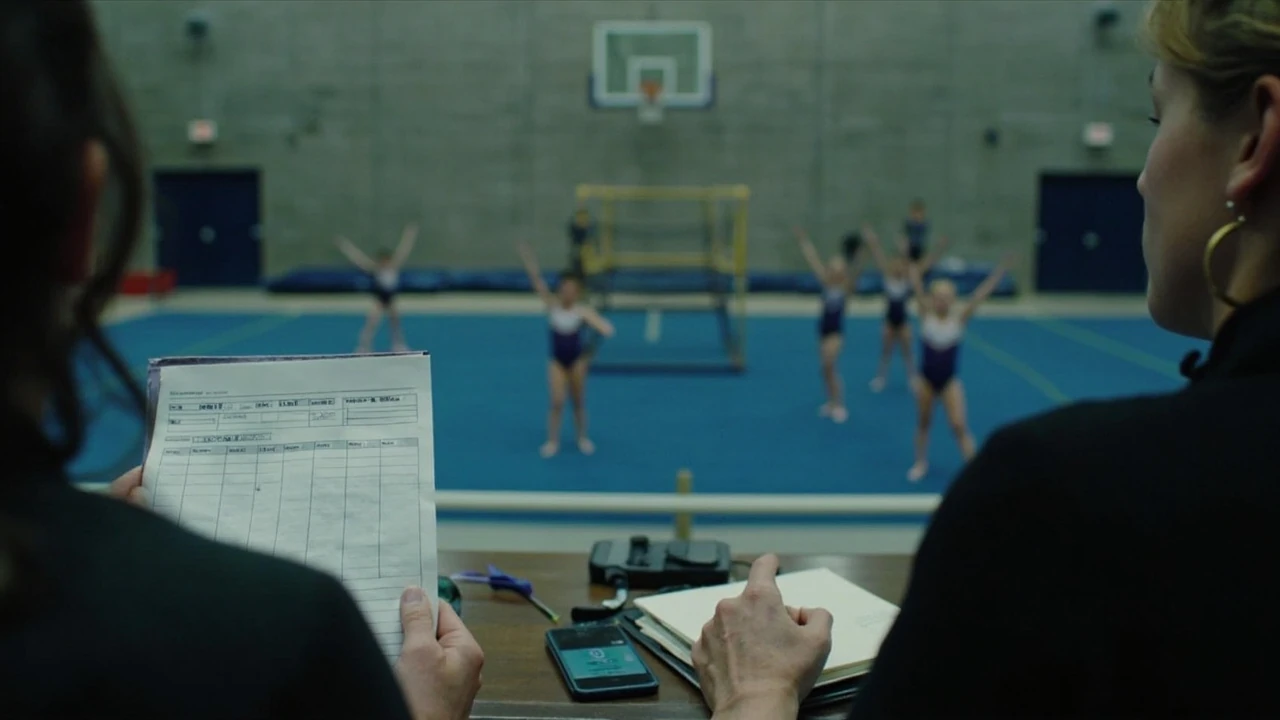
How gymnastics meet session rotations work for parents
Your daughter finishes her bar routine, the coach waves her off the podium, and the announcer calls “rotation two, march.” Within seconds, thirty athletes move in opposite directions through doorways you have never noticed before, and you are standing in the bleachers holding a backpack, a phone at 9 percent, and no idea where your child just went. That first ten minutes of a gymnastics meet is the moment that decides whether the rest of the day feels readable or chaotic, and it almost always comes down to the rotation system.
Meets run on a tight rotation system. Every gymnast in a session competes on every event in the same order, but different groups of gymnasts start on different events and then physically move from one station to the next at the sound of a horn or the call of a judge. Once you understand that single rule, the schedule in your program, the colored wristbands, the lines on the floor, the warm-up pods, the bathroom breaks, and the “why is she suddenly on beam when I expected floor” moments all snap into place.
This guide walks through how gymnastics meet session rotations work for parents, from the structure of a session and the order of events, to the warm-up and touch rules, to the practical things you can do so you never lose track of your athlete again. It also covers the small details that experienced parents take for granted, like when you can walk down to the competition floor, where to stand so you can actually see your child’s routine, and what to do if a rotation runs late.
What a session actually means at a gymnastics meet
A session is one continuous block of competition with a fixed start time and a fixed roster. Every athlete listed in that session competes the full set of events during that block, and the meet is built from several stacked sessions across a weekend. If your daughter is in “Session 3, Saturday at 1:00 p.m.,” that single line tells you almost everything: who is competing, when warm-ups start, and roughly when she will finish.
Sessions exist for practical reasons. Equipment gets reused, and the host gym cannot run every athlete through every event at the same time. Judges have to score each routine fairly, and they need a manageable flow of gymnasts in front of them. The host has to keep the meet running on a published schedule so that working parents, working coaches, and facility staff can plan around it. Treating the session as your “meet day” is the simplest mental model, because within that block your child will not leave, change into a street outfit, or head home until the awards march.
A typical session has a quiet structure inside it. There is an open stretch period, an assigned warm-up rotation, the competitive rotations themselves, and finally the awards ceremony. Coaches often refer to these chunks as “open warm-up,” “touch warm-up,” “comp rotations,” and “awards.” If you hear those terms in the parent group chat, they are the four phases of one session, repeated for every event.
The four events in women’s artistic gymnastics, in the standard order
Most club meets in the United States run four events for women’s artistic gymnastics: vault, uneven bars, balance beam, and floor exercise. The traditional competition order is vault, bars, beam, floor, which is the same order used at the NCAA level and at the Olympic Games. Local meets sometimes reorder the rotation for logistical reasons, but the events themselves do not change.
For parents, the order matters because the equipment near the entrance is often vault, and the equipment near the bleachers is often beam or floor. Knowing the order helps you find your child quickly when she moves. It also helps you pace the day. Vault is the shortest event per athlete, typically thirty seconds of actual work, so the line keeps moving. Bars and beam take longer per athlete because of fall resets, and floor is somewhere in the middle.
| Event | Typical time per athlete | What your child is doing when you cannot see her | What you usually can see from the bleachers |
|---|---|---|---|
| Vault | 20 to 45 seconds of sprint and flight | Waiting in a marshaling line behind the runway | The runway and the landing mat |
| Uneven bars | 30 to 90 seconds, with fall pauses | Standing in chalk line, spotting on the low bar | The bar set and the landing area |
| Balance beam | 60 to 90 seconds | Mount practice, mental reset, breathing | The full beam and the dismount mat |
| Floor exercise | 60 to 90 seconds of music | Waiting in the corner of the floor zone for her cue | The diagonal the gymnast performs across the floor |
If you have a son competing, the order is usually floor, pommel horse, still rings, vault, parallel bars, and horizontal bar, with six events instead of four. Men’s meets use the same rotation system, just with a longer cycle. The men’s event order is also standardized for international competition, which keeps the broadcast rhythm consistent for parents who follow both formats. More detail on the six-event format is available in the Wikipedia entry on Olympic gymnastics.
How rotations, flights, and groups fit together
Inside a session, athletes are sorted into groups, and inside each group they are sorted into flights. A group is a small team of gymnasts who warm up and compete together. A flight is the smaller unit inside a group, and it controls who goes first on each event. The meet director publishes this structure in the program or posts it on a wall near the entrance, and the details matter more than they look.
Here is how it works in practice. Suppose a session has 36 gymnasts. The meet director might split them into three groups of 12, then split each group into two flights of 6. Group A, Flight 1 starts on vault. Group A, Flight 2 starts on bars. Group B, Flight 1 starts on beam. Group B, Flight 2 starts on floor. After about six to eight minutes, the horn sounds, and every flight rotates clockwise to the next event. Flight 1, which was on vault, now moves to bars, and so on. After four rotations, every gymnast has competed every event.
The rotation cycle is almost always clockwise on the printed chart, but the chart in the program and the actual physical movement of athletes are two different things. The chart shows event order. The athletes physically move to the next apparatus. If the chart shows vault, bars, beam, floor, and your child is on bars in the first rotation, you can expect her on beam in the second, floor in the third, and vault in the fourth.
Why your athlete sometimes seems to disappear between events
Parents often lose sight of their gymnast in the minute between rotations, and the reason is that gymnasts leave the competition floor between rotations, not during them. When the rotation horn blows, the flight that just finished vault leaves the vault runway, walks back through the tunnel or doorway, and heads to a designated holding area until it is time for the next rotation. Most meets call this the athlete staging area, and it is usually a curtained corner, a side gym, or a hallway behind the bleachers.
While your child is in staging, she is changing grips, re-chalking, retying a stubborn hair elastic, and listening to her coach. You generally cannot reach her during this window, and the meet director prefers it that way, because a steady stream of parents crossing the floor slows the rotation and creates safety issues around the equipment. The practical result is that the ten-minute stretch between rotations is the time when your phone will lose the live results, your daughter will not respond to texts, and you will wonder if she is okay. She is. She is just out of sight.
Two tips help. First, ask your coach where staging is and whether parents are allowed at the doorway. Some meets are strict, some are relaxed. Second, decide in advance where you will sit so that you can see the event your child is competing on next. The bleachers are usually arranged to face two events at once, and you can usually pivot to watch the other two on a monitor or by leaning forward.
Open warm-up versus touch warm-up
Every session begins with an open warm-up period, and this is where the real logistics start. Open warm-up is the shared window when every gymnast in the session is on the floor at the same time, rotating freely through the four events in small clusters. It typically lasts twenty to thirty minutes, and it is the only time during the session when every apparatus is open to every gymnast. Touch warm-up is shorter, more structured, and happens right before the competitive rotations begin.
During open warm-up, parents are usually allowed on the floor to help younger athletes, take photos, and find the right viewing angle. During touch warm-up, parents are usually asked to clear the floor so coaches can run the gymnasts through their last mounts, dismounts, and specific skills. If you remember nothing else, remember this: the moment the announcer says “athletes only on the floor,” the meet has moved from open warm-up to touch warm-up, and your role as a parent has shifted to spectator. For broader context, the Gymnastics at the Summer Olympics provides a concise reference for this section.
| Phase | Duration | Parents on the floor | What your child is doing |
|---|---|---|---|
| Open warm-up | 20 to 30 minutes | Usually yes | Loose stretching, light tumbling, trying mounts |
| March-in and introductions | 5 to 10 minutes | In the bleachers | Standing with team, waving to judges |
| Touch warm-up | 8 to 15 minutes per rotation | Generally no | Specific skills, last dismounts, mental focus |
| Competitive rotations | 4 cycles, about 8 to 12 minutes each | In the bleachers or designated viewing areas | Competing on each event |
| Awards | 10 to 20 minutes | Usually back on the floor or at the edge | Standing on the podium |
Touch warm-up has its own internal rotation. Each flight gets a few minutes on each event in the same order it will compete, and you can usually tell which flight is up by the chalk dust, the number of coaches in the corner, and the volume of the music. If you have a long lens, the touch warm-up is a calmer, more photogenic moment than the competition itself, because the gymnasts are smiling and the apparatus is less crowded.
How long a full session actually runs
Plan for two and a half to three hours from the moment your session starts to the moment awards finish. A tight meet with experienced judges and small flights can wrap in two hours. A large session with novice judges, frequent fall resets, and a host gym that is generous with awards will stretch to three and a half. The published session time on the schedule is almost always the start of open warm-up, not the start of competition, and that surprises first-time parents every time.
If the meet is running late, do not assume your child will be cut. Meets are run by sanctioned host clubs under the rules of USA Gymnastics or a similar governing body, and the rules require every athlete on the roster to get a score on every event. A late meet is a longer meet, not a shorter one. The awards ceremony, not the start time, is the only reliable finish line.
For multi-session weekends, the gap between sessions is the real recovery window. Athletes from Session 2 will not start Session 3 warm-ups until Session 2 awards are done, the floor is cleared, and the announcer has run the introductions. If you are driving in for the afternoon session, watch the meet’s social media rather than the clock, because late sessions often push back the published warm-up time by thirty minutes or more.
What the printed program is telling you, line by line
Most meets hand out a printed program or post a PDF in the parent group chat a few days before competition. The format varies, but the same six pieces of information show up every time. Learning to read them quickly saves you from walking up to the hospitality table every ten minutes.
- Session number and start time. This is when open warm-up begins, not when your child competes.
- Group and flight assignments. A letter or number for the group, a number for the flight. Your child is “Group B, Flight 2.”
- Starting event. The event your flight begins on. Everything else follows from this.
- Rotation order. Usually listed as a four-step cycle, with vault, bars, beam, floor in the standard sequence.
- Age divisions and levels. Often shown as “Level 4, 9 to 11-year-olds,” so you can see who is in the same age pool.
- Awards timing and format. Whether awards are per event, per age group, or all-around only.
Your coach will usually circle the relevant lines in the program or send a screenshot. Treat the program as the source of truth, because the announcer and the judges are working from the same document. If you ever feel like the meet is in chaos, walk back to the entry table, ask for a second copy, and read it cover to cover. Most of the confusion parents feel at a gymnastics meet is the result of not knowing which line in the program applies to their child.
How awards and the all-around actually work
After the fourth rotation, every gymnast has a score on every event. The host then runs awards, which can be done one of two ways. In an event-finals format, the top six or eight gymnasts in each age group return to the podium to receive a medal or ribbon for each event. In an all-around format, the gymnasts are ranked by their combined four-event score, and medals are given to the top three in each age group. Most local invitationals use the all-around format because it is faster and because it gives every gymnast a meaningful result.
The all-around score is the sum of the four event scores. A score of 35.00 out of a possible 40.00 is a reasonable benchmark for a strong Level 4 meet, and a 37.00 is considered excellent. At higher levels, the bar is higher. The all-around does not require a separate routine. It is just the math.
Parents sometimes ask whether their child should stay for awards if she did not place. The answer is almost always yes. Awards are part of the session, the team photo is usually taken during awards, and leaving early means missing the chance to cheer for teammates who did place.
Where to sit, where to stand, and where to never go
Every meet has a defined spectating area, and it usually covers two events well and two events poorly. The meet director chooses this layout for a reason, often to keep the audience out of the judges’ sightlines, so working with the layout beats fighting it. The general rules below hold true at most sanctioned meets.
- Spectator bleachers. Designated seating, usually elevated, often shared with other parents from your club. This is your default.
- Athlete staging. Off-limits to parents during competitive rotations. You can wave from the doorway if the meet is relaxed, but do not enter.
- Competition floor. Off-limits during rotations. The exception is open warm-up, when parents of younger gymnasts are usually allowed to spot.
- Hospitality table. Open to coaches and judges first, parents second. Bring coffee from home if you want to be sure of a cup.
- Coaches’ box. The padded area next to the beam or bars where your child’s coach is standing. Parents do not enter this space at any point during the meet.
If you have younger siblings in tow, the meet will be a long morning. Pack a quiet activity, a snack, and a fully charged device. The closer you sit to the exit, the easier it will be to step into the hallway with a fussy toddler without disturbing the judges.
How to actually watch your child’s routines
Once you know the rotation order, you can plan to be in the right spot at the right time. A few practical habits make this much easier than constantly pacing the bleachers. The simplest is to identify the two events that are visible from your seat and to accept that you will watch the other two on the venue monitor, if one is available, or on the live stream the host usually posts.
Recording routines on a phone is allowed at most meets, but flash photography is not, especially on beam and floor, where a flash can disrupt a gymnast mid-skill. If you want clean video, sit in a higher row, switch to 60 frames per second, and start recording the moment your child’s flight begins its touch warm-up. You will almost always catch the routine in full, with a small buffer of warm-up at the start. As a separate reference, the editions sports GAR adds source-specific context to this discussion.
The best seat in the house, for most parents, is on the aisle at the end of a row. It lets you slip out to the bathroom, the snack bar, or the doorway to wave at your daughter without climbing over five other parents. It also lets you stand briefly during the dismount, which is the moment your child most wants to see a familiar face.
What to do when something goes wrong
Meets rarely run perfectly. The most common disruptions are equipment delays, judge shortages, injuries, and bathroom breaks that turn into fifteen-minute detours. None of these are your problem to solve, and trying to fix them usually makes the day harder for the meet staff, the coaches, and your child. The parent’s job during a disruption is to stay calm, stay visible, and let the coaches coach.
If your child is injured, the coach will signal you, and the athletic trainer or host staff will take over. Do not run onto the floor unless the coach waves you in. If your child needs the bathroom during a rotation, the coach will usually send a teammate or a parent volunteer. If the meet is running more than thirty minutes behind, the announcer will say so. If the announcer is silent, the delay is small enough to ignore.
One disruption that catches parents off guard is the false start on vault. A gymnast runs, stops, and resets, and the parent assumes something is wrong. In most cases, the gymnast is fine, the coach has reset her mentally, and the next run will be the real one. A second common surprise is the walkover on beam. A beam fall is not the end of a routine, and most lower-level meets allow a remount within the time limit. Try not to react visibly to a fall, because your child can see you in the bleachers even when you think she cannot.
How to read live scoring and results
Most meets now post live scoring through a service like MyMeetsScores or a club-specific app, and a printed results sheet is usually posted on a wall near the entry table after each rotation. The live scoring is fast but not official, the wall sheet is slow but official, and the awards ceremony is the final word. If the live score and the wall sheet disagree, the wall sheet wins.
Scores are written as two numbers separated by a slash, like 8.7 / 9.200. The first number is the difficulty score, which counts the value of the skills performed. The second number is the execution score, which starts from a perfect 10.000 and is reduced for form errors, falls, and wobbles. At lower levels, the difficulty score is capped, so the spread between gymnasts is usually in the execution score. At higher levels, the difficulty spread gets wider, and the scores tell a more nuanced story.
If you want to follow along without refreshing the app every thirty seconds, the simplest trick is to write down your child’s score after each event on the back of the program. By the time awards start, you will already know her all-around total, and you can compare it to the published results without needing to check a screen in front of her.
What coaches wish parents understood about rotations
Most coaches have a short mental list of things they wish every parent knew on meet day. Sharing it here is a shortcut to a smoother day for everyone, including your child.
- The rotation order is the same for every gymnast in the session. Your child is not being singled out for a late or early slot.
- Coaches cannot change the rotation order. If your child is in the third flight, she is in the third flight, and no request will move her.
- Touch warm-up is a working time, not a visiting time. Greetings and small talk with the coach are best held for before open warm-up or after awards.
- Your child’s score is a number, not a judgment. The number belongs to the routine, not to her as a person.
- If your child competes out of order because of a no-show or a conflict, the coach will let you know. Otherwise, trust the program.
These are not hard rules handed down by a governing body. They are the small courtesies that keep the day running on time, and they tend to be the same courtesies experienced parents already follow.
Common meet-day mistakes parents make
Most parents make the same handful of mistakes at their first meet, and most of them are easy to avoid once you have seen them written down. None of these are failures of character. They are the predictable result of walking into a structured environment for the first time.
- Arriving at the published start time instead of fifteen minutes earlier, which means missing the coach’s pre-meet talk.
- Sitting in the first row of the bleachers, only to be asked to move because that row is reserved for coaches and judges.
- Walking onto the floor between rotations to find their child, which is against the rules at most venues.
- Reacting visibly to a fall or a low score, which the gymnast almost always notices from the corner of her eye.
- Leaving before awards, which means the team photo and the medal moment happen without her family in the frame.
If you have read this far, you are already past the most common mistakes. The rest of meet day is timing, patience, and the willingness to let the rotation system carry your child from event to event while you watch from the bleachers.
A simple meet-day timeline for first-time parents
The timeline below is a working draft for a typical Saturday morning session. Use it as a template, then adjust to whatever the program and your coach have published.
- Eight hours before. Pack the gym bag, the meet program, a snack, water, a folding chair if the venue bleachers are uncomfortable, and a portable charger.
- Two hours before. Leave for the venue, accounting for traffic, parking, and the warm-up walk from the car to the gym.
- Forty-five minutes before. Arrive, check in with the coach, find the staging area, and identify your seat in the bleachers.
- Thirty minutes before. Help your child stretch lightly, then step back as the coach takes over.
- Fifteen minutes before. Move to the bleachers, double-check the program for your child’s flight and starting event, and silence your phone.
- Open warm-up. Watch the flow, take a few photos, and resist the urge to coach from the sidelines.
- Touch warm-up and rotations. Stay in your seat, watch the events you can see, and let the coach handle the rest.
- Awards. Return to the floor, cheer for every athlete, and take the team photo.
- After. Go out for a real meal. Your child has earned it, and so have you.
You will not follow this timeline exactly, because meets rarely run on the exact schedule printed in the program. The point of having a timeline is the calm that comes from knowing what comes next.
How to use the program and your coach as your two sources of truth
There is one piece of advice that experienced parents repeat more than any other: when in doubt, ask the coach, and when you cannot find the coach, read the program. These are the only two reliable sources of information during a meet. Other parents, including well-meaning ones, are working from memory, and memory is famously wrong about rotation orders, especially after a long day.
Your coach also has access to information that does not appear in the program, like a teammate who is scratched, a judge who has been moved, or a rotation that is being held for an equipment repair. Trust the coach on these details, because the coach is hearing the same announcements you are, plus a private channel from the meet director. If your coach says your daughter is now starting on bars instead of vault, take it at face value and walk with the change.
For a broader overview of how a meet fits into a competitive season, the USA Gymnastics parents page pairs well with the rotation system explained here. If you are still choosing a program for your child, the parent’s guide to choosing a gymnastics program covers how the meet experience fits into the larger picture of a competitive season.
Frequently asked questions
How long is each rotation in a gymnastics meet?
Most competitive rotations run about eight to twelve minutes, with shorter rotations for younger levels and longer ones for higher levels and larger flights. The rotation includes touch warm-up at the event, the competitive attempts, and the transition out, so the actual competing window is shorter than the total rotation time.
Why does my child compete in a different order than her teammates?
Within a single session, every gymnast in a flight competes in the same order, but different flights start on different events. If you and a teammate are in different flights, you will compete on the same events in the same order, but you will hit each event at a different time during the rotation cycle. This is by design, and it keeps the equipment from being overloaded.
Can I walk down to the floor to see my child between events?
Usually no, and definitely not during competitive rotations. Most meets restrict the floor to coaches, judges, and athletes, and parents are kept in the bleachers. During open warm-up, the rules are looser, and you can often help younger athletes. The meet director will announce any changes to this rule at the start of the session.
What happens if my child has to use the bathroom mid-rotation?
Tell the coach right away. The coach will either pull your child out at the end of her flight or send a teammate with her. A bathroom break will not disqualify your child, and judges will pause or shift the lineup slightly to keep the meet moving. The most important thing is to communicate early, because a late bathroom break during her competitive attempt is much harder to manage.
What is the difference between an invitational and a sanctioned meet?
An invitational is a club-hosted meet, usually smaller and more relaxed, and it is a common first meet for new gymnasts. A sanctioned meet is approved by the governing body, follows the official ruleset to the letter, and is required for gymnasts who want their scores to count toward qualifying for higher-level competitions. Both use the same rotation system, but sanctioned meets tend to be larger, more strictly timed, and more crowded.
Why are there two warm-ups before competition starts?
The first warm-up, called open warm-up, lets every gymnast in the session move through the events together. The second warm-up, called touch warm-up, is a focused window right before competition when each flight warms up only on the event it is about to compete on. The two-phase system is meant to keep the equipment available for the whole session while still giving each gymnast a moment to focus before her routines count.
How do I know if my child is in the right place at the right time?
Read the printed program for her flight and starting event, and then ask the coach to confirm during open warm-up. Once the competitive rotations begin, the rotation horn or the announcer will tell you when the flight is moving. If you still feel lost, look for the chalk dust and the line of athletes near the next event. They will be walking in the same direction your child needs to go.
What if the meet is running late?
Stay flexible. The competitive rotations and the awards ceremony are the only fixed commitments, and the meet will not end those early to catch up on the schedule. If the delay is significant, the announcer will say so. If you have a hard out, tell the coach in advance so she can plan your child’s last event to be the one closest to the exit.
Do parents get to see every routine?
You can see every routine your child performs, and most of the routines in her flight, because the events are visible from the bleachers and the live stream. You will not see every routine in the session, because the four events run simultaneously, and no one has eyes in four places at once. Watching your child is the priority. Watching every other gymnast is a bonus.
Why does the announcer keep saying “march” between rotations?
“March” is the cue for the flight to move from the current event to the next one. When you hear it, the gymnasts who just finished an event gather their grips and water bottles and head to the next station, while the next flight steps up. The word is short, loud, and easy to hear over the music and the crowd, which is exactly what a rotation cue needs to be.
Final reminder for first-time meet parents
Once the announcer says “march,” the rotation has already started, and your child is on her way to the next event with or without you. The best thing you can do in that moment is to be in the right seat at the right time, with your phone charged and your face visible. The second-best thing is to relax, because the rotation system is built to keep her moving, and she does not need you to manage the day. She needs you to cheer when she lands, to clap when she waves at you from the podium, and to take her out for pancakes afterward.