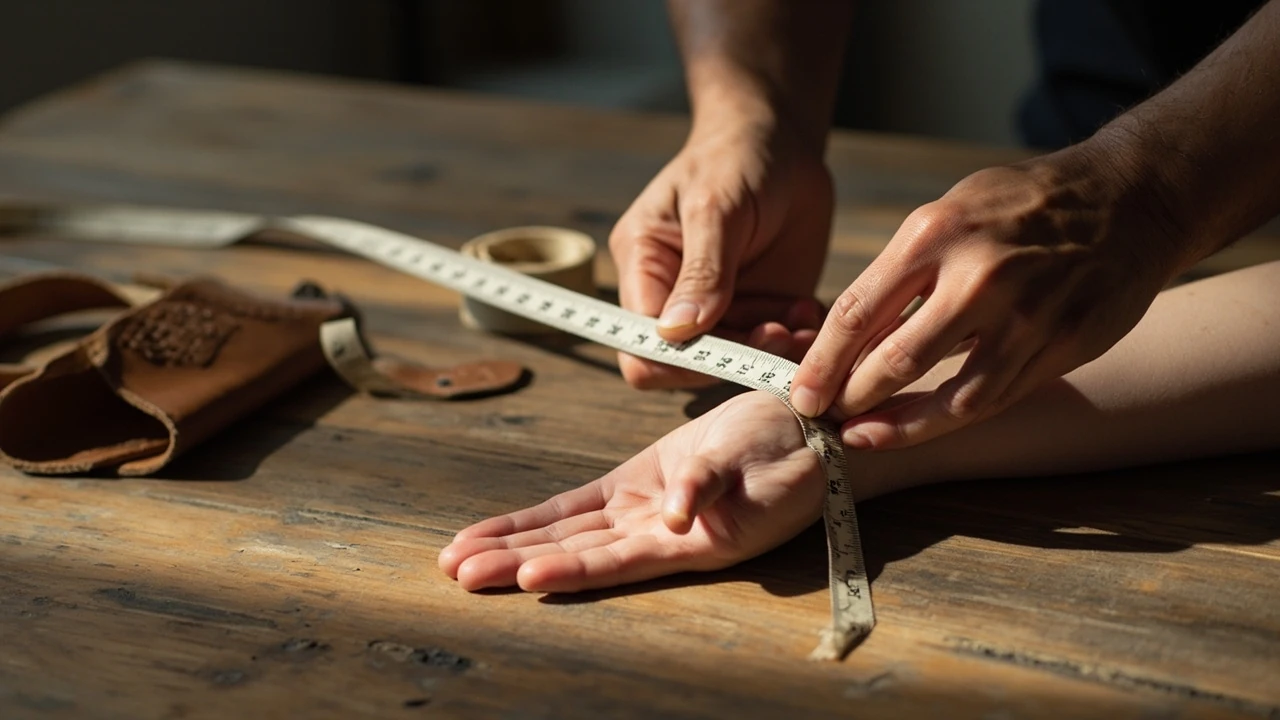
How to measure gymnastics grip size at home
The fastest way to figure out your correct grip size is to stop guessing from a chart and measure the hand that actually swings the bar. Gymnasts often order a standard size, slip on the dowel, and discover that the leather bunches under the fingers or leaves a gap that catches on the bar. A short home measurement takes about ten minutes with a soft tape and a flat surface, and it removes most of the trial and error that turns grip shopping into a guessing game.
Home sizing works because the variables that matter are simple. The dowel channel width, the length of the leather from the buckle to the finger hole, and the distance from the base of the fingers to the wrist crease all need to line up with your hand. A ruler, a soft measuring tape, a pencil, and a sheet of paper are enough to capture the three numbers you need before you compare any chart.
What “grip size” actually means on a gymnastics bar grip
Most gymnasts and parents talk about “size” as if every manufacturer used the same scale. They do not. The three measurements that change between a size 0 and a size 4 on a gymnastics grip are the leather length, the dowel channel width, and the finger hole spacing. A grip that is the right leather length but too wide in the channel will still feel loose, because the leather has to fold around the dowel before the hand reaches the bar.
When you measure at home, treat size as a combination of three numbers, not a single letter or number. That way you can match your hand to any brand chart instead of hoping that one company’s medium is another company’s medium.
- Leather length: the distance from the buckle to the finger hole, which sets how far the grip sits down your palm.
- Channel width: the inside width of the seam that the dowel rides in, which controls how snugly the leather hugs the bar.
- Finger hole spacing: the position of the finger hole relative to the end of the leather, which decides where the second knuckle lands.
Tools you need for a home measurement
You do not need a caliper or a special gauge. The same tools that tailors and physical therapists use to measure a hand will give you a usable number for grip sizing. Lay them out on a flat table before you start so the measurement is not interrupted by a hunt for a pencil.
- A soft fabric measuring tape, the kind used for sewing or physiotherapy.
- A hard ruler or a small carpenter’s square, in millimetres or sixteenths of an inch.
- A sheet of plain paper and a pencil, for tracing the hand outline.
- A strip of masking tape, useful for marking a line on the tape without damaging it.
- Your current bar grips, if you have them, so you can compare the new numbers to what you already use.
Step-by-step method to measure gymnastics grip size at home
The process below is the same one that experienced coaches use in the gym, simplified so a gymnast or a parent can run it on a kitchen table. Work on the hand that you actually swing with, because most people have a slightly larger dominant hand. Take each number twice and use the larger of the two readings so a tight grip does not become a safety problem mid-routine.
Step 1: trace the hand
Place the hand flat on the paper with the fingers lightly together and the thumb relaxed to the side. Trace around the outside of the hand without moving it, then lift it straight up. The outline gives you a reference for the next two measurements and a record you can keep if you need to reorder in six months.
Step 2: measure the leather length
Measure from the distal wrist crease, the line you see when you bend the wrist toward the palm, to the base of the middle finger. Pull the tape snug, but do not press into the skin. A leather length in the 12 to 15 centimetre range is typical for youth and adult recreational gymnasts, while competitive levels often fall between 13 and 16 centimetres. Write the number down in both centimetres and inches so you can read any sizing chart.
Step 3: measure the hand width
Measure across the palm at the widest point, usually at the knuckles of the index and little fingers with the hand held flat. This number tells you whether you need a narrow or a standard channel. Hands wider than 8.5 centimetres usually do better in a standard channel, while narrower hands often need a narrow channel to keep the leather from bowing out at the bottom of the bar.
Step 4: measure the finger length
Measure from the tip of the middle finger to the proximal interphalangeal joint, the second knuckle. This is the segment that lives inside the finger hole. A finger length between 5.5 and 7 centimetres covers most gymnasts, and the position of the finger hole on a given grip is tuned to that segment. If your finger length is at the edge of a range, choose the smaller hole so the grip does not slide down during a release move.
Step 5: record and repeat
Write the three numbers on the tracing, then repeat the entire process. If the two sets of readings differ by more than three millimetres on any single number, measure a third time. The middle reading is the one you compare to the chart. Small differences in tape tension are the most common source of mismatch between a home measurement and a grip that feels wrong in the gym.
Reading a gymnastics grip sizing chart at home
Once you have the three numbers, you can read any manufacturer’s chart, because the labels differ but the underlying dimensions are similar. The table below shows a typical adult and youth range based on the leather length and palm width you just measured. Always check the brand’s own chart before you order, because some brands add a half size for wider dowels and some use a different finger hole placement.
| Size label | Leather length | Palm width | Best for |
|---|---|---|---|
| Size 0 | 11.5 to 12.5 cm | Under 7.0 cm | Young gymnasts with narrow hands |
| Size 1 | 12.5 to 13.5 cm | 7.0 to 7.8 cm | Youth and small adult hands |
| Size 2 | 13.5 to 14.5 cm | 7.8 to 8.5 cm | Most adult recreational and level 4 to 6 gymnasts |
| Size 3 | 14.5 to 15.5 cm | 8.5 to 9.2 cm | Adult competitive and high-level club gymnasts |
| Size 4 | 15.5 cm and up | Over 9.2 cm | Larger adult hands and men’s artistic training |
Use the table as a starting point, then read across to the right column to confirm that the size label matches the intended use. A size 2 hand on a junior recreational gymnast often works, while the same hand on a level 9 bar worker may want a tighter channel. Brand charts sometimes call the same label “S”, “M”, or “L”, so always map the letters to millimetres before you commit.
How dowel material changes the size you should pick
The dowel is the rigid rod that sits inside the leather seam, and it changes the feel of the grip as much as the leather length does. A thicker dowel fills the channel and pushes the hand up, which can make a normally correct size feel short. A thinner dowel lets the leather fold more, which can make the same size feel long. If you already train on a particular bar, note the dowel thickness in your record so the new grips match the bar you swing on most often.
| Dowel type | Common thickness | Effect on sizing | Who usually uses it |
|---|---|---|---|
| Single thin dowel | About 6 mm | Adds little height, good for smaller hands | Beginners and youth optional competitors |
| Single standard dowel | About 8 mm | Baseline sizing for most charts | Recreational and levels 4 to 7 |
| Single thick dowel | About 10 mm | Pushes the hand up by roughly one size | Advanced bar workers and high-level optionals |
| Double dowel | Two rods stacked | Significant lift, often a half size shorter than usual | Elite optionals and collegiate gymnasts |
If your home measurement sits on the border between two sizes, the dowel can decide for you. Pick the smaller label on a thick or double dowel bar, and the larger label on a thin dowel bar, so the leather sits in the right place on your hand.
Common sizing mistakes and how to spot them
Most of the grip fitting problems that show up in the gym come from a handful of repeatable errors. The list below covers the ones that a home measurement can catch, along with the simple check that confirms each one.
- Measuring the wrong hand. Always measure the hand that grips the bar. The dominant hand is often three to five millimetres larger across the palm, which can push you to a larger size than the chart suggests.
- Pulling the tape too tight. A tape under tension compresses the skin and shortens the reading. Lay the tape flat, then read it without pinching the hand.
- Ignoring finger length. A leather that matches the palm can still leave the finger hole in the wrong place. If the second knuckle sits past the hole, the grip is too long even if the leather length looks right.
- Skipping the repeat measurement. One reading can drift by several millimetres. A second or third reading is the cheapest insurance against a wrong order.
- Trusting a single chart. Brand A’s size 2 and brand B’s size 2 are not the same grip. Map every chart to your three numbers before you decide.
How to check a new grip against your home measurements
Once a new pair arrives, the in-hand test is what proves the sizing right. Set the grip on a flat surface and slide two fingers into the finger hole. The second knuckle should rest at the front edge of the hole, not float above it. Then wrap the leather around a dowel of the same thickness as your bar. The seam should sit flush against the dowel without a visible bow. If the leather ripples between the buckle and the finger hole, the leather is too long. If the buckle sits on the back of the hand instead of the wrist, the leather is too short.
A second, more functional check is the swing test. Hang from a low bar with the grip on, then perform a few gentle swings and one tap swing. The grip should stay in place without the fingers gripping hard. If the hand has to clench to keep the leather from sliding, the channel is too wide. If the leather pinches the base of the fingers, the channel is too narrow. Either problem is a sign that the home measurement drifted from the chart, and the grip should be exchanged.
Adjusting grip size for uneven bars, parallel bars, and rings
The same home measurement will not always give the same size on every event. The dowel thickness, the swing style, and the hand position on the apparatus all push the size in different directions. Coaches often keep a chart taped inside the gym bag that lists the size used on each event, because most gymnasts end up with two or three sizes across a full training cycle.
| Event | Typical size trend | Reason | Common adjustment |
|---|---|---|---|
| Uneven bars (low bar) | Standard size | Tight swing, hand wraps the bar | Match the chart |
| Uneven bars (high bar) | Often one size smaller | Release moves and giant swings need a shorter leather | Drop a half size for release sequences |
| Parallel bars | Standard or smaller | Hand turns during turns and pirouettes | Pick a snugger channel |
| Still rings | Often larger | Hand wraps deeper around the ring | Add a half size to keep the leather from bunching |
| Horizontal bar (men) | Standard to larger | Single bar work, no need for a short leather | Match the chart |
If you train on more than one event, write the size for each one next to your home measurement. The same hand can reasonably need a size 2 on low bar and a size 1 on high bar, and that combination is not a sizing error.
How often to re-measure and why hands change
A hand measurement is not a one-time event. Children’s hands grow, adult hands change with training load, and a long break from the sport can thin the palm. A simple schedule is to re-measure at the start of each competitive season, after any growth spurt in a youth gymnast, and after a return from a hand or wrist injury. The whole process takes less time than a single bar routine, and it saves the cost of an unused pair of grips that sit in a drawer because they never fit properly.
For a useful frame of reference on training load and growth, a practical meet preparation checklist covers the seasonal rhythm that usually lines up with a re-measure. Treat the home measurement as one item on that seasonal list, the same way you would check dowel wear or grip strap condition.
Frequently asked questions
What is the easiest way to measure grip size at home without special tools?
A soft sewing tape, a ruler, and a sheet of paper are enough. Measure from the wrist crease to the base of the middle finger for the leather length, across the knuckles for the palm width, and from the fingertip to the second knuckle for the finger length. Repeat each measurement and use the larger reading if there is any doubt.
How accurate is a home measurement compared to a coach fitting?
Within about three millimetres, which is close enough to pick the right size on most charts. A coach fitting adds the in-hand feel and the swing test, which a kitchen table cannot reproduce. The home measurement narrows the choice to one or two sizes, and the coach fitting confirms the final pick.
Do men’s and women’s grip sizes use the same chart?
The hand measurements are the same scale, but men’s grips are often cut longer and use a thicker dowel. A home measurement still works, but a man on single bar work will usually end up in a size 3 or 4 while a woman on uneven bars will more often sit in a size 1 or 2 for the same palm width.
Should I measure with or without a hand wrap?
Measure the bare hand. The grip sits between the wrap and the bar, not between the wrap and the skin. A bare hand reading keeps the leather in the right place and lets you adjust the wrap thickness later without changing grips.
What if my hand sits between two sizes on the chart?
Decide based on the dowel and the event. Pick the smaller size for a thick or double dowel, and for release-heavy bar work. Pick the larger size for a thin dowel, for still rings, and for gymnasts with a wider palm. When in doubt, the smaller size is usually the safer choice because a too-long leather folds under the bar.
How do I know if my current grips are the wrong size?
Look for three signs. The leather ripples or bows away from the dowel, the buckle sits past the wrist crease, or the second knuckle floats above the finger hole. Any one of those is enough to re-measure and consider a different size.
Can two gymnasts with the same hand size use the same grip size?
Often, but not always. Finger thickness, wrist flexibility, and swing style change how a given grip feels. A gymnast with a softer wrist and thicker fingers will often want a slightly snugger channel than a teammate with the same palm measurement and thinner fingers.
How do break-in and grip size interact?
A new leather grip is stiffer and feels shorter than a broken-in pair. Most leathers stretch between five and ten percent in the first few months, which is why a grip that felt just right on day one can feel loose by mid-season. If the home measurement lands on the edge of a size, expect the leather to relax and choose the snugger option.
Is it worth paying for custom grips if the home measurement is careful?
For most recreational and level 4 to 7 gymnasts, a stock size picked from a careful home measurement performs about the same as a custom grip. Custom grips start to make sense at the optional and elite levels, where small differences in channel width and finger hole placement change the feel of release moves and giant swings.
Where can I learn more about choosing, breaking in, and maintaining bar grips?
The bar grips guide on this site covers leather care, break-in routines, and dowel choices in more detail. Pair that read with your home measurement and you have most of what you need to pick a size that survives a full season of training.
A simple home sizing checklist to keep on hand
Run through this short list the next time you order grips, before you click buy. It distils the home measurement into the four checks that actually decide whether a new pair will fit.
- Three numbers are written down: leather length, palm width, and finger length, in both centimetres and inches.
- Both hands have been measured and the larger one is the one used to pick a size.
- The dowel thickness on the bar you swing most is noted next to the numbers.
- The chosen size has been matched to a specific brand chart by millimetres, not by letter.
If all four checks pass, the order is almost certainly going to fit. If any check fails, take another ten minutes with the tape and finish the job. A home measurement costs nothing, while a wrong pair of grips can sit in a drawer for an entire season.